17.0 HIGH DYNAMIC RANGE CAPTURE⧉
In some scenes the range of luminance is too high to be captured, let alone displayed, in a single picture: a sunlit window and the dim room around it, a street at night with its lamps, a landscape with the sun in the frame. The brightest parts that matter can be thousands of times brighter than the darkest ones, while a sensor records perhaps twelve to fourteen stops between clipping and noise, and a screen or a print shows fewer still. Expose for the highlights and the shadows sink into noise; expose for the shadows and the highlights clip to white. This part is about capturing such scenes anyway, by recording more than one exposure, or more than one kind of measurement, and combining them; the next part, Part 18, Tone mapping and display, is about showing the result.
The dynamic range of a sensor is the ratio between the largest signal it records before clipping and the smallest it can tell apart from noise, usually counted in stops (log base 2); Chapter 2.8, Noise, signal-to-noise ratio and dynamic range defines it and shows how noise and ISO set it. A display's range is defined the same way, between its brightest white and its darkest distinguishable black. High dynamic range has no quantitative definition. A scene, an image or a display is called HDR when its range exceeds what a standard sensor can record in one exposure or a standard display can show, so the threshold moves as the technology improves.
Modern sensors can deliver excellent dynamic range, especially with large sensors at low ISO, and single-capture HDR is often a reality. However, in many scenarios, a single snapshot is not sufficient.
HDR is one of the paradigmatic examples of a central idea of computational photography: when the technology cannot record what we want in one picture, capture several pictures that each record part of it, and combine them computationally. The same idea extends depth of field by merging photographs focused at different distances (Chapter 23.3, Focal stacks and depth of field extension), extends the field of view by stitching photographs aimed in different directions (Part 20, Field of view extension and panorama stitching), and reduces noise by averaging several frames of the same scene (Chapter 13.2, Denoising by averaging), or recovers resolution from their sub-pixel shifts (Chapter 14.2, Multi-frame super-resolution). HDR is also one of the first techniques to which the name computational photography was attached: Steve Mann, who coined the term in the mid-1990s, used it for work that included combining differently exposed pictures to extend dynamic range Mann & Picard 1995.
The idea of combining multiple exposures for dynamic range expansion is almost as old as photography. In the 1850s, Gustave Le Gray combined separate negatives for sea and sky to make seascapes that photographic materials struggled to record in one exposure. The Getty's examples even show the same sky negative used with different foregrounds (Getty exhibition). Combination printing was therefore both a response to capture limitations and a compositional choice. Modern HDR merging shares the idea of combining complementary exposures, while adding the requirement that registered measurements describe a common scene. Chapter 18.9, High dynamic range in traditional photography follows that craft further: lighting to reduce the scene's range, graduated filters, the Zone System, and dodging and burning under the enlarger.
Figure 17.0.1 shows two of his prints taken from the same spot at Sète, each printed from two glass negatives, under two different skies.
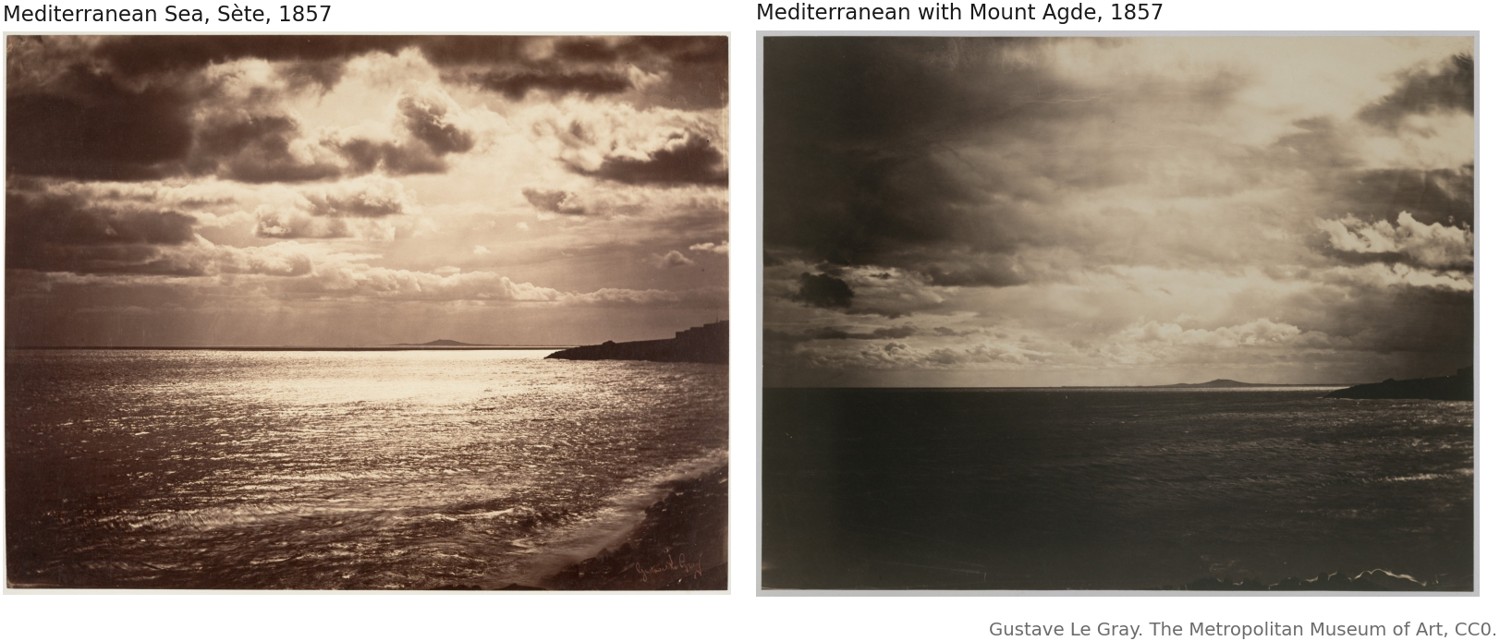
HDR capture estimates a wider range of scene intensities than one exposure can usefully record; tone mapping renders that range for a particular display or print. Calibration and merging should preserve measurement relationships, while rendering chooses brightness and contrast for the viewer, which is why they are two parts. This one ends with a radiance map and the knowledge of where it is trustworthy. Part 18, Tone mapping and display takes it from there, along with the display encodings and gain maps that determine how the result survives distribution.
The chapters follow the capture pipeline. Chapter 17.1, Dynamic range and multiple-exposure capture sets out the gap between the scene, the sensor and the display, then how to capture a bracket: which exposure parameter to vary, what each choice costs, and how some sensors combine exposures on the chip. Chapter 17.2, Camera response and radiance calibration recovers the camera's response so that differently exposed frames can be compared in linear units, a step raw files make nearly free. Chapter 17.3, Merging exposures combines the calibrated frames into one radiance estimate, weighting each frame by how well it measures each pixel, and Chapter 17.4, Ghosts and motion deals with whatever moved between frames. Chapter 17.5, Single-shot range and inverse tone mapping covers sensors that deliver extra range in one frame and methods that estimate the missing range from a single image. Chapter 17.6, HDR+ and burst imaging on phones protects the highlights with a burst of short, identical exposures and averages them to recover the shadows. Chapter 17.7, Encoding HDR images closes the part with the file formats that store a radiance map and deliver an HDR photograph. Rendering the result, including exposure fusion, which skips the radiance map, and the darkroom craft that met the same problem before digital sensors, is the subject of Part 18, Tone mapping and display.
Contents of this part
- 17.1 Dynamic range and multiple-exposure capture
- 17.2 Camera response and radiance calibration
- 17.3 Merging exposures
- 17.4 Ghosts and motion
- 17.5 Single-shot range and inverse tone mapping
- 17.6 HDR+ and burst imaging on phones
- 17.7 Encoding HDR images
- 17.7.1 How many bits does a range need?
- 17.7.2 Floating point: half floats and OpenEXR
- 17.7.3 Shared exponents and logarithms: Radiance RGBE and LogLuv
- 17.7.4 Editable HDR: floating-point DNG and TIFF
- 17.7.5 Backward-compatible HDR: from JPEG-HDR to gain maps
- 17.7.6 Display-referred encodings: PQ, HLG and video
- 17.7.7 Choosing an encoding