37.2 VR goggles⧉
Physically, a virtual-reality headset is a very small stereoscope strapped to your face: a tiny microdisplay and a magnifying lens in front of each eye, showing each eye its own image. If that were all it did, it would be a head-worn 3-D photo, the first rung of Chapter 37.1, Stereo glasses and no more. What makes a headset categorically different is that it tracks the position and orientation of your head and re-renders the two images, sixty or ninety or a hundred and twenty times a second, to match where you are now looking from. Move, and the view moves correctly. Tracking your head pose and re-rendering the view is what climbs the ladder.
The distinction matters because the marketing language ("3-D," "immersive," "spatial") flattens distinctions that are physically and perceptually separate. There are three different things a headset might give you, each a genuinely different cue, each additive on top of the last, and each requiring strictly more capability than the one below. Confusing them is the single most common error in talking about this technology, so we name them and keep them apart.
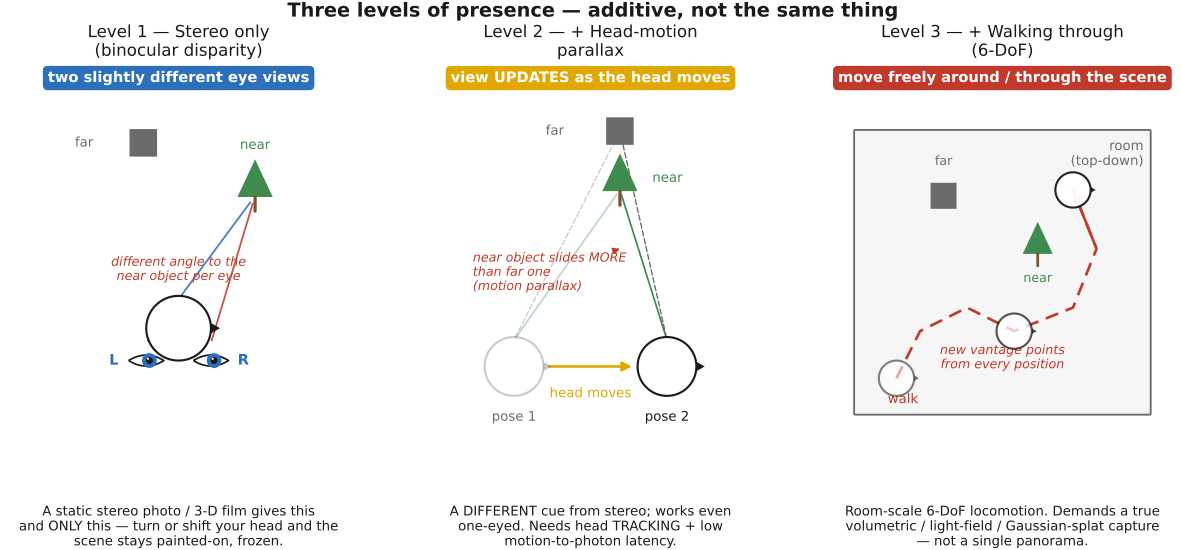
Stereo, head-motion parallax, and walking-through are three different, additive levels, not three names for the same thing. (1) Stereo is two images for two eyes; a static stereo photo or a 3-D film delivers this and only this. (2) Head-motion parallax is the view updating as the head moves; it is a different cue (it works with one eye shut), it requires head tracking and low latency, and it is what makes a scene feel solid and world-anchored. (3) Walking-through is full 6-degree-of-freedom locomotion through the space, which demands a truly volumetric / Chapter 31.1, Light fields 101 capture of the scene, not a single viewpoint. Each rung adds realism the one below cannot; a "spatial photo" sits on rung 1, a 360° panorama near rung 2, and only a volumetric capture reaches rung 3.
37.2.1 The three levels⧉
Level 1, stereo (binocular disparity). Two eyes receive two images, providing the disparity cue of Chapter 37.1, Stereo glasses. A captured stereo pair supplies two sampled viewpoints. A headset can show that pair in a world-anchored window, so it need not slide rigidly with the head, but the pair alone contains no complete set of newly revealed surfaces for arbitrary viewer translation. Spatial photos and videos can use stereo capture; learned depth and view synthesis can add inferred parallax, which should be distinguished from recorded views.
Level 2, head-motion parallax. Now let the rendered view update as the head rotates and translates. Lean left and the near coffee cup slides across the far bookshelf behind it; the differential motion of near against far is motion parallax, and it is one of the strongest depth cues we have; it works with one eye closed, which is the clean proof that it is a separate cue from stereo disparity. This is the rung that makes a headset feel like a window onto a solid, stable world rather than a 3-D photo glued to your face. It is not free: it requires the system to track the head, full 6-DoF pose for translational parallax. Tracking only 3 rotational degrees of freedom lets you look around from a fixed center but does not supply the near/far differential shift caused by translation, and to re-render and display the new view fast enough that the world stays glued in place as you move.
Level 3, walking through the space. The third rung is 6-DoF, room-scale locomotion: you physically walk your body across the room (or teleport), and the environment is there to be explored from any vantage; step around the virtual sculpture and see its far side. This extends the spatial range of the same translational-parallax cue, rather than introducing a new optical depth cue. Small head translations can be served by a limited range of nearby views; a single panorama supports rotation but not that parallax; walking through a space and seeing every object from every side demands that the scene be captured volumetrically, as a true Chapter 31.1, Light fields 101, a textured 3-D reconstruction, or a Gaussian splat, so that new viewpoints within the supported capture volume can be synthesized. A single 360° panorama, however immersive it looks, cannot do this: pan around all you like, but you cannot walk behind anything, because the data for the back side was never recorded.
37.2.2 The optics: a microdisplay and a magnifier per eye⧉
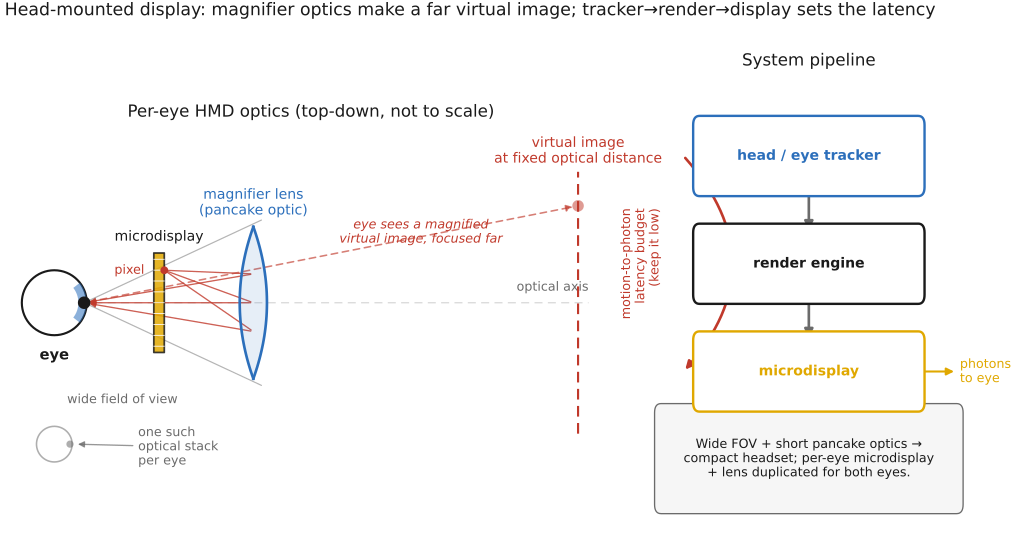
The optical problem a headset solves is that the display sits only a few centimeters from your eye, far closer than the eye can focus. So each eye gets a magnifier lens between it and the microdisplay: the lens takes the tiny, too-close panel and forms a large virtual image of it at a comfortable optical distance (typically a couple of meters, or "optical infinity"), filling much of the field of view. The lens both magnifies the small panel and pushes its apparent focal plane out to where the eye can relax and focus. Two such optical stacks, one per eye, fed two slightly different images, give the stereo of rung 1; head tracking driving the rendering gives rung 2.
Early headsets used a single simple magnifier, which is bulky because the lens must sit a full focal length from the panel. Modern headsets shrink this dramatically with pancake lenses, which use a folded optical path that bounces the light back and forth (typically three passes) between a half-mirror and a polarization-selective reflector, so a long optical path folds into a thin sandwich. Pancake optics are why recent headsets are far slimmer than the bulkier headsets from a decade ago; the price is some lost light (the folding throws away more than half the photons) and stray reflections to manage.
37.2.3 Tracking, latency, and why headsets used to make people sick⧉
Rung 2 turns the headset into a closed loop: you move, a tracker measures the new head pose, the engine renders the matching view, and the display shows it. The loop's defining number is motion-to-photon latency, the total time from your head starting to move to the corresponding photons reaching your eye. If that delay is too long, the world lags your motion: you turn your head and the scene swims, catching up shortly afterward. Because your inner ear (the vestibular system) reports the motion instantly while your eyes report a delayed visual world, the two senses disagree, and that sensory conflict is a leading cause of simulation sickness, the nausea that gave early VR its reputation. The rule of thumb the industry converged on is that motion-to-photon latency must stay under roughly 20 milliseconds to feel solid; getting there drove fast low-persistence displays, high-rate tracking, and clever prediction (render for where the head will be, not where it was). Tracking itself moved from external "outside-in" sensors to inside-out tracking, where cameras on the headset watch the room and compute the headset's pose by the same visual-odometry and SLAM machinery used elsewhere in computer vision.
This is the lineage that runs back to Ivan Sutherland, who built a pioneering tracked computer-graphics head-mounted display in 1968 Sutherland 1968, the famous ceiling-suspended "Sword of Damocles," with a mechanical arm tracking head pose and re-drawing wireframe graphics to match. Sutherland already had the closed loop and the head-tracking; what took fifty years was making the displays, optics, trackers, and renderers small, fast, and cheap enough to wear comfortably.
37.2.4 Passthrough, mixed reality, and where today's products sit⧉
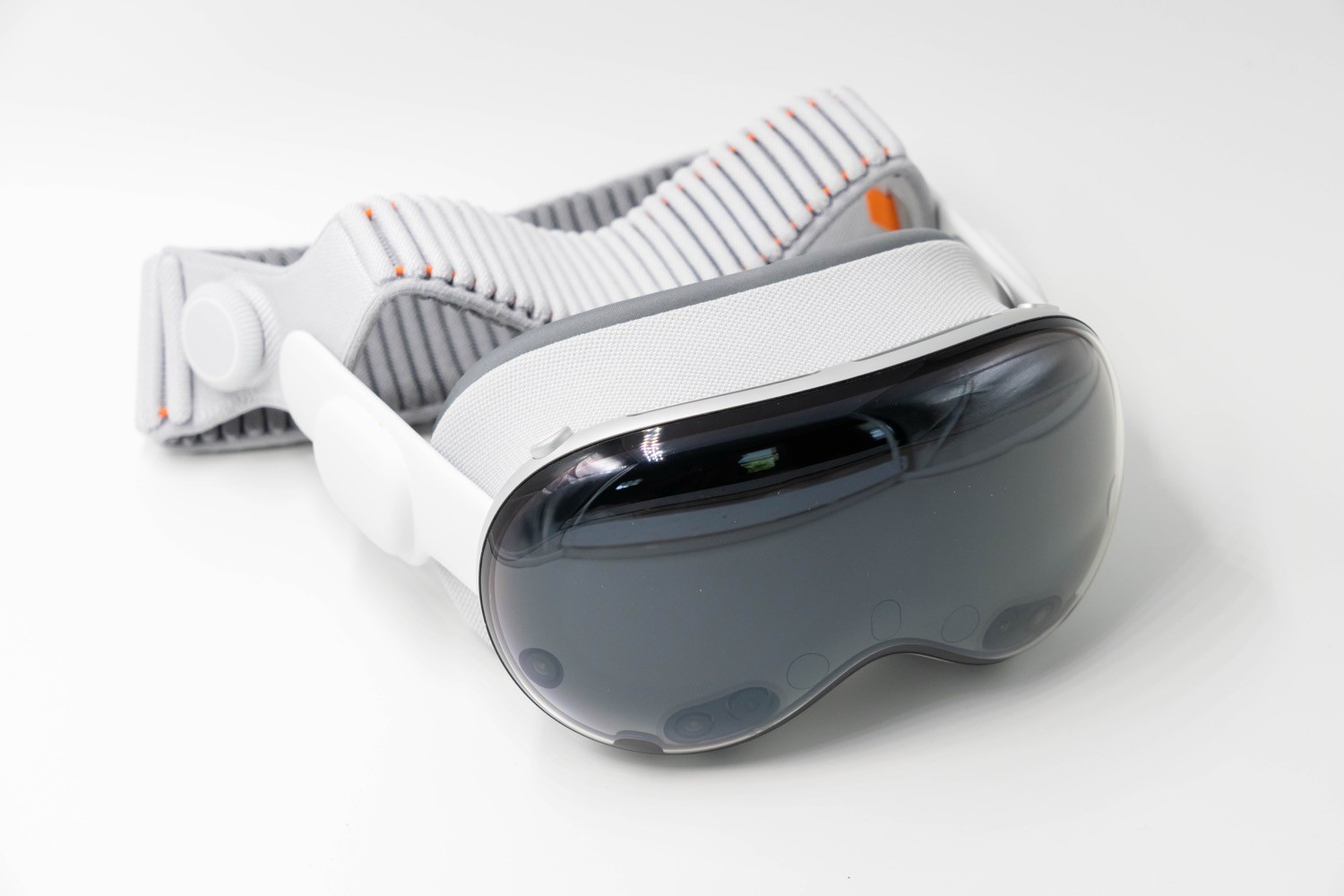
Two familiar product families illustrate the distinctions. Meta's Quest line is a leading mass-market example: standalone inside-out 6-DoF headsets that deliver stereo and head-motion parallax for rendered game and application content, and increasingly video passthrough. Apple's Vision Pro (2024) pushes the optics and tracking, with high-resolution microdisplays and precise eye tracking, and leans on passthrough augmented reality: rather than a transparent see-through optic, outward-facing cameras capture the real world and the headset re-displays it on the internal screens, compositing virtual content on top. Passthrough makes "mixed reality" a software problem (you can dim, replace, or augment the real view at will) at the cost of viewing the world through cameras and screens rather than directly.
The products mix these content types. A spatial photo is rung 1 (stereo, frozen viewpoint). A monoscopic 360° panorama supplies rotational viewing but no binocular scene disparity: you can rotate your view freely (so it responds to head rotation), but it is captured from a single point, so translating your head does not reveal parallax and you certainly cannot walk through it. A true 6-DoF capture, such as a volumetric reconstruction or light field of a real place, is rung 3, the only content that lets you move your body and explore. Spatial video shot by two cameras sits at rung 1 with a time axis: convincing depth, but a fixed vantage. On conventional fixed-focus headsets, none of these content types by itself supplies accommodation-correct imagery. The eye still focuses on one fixed virtual-image plane while converging to wherever the virtual object appears, the same vergence–accommodation conflict inherited from Chapter 37.1, Stereo glasses. Resolving that is the subject of Chapter 37.3, 3D displays with accommodation.
Recap: big lessons of this chapter
Stereo, head-motion parallax, and walking-through are three different, additive levels, not three names for the same thing. (1) Stereo is two images for two eyes; a static stereo photo or a 3-D film delivers this and only this. (2) Head-motion parallax is the view updating as the head moves; it is a different cue (it works with one eye shut), it requires head tracking and low latency, and it is what makes a scene feel solid and world-anchored. (3) Walking-through is full 6-degree-of-freedom locomotion through the space, which demands a truly volumetric / Chapter 31.1, Light fields 101 capture of the scene, not a single viewpoint. Each rung adds realism the one below cannot; a "spatial photo" sits on rung 1, a 360° panorama near rung 2, and only a volumetric capture reaches rung 3.