35.2 High-speed and stroboscopic photography⧉
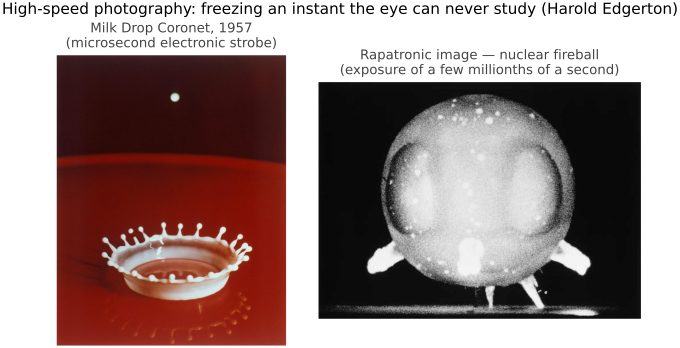
Edgerton's photographs make the physics visible. A bullet hangs frozen as it pierces an apple, a corona of pulp blown out the far side. A drop of milk has landed and thrown up a perfect crown of identical droplets. A hummingbird's wing is sharp in mid-beat. None of these could be seen by a human eye, and none could be captured by a mechanical shutter. They happen too fast. They are captured because Edgerton (Edgerton and Killian 1939) replaced the shutter with light itself: in a dark room, with the camera's shutter held open, the only thing that determines the exposure is when, and for how long, the flash fires. Make the flash burst short enough, a few millionths of a second, and it freezes motion whose displacement during the pulse is small enough at the chosen image scale. Here the flash sets the exposure, and the engineering is all about controlling that burst in time.
35.2.1 Freezing motion: the microsecond strobe⧉
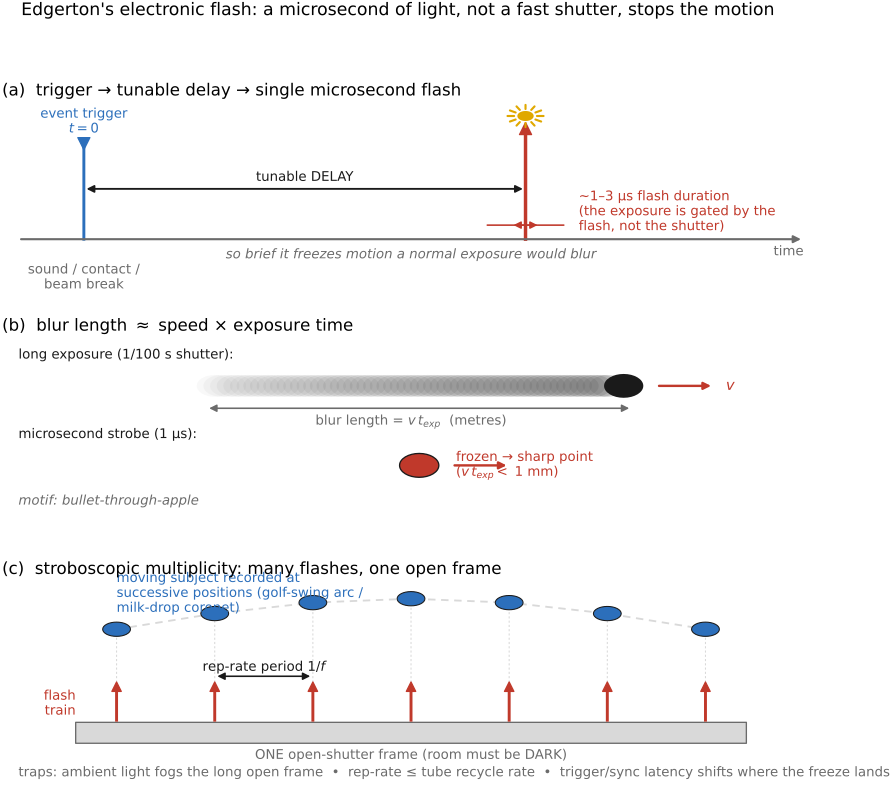
Why does a short flash freeze motion? It is the flash duration vs motion blur tradeoff, the same one that governs every exposure (Chapter 30.1, Motion blur, temporal sampling, and resampling). A moving object smears across the sensor by an amount proportional to its speed times the exposure time: image-plane blur length $\approx v \cdot \Delta t$, with $v$ the image-plane speed. Object-space speed must be converted through magnification before comparing the blur with pixels. Even a mechanical focal-plane shutter set to 1/8000 second is far too long for a bullet traveling several hundred meters per second. The resulting streak length depends on magnification, but can span many pixels. But Edgerton's electronic strobe, a gas-discharge tube dumping a charged capacitor through xenon, produces a flash lasting only one to a few microseconds. In a dark room the only light reaching the open shutter is that microsecond burst, so the effective exposure is microseconds, and a bullet traveling 300 m/s moves 0.3 mm in one microsecond. The motion is frozen because the light is brief, not because the camera is fast (Figure 35.2.1, top). This also explains the dark room: the strobe determines the effective exposure when its recorded contribution dominates ambient light, since any ambient illumination leaks in for the whole time the shutter is open and re-introduces the very blur the strobe eliminated.
35.2.2 The trigger problem⧉
A microsecond flash that freezes a bullet is useless if it fires at the wrong microsecond. The hardest practical problem in high-speed photography is the trigger: arranging for the flash to fire at exactly the instant the bullet reaches the apple. You cannot do it by hand. Human reaction time is a tenth of a second, tens of thousands of times too slow. So the event is made to trigger itself, and then a tunable delay dials in the precise moment (Figure 35.2.1, top).
The triggers vary. A sound trigger picks up the muzzle blast of the gun (or the snap of a balloon, the crack of a bat) on a microphone and starts a timer. A light-beam trigger watches a photocell; when the bullet breaks an infrared beam strung across its path, the beam-break fires the chain. A contact trigger closes an electrical circuit at the instant of impact. Whichever senses the event, the signal then passes through a precisely adjustable delay before it reaches the flash, because the trigger fires when the bullet leaves the gun or breaks the beam, but you want the photograph when it is inside the apple, a known distance and a known few microseconds later. Tuning that delay is the craft: too short and the bullet has not arrived, too long and it has passed through.
This is where the practical limits appear. Sync and trigger latency: every element, including the microphone, the trigger electronics, and the flash tube's own turn-on lag, adds delay that must be calibrated out, and any jitter in those latencies shows up as the bullet landing in a slightly different place each time. Repeatability: to get the shot you fire many rounds and vary the delay, which only works if the whole chain is reproducible to microseconds. Ambient-light contamination is the constant constraint: ambient exposure must remain negligible relative to the flash exposure, because the open shutter integrates every photon for its whole open duration, and a single overhead light will paint a motion-blurred ghost over your frozen bullet.
35.2.3 Stroboscopic multiplicity: a sequence on one frame⧉
Edgerton's second great instrument was the stroboscope, a flash that fires not once but repeatedly, at a controlled rep-rate (flashes per second). Point a stroboscope at a moving subject in a dark room, hold the shutter open for one frame, and each flash records the subject at a successive position on the same negative. A golf swing becomes a fan of frozen club positions; a bouncing ball becomes a dotted parabola; a person walking becomes a stroboscopic procession (Figure 35.2.1, bottom). One photograph now contains a whole motion sequence, its temporal sampling set by the rep-rate: fire faster and the frozen copies crowd closer together; fire slower and they spread apart. This is sampling the time axis with light. A strobe at 60 Hz lays down 60 frozen instants per second onto one frame, the spatial-overlap cousin of the time-lapse and high-frame-rate sampling in Chapter 30.7, Time-lapse photography and Chapter 30.1, Motion blur, temporal sampling, and resampling.
Stroboscopic multiplicity comes with its own traps, layered on the single-flash ones. The rep-rate is bounded by the flash's recycle time: a strobe tube needs time to recharge its capacitor between flashes, so you cannot fire arbitrarily fast without the later flashes growing dimmer or failing: rep-rate trades against per-flash brightness. The frozen copies overlap and confuse if the subject moves too little between flashes or doubles back on its own path, so the rep-rate must be matched to the motion. And ambient light is now doubly dangerous: across the longer open-shutter interval needed to catch many flashes, even faint room light accumulates into a wash that buries the crisp strobe exposures. A usable motion study requires a dark room, a matched rep-rate, and enough per-flash brightness.
35.2.4 Digital descendants: LED strobes and high-speed cameras⧉
Edgerton's xenon strobes are not museum pieces; their logic runs straight into modern hardware, with one conceptual shift. There are two ways to make a microsecond exposure: keep the sensor "on" the whole time and pulse the light (the strobe), or flood the scene with steady light and gate the sensor (a fast electronic shutter). Edgerton did the former because film has no fast shutter; modern imaging increasingly does the latter.
LED strobes are the direct heirs of the xenon tube: a solid-state emitter that can be driven in microsecond pulses, dimmer per flash but able to sustain very high rep-rates without a gas-discharge capacitor recycle cycle, though driver current, heat, and duty cycle still limit repetition, and they are easy to synchronize to electronics. They light machine-vision inspection lines, particle-image velocimetry, and droplet studies today, doing exactly Edgerton's job with a controllable, repeatable, long-lived source. High-speed cameras make the other choice: instead of one open frame lit by many flashes, they capture thousands to millions of genuinely separate frames per second with an extremely short electronic integration time per frame, under continuous (very bright) illumination. The motion-freezing burden has moved from the light to the sensor's electronic shutter, but the governing tradeoff is unchanged: short integration freezes motion, and short integration means little light, so high-speed cinematography is a perpetual fight for photons (very bright illumination, fast lenses, sensitive sensors). And at the far extreme, when even microseconds are too slow, and you want to watch light itself propagate, the burst migrates onto a pulsed laser and a picosecond-gated sensor, which is transient imaging and femto-photography, treated in Chapter 35.8, Coherent imaging and the time-of-flight material; Edgerton's milk-drop, sped up a billionfold, becomes a movie of a light pulse sweeping across a scene.
Whether the brief window is cut by a pulsed light or a gated sensor, high-speed imaging makes the exposure short so the illumination wins the race against motion, and Edgerton's strobe, fired in a dark room behind an open shutter, remains one of the clearest demonstrations of that principle.