• it's a **vocabulary to talk about pictures**, not a creativity recipe — take pictures and **critique your own**
• the throughline: **layering & separation** — make the subject stand out from its surroundings
• 💡 **Big lesson:** separate the subject from its surroundings, and commit — every rule below is one tactic for layering/separation; whatever you do (off-center, blur, tilt, saturate), do it boldly or not at all (the timid half-measure is the amateur's tell)
#### Composition
• **control the background** (the #1 fix): move your feet, shallow depth of field, telephoto compression, crop / get close, clean up (clone / Poisson), desaturate / darken, or go black & white
• **simplify — get close**: "if you can't make it good, make it tight"
• **off-center the subject** (rule of thirds); leave room ahead of motion or gaze — or deliberately **center** for symmetry
• **negative space**: give the subject room to breathe
• **pick the viewpoint** ("move your feet"): get **low** or to **eye level** (people, animals), occasionally high — the angle beats the zoom
• **horizontal vs vertical**: match the frame orientation to the subject
• **mind the geometry**: keep verticals straight, avoid near-parallels and accidental alignments (correct perspective with a homography later), build on diagonals, try an unusual angle
• **sweep the frame edges** before you shoot — catch distractions and anything half-cut by the border
• **foreground helps** (landscapes): a near element adds depth
#### Light
• **it's the light that counts**: soft, directional light flatters; harsh midday sun rarely does
• **open shade / overcast** = soft, even light — often the easiest good light
• **golden hour** (sunrise / sunset) for warm, low, directional light; **blue hour** just after sunset
• **fill the shadows**: fill flash, **bounce** flash (off a wall or ceiling, ~45°), a diffuser, or a reflector — never bare flash head-on
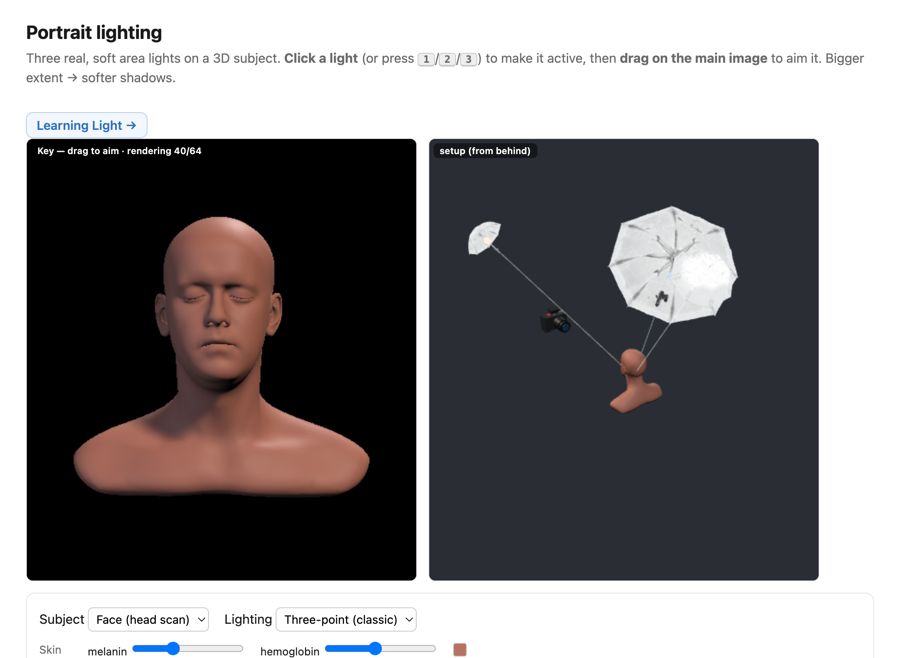
• the deeper idea: most lighting rules are about **managing dynamic range** (soft light / fill / reflectors compress contrast); studio three-point lighting; HDR + tone mapping in post
#### Portraits
• it's **all about the eyes** (focus there, catchlight); shoot near **eye level**; a short **telephoto** (~85–135 mm) flatters faces; light the face softly, warm WB a touch; basic **lighting & makeup** shape a face with light and shadow; over-shoot
#### Then, lightly, in post
• (→ ISP / Color / HDR): shoot **RAW**, set **white balance**, fix exposure, **manage contrast** with a tone curve, dodge / burn, crop; boost saturation/vibrance a touch; HDR + tone-mapping for high-contrast scenes
• governing principle: **whatever you do, do it less** — restraint is the mark of the finished image