1.5 Problem sets⧉
Implementing a method exposes choices that an explanation can hide: boundary handling, units, numerical precision, and failure cases. These assignments from MIT's Digital & Computational Photography course ask you to build simplified algorithms and try them on real photographs. Their sequence follows the course rather than the book; each assignment links to the chapters it uses. Full handouts are collected in Part 45, Appendices.
Start with small inputs you can check by hand, then inspect the photographic results. A constant image, an impulse, or a known geometric transform often reveals an error more clearly than a natural photograph. If you are taking a course, follow its own submission and AI-assistance rules.
 PS0: Environment and C++ basics. Set up the toolchain, write a minimal
Imageclass, and read and write image files. (→ Chapter 9.1, Developing, Testing and Debugging)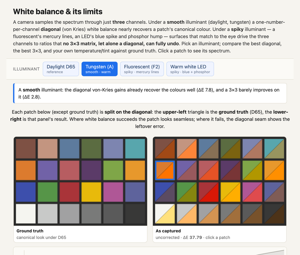 PS1: Image class, point operations, color. Pixel access; brightness and contrast; the luminance–chrominance (YUV) split; gamma; white balance; and the Spanish-Castle afterimage illusion. (→ Chapter 8.1, Image representation, Chapter 8.3, Tone point operations, Chapter 3.2, Perceptual color and trichromatic vision)
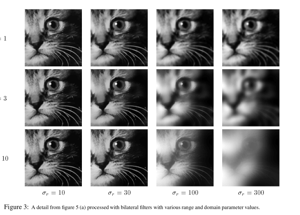 PS2: Convolution and the bilateral filter. Box and Gaussian blur, image gradients, sharpening, and bilateral denoising (with a YUV chroma variant). (→ Chapter 6.2, Convolution, Chapter 10.1, Bilateral filtering)
 PS3: Denoising and demosaicking. Align-and-average a burst (and the ISO/variance story); Bayer demosaicking: basic green, then edge-directed green and color-difference R/B; and Prokudin-Gorsky three-plate color alignment. (→ Part 13, Denoising, Part 15, Demosaicking and joint methods)
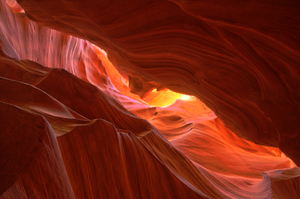 PS4: High dynamic range. Merge an exposure bracket into a radiance map and tone-map it for display. (→ HDR merging, Chapter 18.2, Global tone mapping)
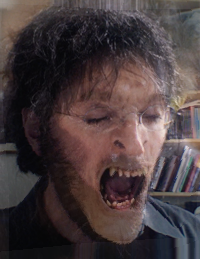 PS5: Resampling, warping, and morphing. Nearest / bilinear / bicubic / Lanczos resampling; Beier–Neely segment warps; and a full Beier–Neely morph. (→ Chapter 11.1, Warping, Chapter 11.3, Morphing)
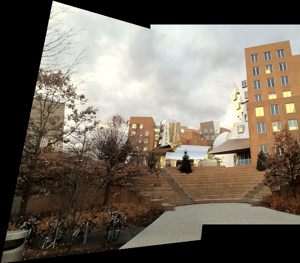 PS6: Homographies and manual panoramas. Homogeneous coordinates, warping by a homography, solving the homography from four point correspondences, and stitching a planar mosaic. (→ Chapter 20.1, Manual panorama stitching from multiple views)
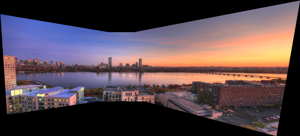 PS7: Automatic panoramas. Harris corners (the structure tensor), patch descriptors, the second-nearest-neighbor ratio test, RANSAC, and feathered / two-scale blending. (→ Chapter 20.2, Automatic panorama stitching from multiple views and feature matching)
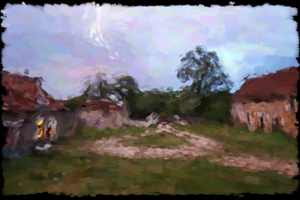 PS8: Non-photorealistic rendering. Paintbrush splatting and single-scale, two-scale, and gradient-oriented painterly rendering. (→ Chapter 25.2, Non-photorealistic rendering)
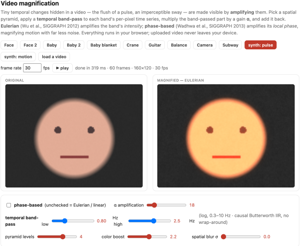 PS9: Make-your-own, video, and ethics. A self-proposed project (optical-flow retiming, phase-based video magnification, and the like) together with the ethics deliverable. Its open menu of advanced topics seeds many sections of Part 33, Computational optics and coded imaging. (→ Chapter 12.8, Optical flow, Chapter 38.3, Motion and video magnification)
The assignments deliberately distill an area into a small algorithm that you can build and inspect. Their purpose is to expose the principle before the production machinery obscures it. A basic align-and-average burst, for example, makes registration and noise reduction visible even though a shipping camera will need more elaborate handling of motion and outliers.