38.5 Corner camera⧉
Stand at the corner of a building and you cannot see what is around it. That is what a corner is: an occluder that hides half the world from you. But look down. The patch of ground right at the base of the corner is not in uniform shadow or uniform light; it carries a soft gradient, a penumbra, where the wall's edge partly blocks whatever is around the corner. That gradient is not noise. It is a measurement. The chapter's central claim, from Bouman and colleagues' "turning corners into cameras" (Bouman et al. 2017 (corner camera)), is that the penumbra on the floor encodes a one-dimensional video of the hidden scene, and that a phone-camera video of that unremarkable patch of ground is enough to estimate angular trajectories of moving subjects around the corner. A suitable corner can supply an imaging aperture, provided the floor receives enough light from the hidden scene.
38.5.1 The edge as a one-dimensional aperture⧉
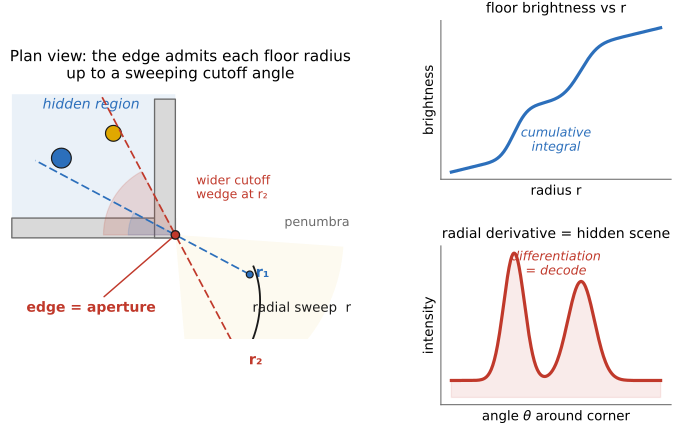
Here is why it works. Get the geometry exactly right, because everything follows from it. Forget the corner for a second and think of the simplest imaging element in the book: a pinhole. A pinhole forms an image because it lets each point on the film see light from only one direction. Block all directions but one, and the wall becomes a camera (Chapter 6.7, Image formation as a linear system). A vertical edge supplies an angular cutoff rather than the narrow ray bundle of a pinhole. Consider a single point on the floor near the corner. From that point, look up past the edge of the wall: the edge blocks everything on one side of a certain angle and reveals everything on the other side. The edge is a knife that, for each floor point, admits the hidden scene up to one cutoff angle and rejects the rest.
Now sweep around the corner across the visible floor fan. The cutoff depends on the floor point's azimuth about the vertical edge. Points at different angles see different angular portions of the hidden scene. Along a radial line from the corner, the cutoff is approximately the same in the simplified model, though distance and incidence angle change the received irradiance. After accounting for these weights, floor brightness is a cumulative integral of the hidden scene's angular profile.
The consequence is simple. If brightness on the floor is the integral of the hidden scene over angle, then the derivative of the floor brightness, how fast it changes as you sweep around the corner, is the hidden scene's brightness at the corresponding angle. The penumbra's gradient, differentiated with respect to angle, hands you a one-dimensional image of the hidden scene as a function of angle around the corner (Figure 38.5.1). The wall's edge has done the optical work of a lens; differentiation does the decoding. The corner camera is, quite literally, a one-dimensional angular camera whose aperture is an architectural accident.
38.5.2 From a faint gradient to a usable signal⧉
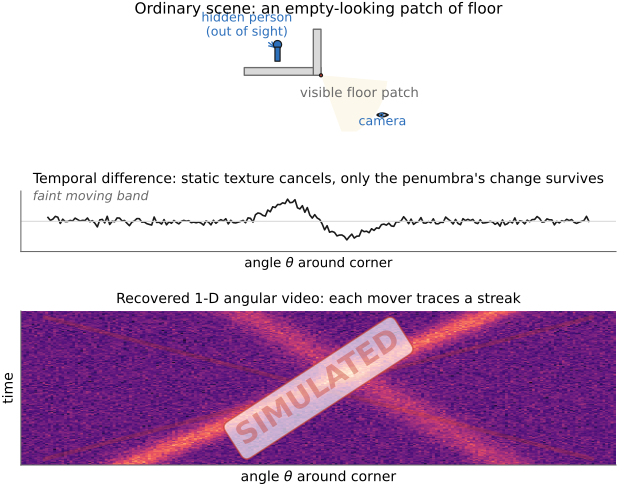
If it were that easy, you would see it with your eyes. The catch is that the penumbra signal is tiny, a percent-level modulation riding on top of the floor's own texture, its baseline shading, and whatever ambient light is bouncing around. A single still frame buries the hidden image under the floor's wood grain and dirt. This is where two ideas rescue the method, and both are recurring moves in this part.
The first is differencing in time. The floor's texture, the static furniture's contribution, the slow drift of daylight. These are constant or near-constant from frame to frame. What changes is what moves around the corner. So take a video and subtract consecutive frames: the static scene cancels, and what survives is the change in the penumbra caused by motion in the hidden region. This is exactly the strategy that runs through Chapter 38.3, Motion and video magnification and Chapter 38.4, Visual microphone. The signal you want is the small temporal change, and you isolate it by treating everything stationary as a nuisance to subtract away. Temporal background subtraction suppresses static contributions and helps recover changing angular structure. It does not guarantee detection of every moving object, and floor reflectance still modulates the signal. The result is a one-dimensional video of the measurable changes (Figure 38.5.2).
The second idea is averaging and integration over the strip. The profile varies across angle. Samples at different radii along a given angular direction provide redundancy, after allowing for geometric falloff and floor reflectance. Averaging over that redundancy beats down the camera's own shot noise and the floor's small-scale texture, pulling a one-percent signal out of the muck. The reconstruction is then a modest linear inverse problem: a known cumulative-integration forward operator, inverted by differentiation with regularization to keep the noise from exploding. This is the mild end of the inverse-problem spectrum that Chapter 38.7, Passive non-line-of-sight takes to its photon-starved limit.
38.5.3 What the corner can and cannot tell you⧉
The limits define the whole passive-NLOS regime. A single edge gives you one angular dimension, position around the corner, and essentially nothing about range. You can estimate motion and bearing, and sometimes distinguish multiple subjects, but overlapping angular signals can be ambiguous. Two separated edges, such as the sides of a doorway, can provide stereo bearings and constrain range Bouman et al. 2017 (corner camera). You can recover a one-dimensional video, not a picture. And the method lives and dies by the edge: a sharp, isolated vertical occluder gives a clean cumulative-integration forward model; a rounded corner, a cluttered doorway, or a soft edge blurs the angular cutoff and degrades the reconstruction. The corner camera works because the built world is full of crisp vertical edges, and it is no accident that the demonstrations are shot at the corners of corridors and buildings.
But the general lesson reframes how you see the world. Imaging does not require a camera in the optical sense. It requires a measurement whose dependence on the scene you can model and invert. A vertical edge plus a patch of floor is such a measurement. The edge selectively blocks light, which is all an aperture ever does; the floor records the result, which is all film ever does; and regularized differentiation recovers angular structure under the model. Once you see the corner as a one-dimensional camera, the question of Chapter 38.7, Passive non-line-of-sight becomes irresistible: if a line (the edge) buys you one angular dimension, what does a more structured occluder, such as a doorframe or an object casting a full shadow, buy you? The answer, a full two-dimensional hidden image from a single photograph, is the next chapter but one. First, the active route: when you are allowed to bring your own light and time its return.