43.2 Why phones are so good (at photography)⧉
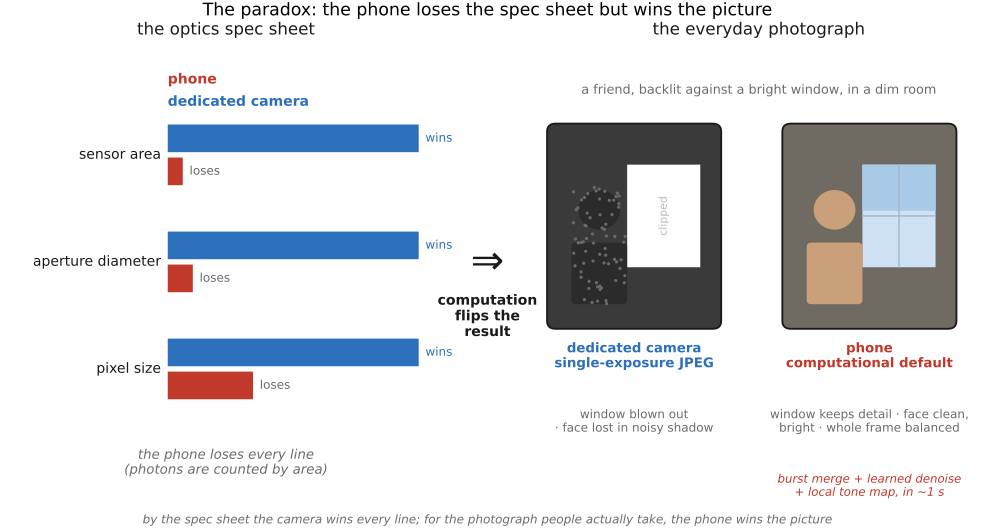
Put two cameras side by side on paper and the contest looks settled before it starts. One is a dedicated camera, with a full-frame sensor the size of a postage stamp, a lens as long as your hand, and a piece of glass that costs more than the body it bolts onto. The other is a phone: a sensor a few millimeters across, a lens a few millimeters long, the optical stack constrained by the thickness of the phone and its camera bump. By the classical rules of Chapter 5.1, The camera as an instrument, the rules this book spent its first part deriving, it is not close. For matched framing, f-number, and exposure time, a larger sensor generally collects more total light. Dynamic range and resolved detail also depend on sensor design, pixel count, and optics; a larger entrance pupil gathers a wider cone of rays from a subject point and isolates a subject against a melted background that no fingernail-sized aperture can produce. Light is photons, photons are counted by area, and the phone simply has almost no area. Those physical constraints put pressure on single-exposure image quality.
And yet, for the photographs that almost everyone actually takes, such as the backlit friend in front of a window, the dim restaurant, the kid mid-jump, or the city street at night, a phone can deliver the more pleasing automatic result, for reasons beyond convenience: the picture that comes out of the phone is frequently cleaner, better-exposed, and more pleasing than the one a far more expensive camera hands its owner straight out of the box. This chapter is about that inversion. How does a device that loses every line of the optics spec sheet beat the thing that wins them? The answer is the whole book in miniature, and it has six parts: computation beats glass; the whole pipeline is co-designed; machine learning and data carry the load; many small cameras stand in for one big one; the phone has system and human advantages a camera cannot match; and physics still wins where it must, and the picture is increasingly inferred rather than recorded.
43.2.1 Computation beats glass⧉
Start with the deficit itself, because the phone's whole strategy is built to invert it. A tiny sensor means tiny photosites, and a tiny photosite holds few electrons. Its full-well capacity tends to be smaller, while read noise depends on the pixel and readout mode. By L2.46, dynamic range is full-well capacity divided by the noise floor, so the small sensor is squeezed from both ends: it clips its highlights early and drowns its shadows in noise. The smaller capture area is a disadvantage under comparable conditions, though sensor technology, optics, exposure settings, and output resolution also affect the comparison.
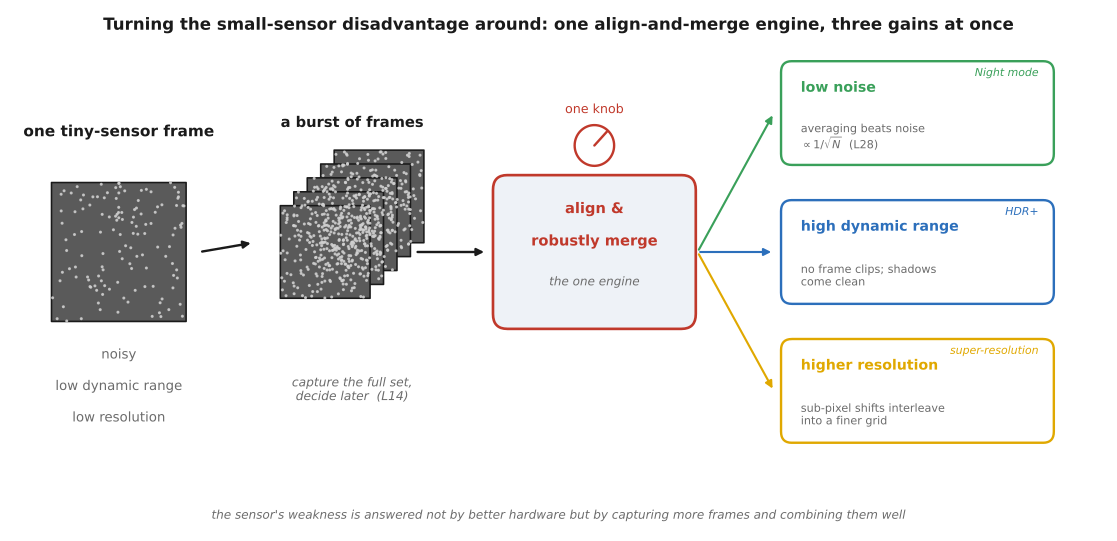
So the phone does not take a single shot. The move that runs through Multiple exposure imaging is L13.1, capture the full set, decide later, and the phone is where that idea reached mass use. In the original HDR+ design, the phone combines a burst of short raw exposures at the same setting, chosen to protect highlights; modern burst schedules vary by mode and scene; it aligns them and robustly merges them into one image whose highlights survive (where the chosen exposure kept them below clipping) and whose shadows come clean (because averaging $N$ frames beats the noise down as $1/\sqrt N$, the law of L28). That single pipeline, Chapter 17.6, HDR+ and burst imaging on phones, is simultaneously a high-dynamic-range merge and a denoiser, and it is the direct answer to L2.46's squeeze: it manufactures the dynamic range and the low noise that the small sensor cannot hold in one frame. Push the same substrate into near-darkness and it becomes Chapter 17.6, HDR+ and burst imaging on phones, stretching the burst to dozens of frames and metering for motion so it catches every photon it can without smearing (Liba et al. 2019). If you exploit the sub-pixel hand tremor between frames as a sampling signal rather than a nuisance, it becomes Chapter 14.2, Multi-frame super-resolution, recovering real detail beyond a single frame's grid and standing in for the long lens the phone does not have (Wronski et al. 2019). The same align-and-merge engine addresses dynamic range, low-light performance, and resolution (Hasinoff et al. 2016).
This is the precise sense of the book's slogan, computation is the new optics (Chapter 1.1, From Digital to Computational Photography): burst processing can compensate for some limits of a compact optical system by spending additional capture time and computation. Sensor and lens improvements still matter, and dedicated cameras can also use multi-frame methods.
43.2.2 The whole pipeline is co-designed⧉
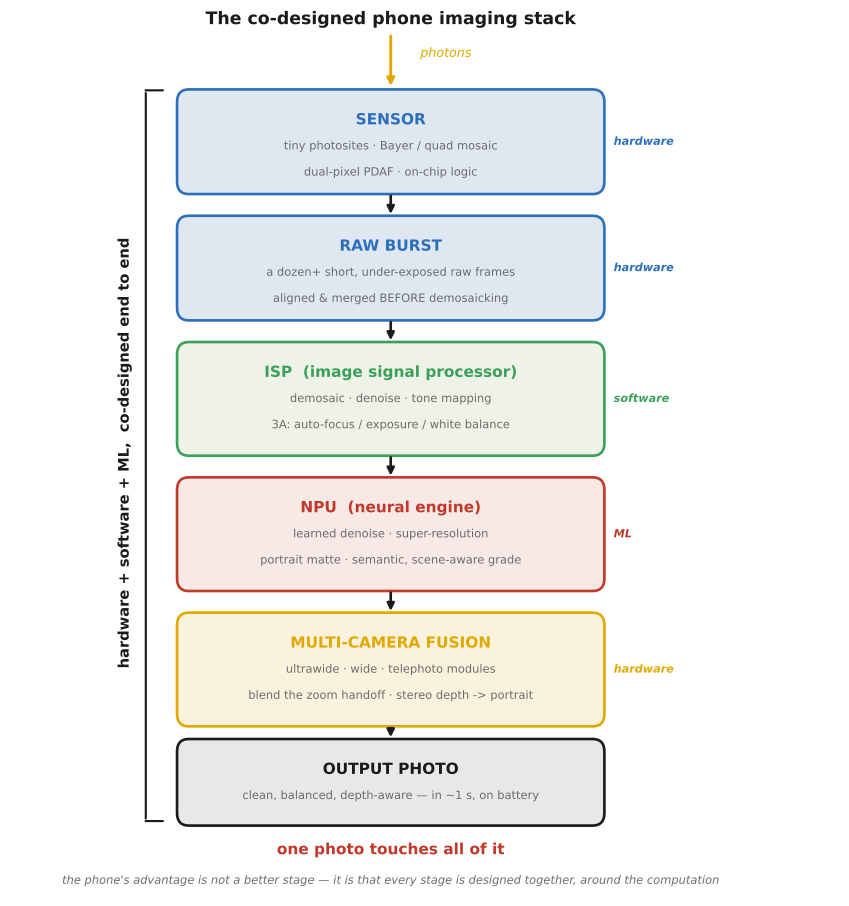
A second answer is that none of this is bolted on after the fact. On a phone, the sensor, the image signal processor (ISP), and the neural-processing unit (NPU) are designed together as one machine, and the software is written to that machine. Dedicated cameras also co-design sensors and processing. Phones make especially extensive use of coordination among capture timing, mobile compute, and automatic image rendering. This is the optics-and-algorithm co-design argued for in Chapter 1.1, From Digital to Computational Photography, now applied to the whole imaging stack rather than just a coded aperture.
You can see the co-design in where the work happens. The merge runs in raw, before demosaicking (Chapter 17.6, HDR+ and burst imaging on phones), so denoising and HDR happen on the cleanest, still-linear signal. This follows the discipline of working in linear light, before a tone curve distorts the average. The classic Chapter 8.12, Recap ISP, non-destructive editing stages, including Part 15, Demosaicking and joint methods, Part 13, Denoising, and the 3A triad of auto-focus, auto-exposure, and Chapter 8.10, Auto-exposure and auto white balance, are no longer a fixed sequence applied blindly; they are run on a budget of about a second, on a phone, without draining the battery, and increasingly they are semantic: the pipeline knows there is a face here and sky there, and it brightens the face and not the sky, holds skin tones, and grades the scene to what it recognizes the scene to be. The ISP stopped being a fixed function and became a scene-aware program. This combines performance engineering with machine learning, and it depends on close coordination among hardware and software teams, often across several suppliers.
43.2.3 Machine learning and data at scale⧉
The third answer is the one the rest of the field has been converging on, and it is the bitter lesson of Chapter 1.1, From Digital to Computational Photography applied in hardware. Many of the phone's pipeline stages are no longer hand-tuned heuristics but learned operators. This is L7.6: a learned operator swaps a hand-designed prior for one learned from data. The denoiser, the demosaicker, the portrait matte, the upscaler, the very mapping from a dark, noisy raw to a clean photograph are increasingly neural networks trained on enormous corpora of real and simulated captures (Chen et al. 2018; see Chapter 7.3, Deep learning). And photography has the twist that softens the bitterness: the forward model is known, including projection, the sensor's noise, and the color-filter mosaic, so we can generate paired training examples by simulating degradation, while accounting for the gap between the simulator and real lenses, sensors, and scenes, and bake the physics in as an inductive bias. The phone is the largest deployment of exactly that strategy.
The data advantage compounds the model advantage. A phone vendor ships to hundreds of millions of users and can learn from that scale: which scenes occur, which faces and skin tones must be rendered well (and the Chapter 40.2, Ethics of computational photography that comes with it), what "good" looks like across the world's lighting. And the understanding runs live, in the viewfinder, before you even press the shutter: Chapter 12.10, Face tracking are detected and focused, scenes are classified, the moment everyone is smiling is recognized and chosen. Computer vision, which usually treats the image as a means to recover meaning, is here pressed into the service of the picture. This is the inversion introduced in the first chapter, and phones are its clearest example.
43.2.4 Many small cameras for one big one⧉
The fourth answer is geometric. Open the back of a modern phone and there is not one camera but a cluster, typically Chapter 32.3, Multi-camera phones, and sometimes a folded periscope tele, sitting a centimeter or two apart, and the phone's job is to make them feel like one continuous instrument by fusing them. As you zoom, it switches modules and blends the handoff, borrowing detail from whichever lens is sharpest at that magnification; in most such systems this is discrete optical steps plus computational interpolation, not a continuous optical zoom (Chapter 32.3, Multi-camera phones), but the seams are usually invisible.
The same arrangement buys depth. Two modules a known distance apart see the scene from slightly different viewpoints, so the disparity between them is a stereo cue, because near objects shift more than far ones, from which the phone estimates a depth map. That depth map drives portrait mode: the synthetic, depth-dependent background blur of Chapter 23.2, Fake (synthetic) depth of field, rendered computationally to produce stronger or more controllable blur than the capture optics provide for that framing and distance (Wadhwa et al. 2018). This is one place where the phone cannot beat the optics: shallow depth of field is genuinely an aperture-size phenomenon, so it simulates the look instead, with a pipeline (estimate depth, matte the subject, render a plausible aperture blur, composite in depth order) that is only ever as good as its weakest stage. When it works it is indistinguishable; when it fails, a strand of hair or a coffee-cup handle is blurred on the wrong side of the matte, and the artifact becomes visible.
43.2.5 The human and system advantages⧉
The fifth answer is the one the spec sheet never lists, and it may be the most decisive. The best camera is the one you have with you, and the phone is always with you. The dedicated camera, however good, is in a bag at home for all but a few deliberate outings; the phone is in your hand for the unrepeatable moment. That alone wins most of the photographs that get taken at all.
And around the capture sits an entire system the camera lacks. The phone applies computational defaults that turn a "good enough" capture into a better one automatically. Chapter 40.1, Human factors and the art of photography, a photographer used to make by hand (expose for the highlights, fill the shadows, warm the white balance, isolate the subject) are now made automatically, well, by the pipeline, for a user who knows none of them. The picture is instant, visible, editable, and shared a moment later. That immediacy is what won digital photography in the first place. It is geotagged and searchable: the phone knows where and when, recognizes the people and the places, and lets you find "the beach, last summer, with Maya" by typing it. The "you press the button, we do the rest" promise that opened this book (Chapter 1.1, From Digital to Computational Photography) is, on a phone, more completely kept than Eastman imagined. The rest now includes exposure, denoising, tone, depth, sharing, and search.
43.2.6 The hard caveats: physics still wins where it must⧉
It would be false to end on triumph, and this book does not oversell. Physics still limits the phone, and exactly where you would predict. Where light is truly scarce, not dim but dark, there are only so many photons to catch through a few millimeters of aperture, and no number of frames invents signal that never arrived; a big sensor with a fast lens still pulls cleaner images out of real darkness. Strong portrait-style blur is often simulated, though phone lenses also produce optical defocus, especially at close range, and the simulation breaks at the hard cases (fine hair, transparency, busy occlusion) where the matte cannot be trusted. Long reach is reconstructed and eventually hallucinated: super-resolution recovers genuine detail up to a point and then begins to invent it. And the big print, the wall-sized enlargement, the demanding crop still reward real resolution and real dynamic range that computation can stretch but not conjure. The phone wins the everyday photograph; it does not repeal optics.
A deeper caveat is that as more of the pipeline becomes learned and generative, the phone's photograph is increasingly rendered or inferred, not recorded. A demosaicked, denoised, tone-mapped, depth-composited, super-resolved, scene-graded image is a long way from a measurement of the rays that entered the lens. It is a plausible reconstruction the system believes in, guided by priors learned from millions of other photographs. This is the measurement → generation arc the book has tracked from its first pages (Chapter 1.1, From Digital to Computational Photography): image-making began as pure generation (the painter), photography swung hard toward measurement (the camera as objective recorder), and the learned phone pipeline swings back toward generation, with measurement and synthesis blurred into each other. That is not a bug to be fixed; it is what makes the picture good. But it changes what a photograph is, and it is why the clear-eyed reckoning of Chapter 5.8, Photographic representation and its limits, the argument that Chapter 5.8, Photographic representation and its limits, and Chapter 40.2, Ethics of computational photography are not appendices to this story but its conclusion. The phone makes a beautiful picture by deciding, on your behalf and largely invisibly, what the scene should look like, and we ought to know that it is making that decision.
43.2.7 The throughline⧉
So the answer to why phones are so good is the whole book. A phone has a physically tiny sensor and a physically tiny lens, and by every classical measure it should lose to any dedicated camera. Its success in everyday automatic photography comes from combining the optical instrument with sustained computation and convenient operation. It captures the full set and decides later, co-designs the sensor, silicon, and software, learns its operators from data at massive scale, fuses several small cameras into one, and wraps the result in a system that is always with you and immediately searchable. The book's single throughline is that the camera became a computer; the phone is simply where that transformation is most complete. Everything else in computational photography is visible somewhere, in a microscope, a telescope, a scanner, or a research rig, but only on the phone is it all present at once, in your pocket, finishing in a second, for a billion people who never had to learn a single rule of the craft. That is the field's achievement, and its main tension.