38.7 Passive non-line-of-sight⧉
The active method of the previous chapter uses specialized illumination and timing hardware. Pulsed illumination and fast timing add path-length information to a weak scattered return, enabling depth-resolved reconstruction when enough photons are measured. The question that makes passive non-line-of-sight imaging so seductive is the opposite one: how much of the hidden world can you recover with nothing but an ordinary camera and the light that is already there? No illuminator, no synchronization, and no timing, just a single photograph (or video) of a relay surface, lit only by the ambient light the hidden region happens to be emitting, and the faint structure that everyday occluders imprint on that light. The answer is that you can recover more than you might expect, if you are willing to solve a hard, ill-conditioned inverse problem.
38.7.1 The occluder is what makes it solvable⧉
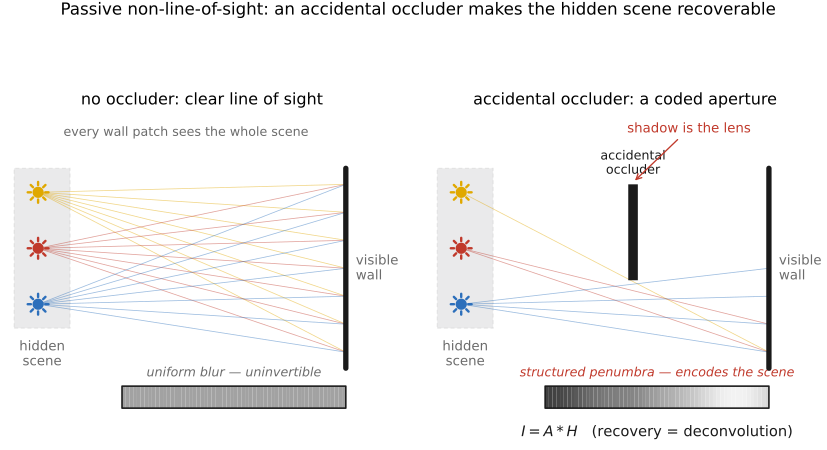
Start with why the problem is even possible, because the answer runs against intuition. Imagine a hidden room glowing with ambient light, spilling onto a blank wall you can see. If the wall sees the entire hidden scene with nothing in the way, every patch of wall receives light from the whole hidden region, and so nearby patches often record very similar weighted averages. Distance and incidence angle still vary across the wall, so the signal need not be uniform, but fine scene structure is poorly conditioned. An occluder can introduce much stronger spatial variation in those weights.
What makes the problem solvable is an occluder. Put something in the way: a wall edge, a doorframe, an opaque object between the hidden scene and the relay surface. Now different patches of the visible surface see different subsets of the hidden region, because the occluder blocks different rays for different patches. The occluder modulates the hidden light, exactly as a pinhole or a coded mask modulates a normal scene (Chapter 33.3, Coded aperture). It breaks the fatal symmetry: instead of every patch averaging everything, the surface now carries a structured pattern in which the hidden scene's spatial layout is encoded. The occluder, far from being an obstacle, is the optical element that turns a featureless glow into a coded measurement. The big lesson of passive NLOS is precisely this inversion of intuition: the shadow is the lens.
38.7.2 A deconvolution where the lens is unknown⧉
Once you see the occluder as a coded aperture, the structure of the problem is familiar from the rest of the book. The light measured on the visible surface is a weighted integral of the hidden scene, with the occluder's visibility specifying which paths are blocked. In an approximately shift-invariant planar setup this becomes a convolution. Recovery is then a deconvolution, the same inverse-problem skeleton as Chapter 33.3, Coded aperture decoding or motion deblurring: you have a measurement, you have (a model of) the forward operator that produced it, and you invert.
But passive NLOS is an unusually difficult deconvolution problem, for two reasons the chapter should not soften. First, the forward operator depends on the occluder geometry, which is often part of the unknown, because you may not know the exact shape and position of the edge or object doing the coding, so you are solving for the hidden scene and estimating the operator, the same chicken-and-egg as blind deblurring. Second, and worse, the measurement is photon-starved and ill-conditioned. The penumbra modulation is a percent-level whisper on top of the surface's own albedo and texture; an accidental occluder is a terrible coded aperture compared to one you design, with a soft, low-contrast transfer function that suppresses exactly the high frequencies you would want to recover. So the inverse problem is severely ill-posed: small measurement noise blows up into large reconstruction error, and you survive only by leaning hard on regularization and priors, such as smoothness, non-negativity (the hidden scene can't emit negative light), and whatever structure you can assume. Recovered detail depends on signal strength and conditioning. Regularization stabilizes the estimate but cannot restore information the measurement does not constrain; sufficiently poor geometry or faint light can prevent useful recovery.
38.7.3 One dimension: the corner camera⧉
The cleanest instance of this whole framework is the one we already met. At a wall corner, the vertical edge is the accidental occluder, and its visibility function is the simplest possible: a knife-edge that, for each floor point, admits the hidden scene up to one cutoff angle. That makes the forward operator a cumulative integral along angle, and the deconvolution reduces to a differentiation of the penumbra, which is why Chapter 38.5, Corner camera of Bouman and colleagues recovers a one-dimensional angular video so cleanly (Bouman et al. 2017 (corner camera)). The edge is a one-dimensional coded aperture; it buys you one dimension of the hidden scene (bearing around the corner) and a tractable, near-closed-form inversion. The corner camera is passive NLOS in its simplest form, a special case where the occluder is so simple that regularization is still needed because differentiation amplifies measurement noise.
38.7.4 Two dimensions from a single photo: computational periscopy⧉
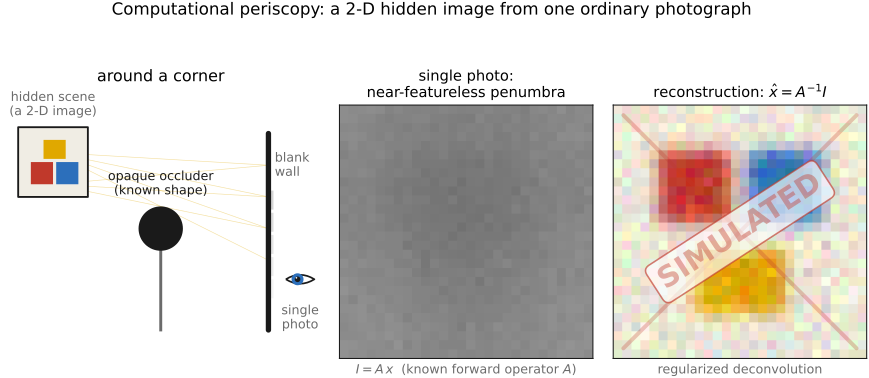
The leap is to ask for a full two-dimensional image of the hidden scene, not just an angular profile but a picture, from a single ordinary photograph. This is computational periscopy, the remarkable result of Saunders, Murray-Bruce and Goyal (Saunders et al. 2019 (periscopy)). The setup is almost aggressively mundane: a hidden scene (say, a small image displayed around a corner), a blank visible wall, an ordinary digital camera photographing that wall, and an opaque occluder of known or estimated shape sitting between the hidden scene and the wall, casting a soft shadow on it. No laser. No time-of-flight. One photograph.
The occluder's cast shadow is the coded aperture, and a richer one than a single edge: a two-dimensional opaque object blocks a two-dimensional pattern of rays, so different wall points see different two-dimensional subsets of the hidden scene. If you know the occluder's shape and position, you can write down the forward operator, the matrix that maps the unknown 2-D hidden image to the measured wall photograph, and invert it to reconstruct the hidden image (Figure 38.7.2). That inversion is, again, badly ill-conditioned, and Saunders and colleagues stabilize it with regularization and careful calibration of the occluder geometry; where the occluder shape is uncertain, it can be estimated jointly. The result is genuinely a picture of a scene the camera cannot see, pulled from a single snapshot of a blank wall. It is the same idea as the corner camera, promoted from one dimension to two by trading the bare edge for a structured occluder whose shadow encodes both image dimensions.
38.7.5 Active versus passive, the ledger⧉
Now the two routes can be set side by side fairly. Active non-line-of-sight (Chapter 38.6, Active non-line-of-sight) sends a controlled pulse and times its return, providing time-resolved constraints for often 3-D reconstruction, at the cost of a pulsed laser, a picosecond detector, scanning time, and a relay wall you can illuminate. Passive non-line-of-sight buys none of that hardware and pays for it everywhere else: the signal is the ambient light that happens to be there, the coded aperture is an occluder you did not design and may not fully know, the measurement is photon-starved, and the inverse problem is ill-conditioned. Active spends hardware to buy signal; passive spends signal to save hardware.
Passive NLOS can exploit existing illumination and occluders. Its success is conditional: insufficient signal, ambiguous geometry, or an uninformative occluder can make reconstruction fail rather than merely blur it. And because it needs only an ordinary camera and existing light, it reframes every ordinary photograph as a partial measurement of the world outside the frame. The corner you walk past, the doorway or the object casting a shadow on the floor can each act as an accidental coded aperture, each photograph a potential measurement whose recoverable detail depends on geometry and noise of a scene you cannot directly see. That is the unifying thesis of this whole part: vision is not bounded by the field of view, only by what you can model and invert. The last chapter pushes that thesis past visible light entirely, to radio waves that can penetrate some walls.