40.6 The social and personal practice of photography⧉
A photograph of a friend's celebration and a photograph of a broken fitting may pass through the same camera pipeline but serve different purposes. One preserves or communicates an experience; the other helps complete a task. A design that improves attractiveness can harm the second use if it removes a faint mark or changes a label.
Part 5, Photography develops the capture decisions. Here the subject is how photographs enter people's activities, collections and paid work. Evidence about those practices needs a population, a task and a period of observation.
40.6.1 Purposes and subsequent uses⧉
Keeping, sharing, self-presentation and practical reference can overlap within one capture. A photograph made for oneself may later become a message to someone else. Ask about both the intention at capture and the subsequent use; a file's visual subject alone does not identify either.
40.6.2 A small map of motives⧉
Kindberg, Spasojevic, Fleck and Sellen's early camera-phone study reports six intention categories Kindberg et al. 2005. Its affective categories concern a mutual experience, absent friends or family, and personal reflection. Its functional categories concern a mutual task, a remote task and a personal task. The distinction between people present and absent is part of that taxonomy.
An affective-versus-functional and individual-versus-social 2×2 can serve as a simplified design sketch, but it collapses categories and should be labeled as our simplification. The original study establishes examples and distinctions from its participants' use; it does not establish the prevalence of each purpose in today's entire camera-phone population.
Immediate sharing adds uses to photography. Determine whose activity is being studied before claiming that one motive has replaced another.
The functional photographs are easy to overlook if photography is discussed only as memory or self-expression. A photograph of a parking-bay number can be a personal reminder. A picture of a broken part sent to a repairer can support a remote task. A whiteboard photograph can help people continue a task they shared in person. A private keepsake or a photograph sent to share a feeling serves a different purpose. These examples explain why camera design has to accommodate visual note-taking and coordination as well as pictures intended for appreciation; the same device serves several motives Kindberg et al. 2005.
Van House, Davis and colleagues describe memory and personal archiving, relationship maintenance, self-presentation and expression, and functional uses in their camera-phone research Van House et al. 2005. This complementary account helps separate a photograph's visible content from the work it does socially. A picture of a meal can be an appreciative record, a message to a friend, an identity claim or a reminder of a dietary detail. Its pixels alone do not disclose which use mattered.
40.6.3 Photography as communication and memory⧉
A photograph can be sent while its subject is still in front of the camera. That affordance supports conversation and coordination as well as archiving. It does not establish that memory has ceased to be the dominant purpose for any particular population.
The photoware and personal-collection studies by Frohlich et al. Frohlich et al. 2002 and Rodden and Wood Rodden & Wood 2003 provide historical context for keeping, organizing and sharing. Later platform-specific research needs to be read in its own context. Public posting, private messaging and a personal camera roll expose different selections of photographs.
40.6.4 What the psychology actually shows⧉
Diehl, Zauberman and Barasch Diehl et al. 2016 found increased enjoyment in several photo-taking conditions and examined engagement as a mechanism. The result depended on the activity and how photographing affected attention; it is not a prescription to photograph every experience.
Barasch, Zauberman and Diehl Barasch et al. 2018 compared photo-taking goals and found that an intention to share could reduce enjoyment relative to photographing for oneself, with self-presentational concern contributing to the effect. That comparison does not establish that sharing is universally harmful.
In Henkel's museum experiments Henkel 2014, photographing whole objects impaired subsequent memory on the tested measures relative to observing them, while focusing on a detail changed the result. “The camera remembers so the mind stops” is a possible interpretation, not a direct measurement of the mechanism. Study design, attention and later review of photographs matter when applying such findings to another activity.
40.6.5 When people take photos, and why the usual numbers are not evidence⧉
A claim about annual photo counts or a typical camera roll needs an identifiable sampling method. Do not combine a marketing survey, a device-shipment total and a count of public uploads as though they measured the same population. Retain the question when suitable evidence is missing rather than supplying a plausible number.
The figures that circulate most are a useful exercise in tracing a source. Numbers such as 1.8 trillion photographs a year, six photographs a day for the average American, or about 2,795 photographs on a typical phone, with breakdowns by event, are quoted widely and sourced rarely. Traced back, many lead to one OnePoll survey of 2,000 US adults commissioned by Mixbook, a photo-book company with an interest in the answer Mixbook / OnePoll photo-habits survey. It is self-reported, small and commissioned for marketing; treat it as anecdote, not measurement.
A public image collection can support a narrower analysis. Capture timestamps in YFCC100M can be used to examine time-of-day or seasonal patterns among its included photographs Thomee et al. 2016 (YFCC100M). Validate timestamps, time zones, duplicates and the difference between capture and upload time. Report the denominator after filtering. The result describes that selected collection, not all photographs people took. The Unsplash Dataset adds search and download behavior for a curated, enthusiast-oriented collection Unsplash Dataset, with the same limitation.
Private task photographs can be underrepresented in a public corpus. A missing category in such data does not show that the activity is rare. Studying a private camera roll requires a different sampling and consent process from analyzing public metadata.
40.6.6 From observed practice to design requirements⧉
Translate the observed purpose into a testable requirement. A document interface should preserve text and support correction of recognition errors. A personal archive should help retrieve a remembered event even when the user did not tag it. A sharing interface should make the audience and retained metadata understandable. Evaluate the requirement with the people and tasks it is meant to serve.
40.6.7 Optional background: paid photographic work⧉
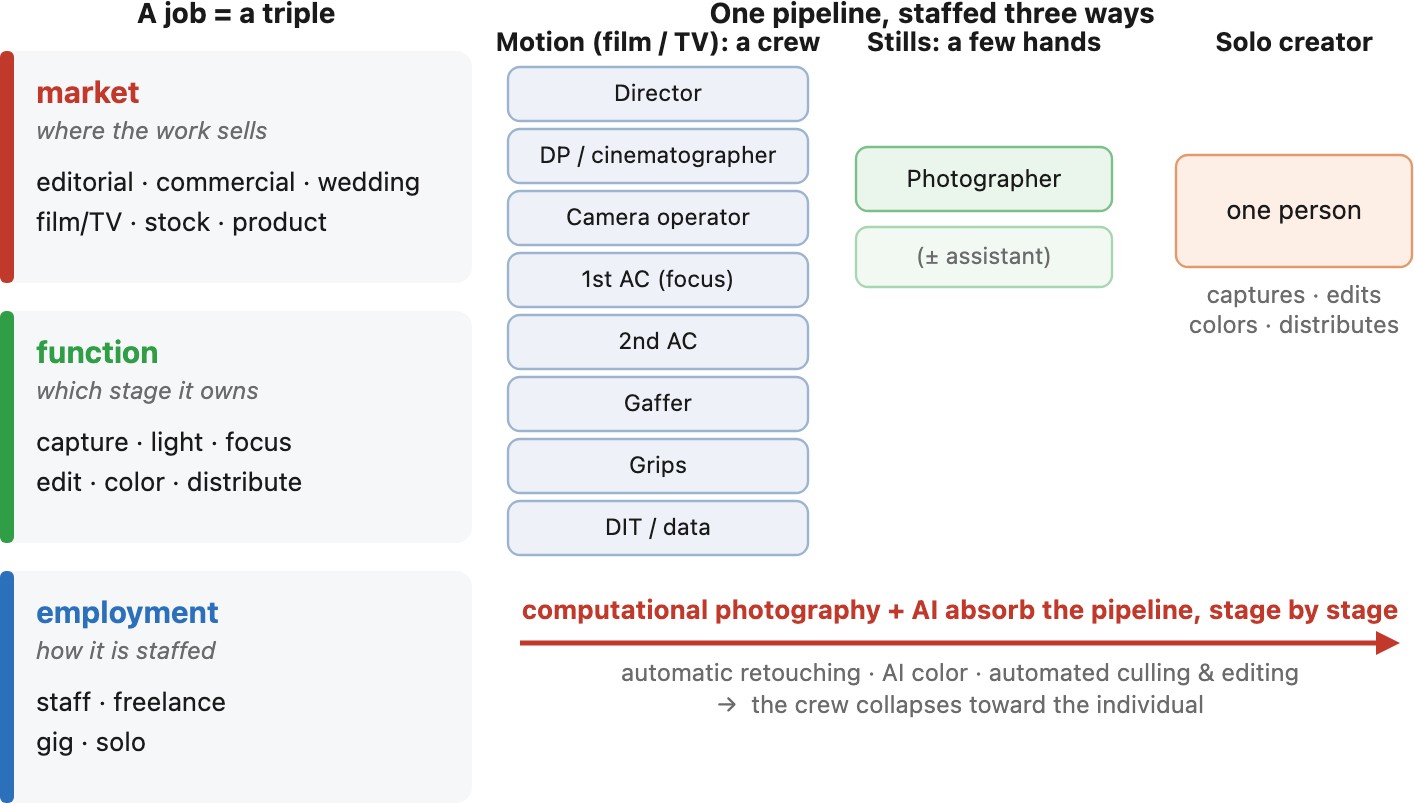
Paid photographic work can be described by its market, production function and employment arrangement. These dimensions clarify technical requirements without ranking occupations or predicting their future. The same person can perform several functions, and the same deliverable can be produced by different-sized teams.
The market: what the image is for⧉
An event client buys coverage of an occasion that may not be repeated. An advertiser may buy a constructed illustration. An editorial assignment may require a documented account under specified publication rules. Scientific imaging may require calibrated data. These purposes affect acceptable transformations, delivery times and the importance of retaining source material.
The markets include consumer portraits and events; commercial product, fashion, food and advertising; editorial and journalism; corporate and industrial communication; entertainment; scientific, medical and forensic imaging; fine-art prints and teaching; and stock licensing. These are useful distinctions because the client or intended use sets different deadlines, access requirements and evidentiary claims. A product illustration can be constructed around a brief, while a scientific image may need a calibration that survives subsequent analysis. The market does not uniquely specify crew size or employment arrangement.
The role: where in the pipeline⧉
Production includes planning and access, capture, editing, color work, compositing and delivery. On a larger motion production, focus, lighting, camera operation and data management can be separate responsibilities. In a small stills assignment one person may perform most of them. Automation of one operation does not determine how responsibility for the result is allocated.
| Production stage | Examples of responsibilities |
|---|---|
| Pre-production | Producing, casting, location scouting, styling, set design and art direction |
| Capture | Photography or cinematography, camera operation, focus pulling, camera assistance, lighting, grip work and digital imaging |
| Post-production | Selection, retouching, picture editing, color grading, compositing, visual effects and motion graphics |
| Support | Studio and asset management, equipment service, representation, archiving, education and curation |
On a motion crew, the director of photography sets the photographic approach, camera operators execute camera work, and the first assistant camera commonly takes responsibility for focus. The gaffer leads electrical lighting work, while grips handle support and rigging within the production's division of responsibilities. A digital imaging technician supports the digital capture and on-set image pipeline. Data-management assignments vary with the crew. These functions explain why capture, color interpretation, monitoring and reliable handling of recordings are separate technical concerns even when one person performs them.
The employment model⧉
A photographer, retoucher or colorist may work as an employee, freelancer, studio owner or contractor within a larger production. A role title does not specify its working arrangement, and technical proficiency is only one part of sustaining the work. Scheduling, communication, access and reliable delivery remain requirements even when image processing is automated.
A job is a triple⧉
Consider a freelance event photographer and a staff colorist in a post-production facility. The former may need to capture, select and deliver a coherent set quickly; the latter may need to maintain a controlled color pipeline across many shots. The description by market, function and arrangement is a way to identify these requirements. It is not a set of mutually exclusive occupational categories or a statistical model of employment.
What would establish a change in employment?⧉
Digital delivery, online distribution and automated editing change tasks and business options. They can reduce the time needed for an operation, change what clients request or introduce new review work. Establishing an employment effect requires dated labor or business evidence with clear occupational and geographic definitions.
A tool capable of synthesizing a product image does not establish how many photographers lost work, how prices changed or which new assignments appeared. Keep those as research questions unless suitable evidence supports a narrower claim. The retained market figure must state what it actually measures.
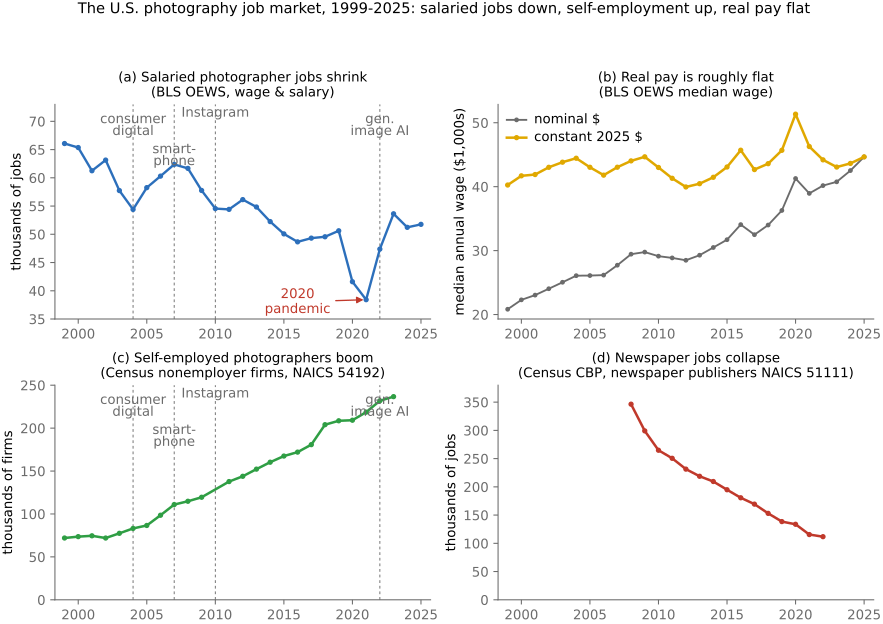
Three technological changes help organize the question. Digital capture reduces the marginal cost of another exposure and replaces film-development operations with digital ingestion and processing. Network distribution permits direct delivery, online portfolios and searchable stock libraries. Generative methods can produce illustrations without photographing the depicted arrangement, while automated selection and retouching can change post-production work. These changes affect different stages, so their consequences should be studied separately.
There is also a distinction in what the client is purchasing. A plausible illustration can sometimes be synthesized from a brief. A record of a particular wedding, performance or experiment depends on access to that event and the trustworthiness of its documentation. Direction, selection, provenance and responsibility for a delivered result remain meaningful tasks. This distinction explains why measuring an algorithm's production speed alone cannot predict its effect on the photographic professions.
Automation and the allocation of work⧉
A small team can combine capture, editing and distribution in one workflow. A larger team can distribute tasks for throughput, specialization or accountability. Automation can assist either arrangement, and inspecting automated output can itself require work.
Compare who performs each task before and after introducing a tool, including selection, correction and responsibility for errors. Time saved on one stage does not by itself demonstrate a smaller crew or a reduction in paid employment.
Recap: big lessons of this chapter
Immediate sharing adds uses to photography. Determine whose activity is being studied before claiming that one motive has replaced another.