💬Comments welcome. To leave a note, select any text and click the note / highlight button that pops up — or open the panel with the tab at the top-right (‹). Notes are visible only inside our private review group.
Computational Photography, an AI-powered Slopendium — 35 Computational illumination
expand to📖 Full book outline1 parts · 8 chapters · 36 sections · 3 figures embedded · 1 placeholders · double-click a figure to enlarge
If you control the light as well as the camera, a whole second axis of coding opens up: vary the **illumination** — its timing, direction, spectrum, polarization, or spatial pattern — and fuse the resulting images. From flash/no-flash and multi-flash to structured light, dual photography, and robot-flown light sources, the optimized degree of freedom here is the **light itself**.
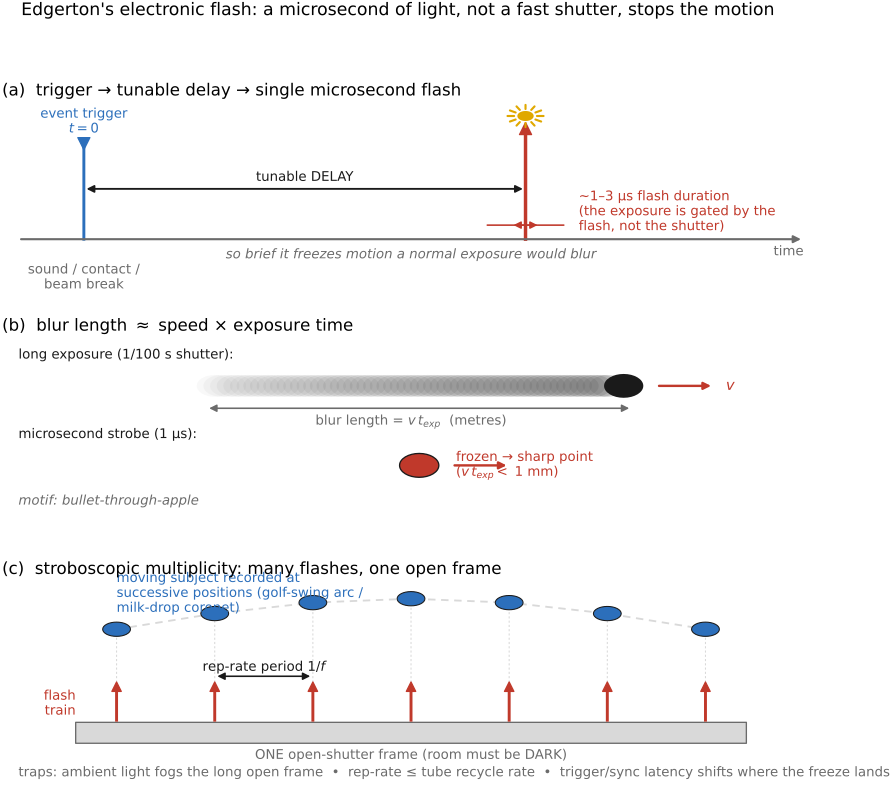
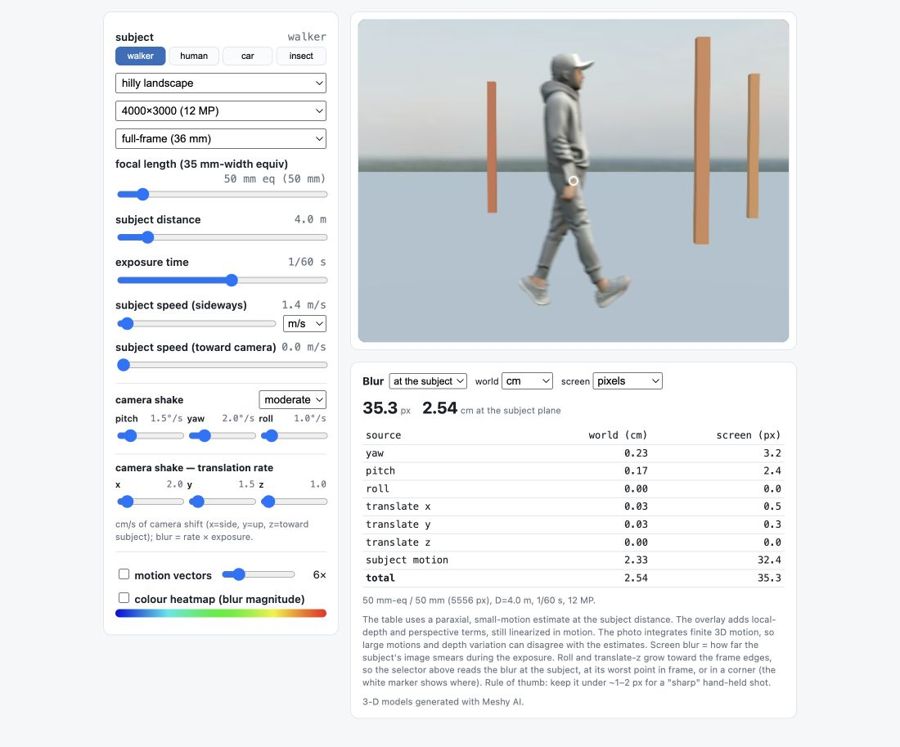
fig-edgerton-strobe-timeline · fig-motion-blur-calculator · live motion-blur calculator: a 3-D scene (walking figure or a car) imaged by a virtual camera, the blur rendered by **temporal supersampling** (many instants across the exposure, averaged). Set resolution / sensor / focal length (35 mm-equiv) / distance / exposure, add camera-shake **rates** in rotation (pitch/yaw/roll) and translation (x/y/z) plus a subject speed; the readout gives the blur at the subject in world (cm/m/in) and screen (px / % width) units, broken down by source. A per-pixel **G-buffer** (depth + subject mask) drives exact motion-vector arrows and a blur-magnitude heatmap: the subject carries its own motion, the background only camera shake. Environment backdrops + car color picker. Static fallback is a screenshot. *3D models generated with Meshy AI.* ✅
⬜ figure not yet created
multi-strobe rep-rate freezing a motion sequence). fig-temporal-nyquist
• a **tabletop light dome** — a small dome studded with controllable LEDs over an object on a stand — is the bench-scale version of the same idea: capture the object under each light direction (one LED at a time) to build a per-point reflectance / one-light-at-a-time (OLAT) stack for relighting, photometric stereo, and BRDF/normal capture. The miniature sibling of the room-scale [[#Light domes|light dome]] above.
• the dome idea taken *into the wild*: Murmann et al.'s **multi-illumination dataset** captures everyday indoor scenes under many controlled light directions (a flash bounced to a grid of directions, ~25 per scene over 1000 scenes), a no-dome stand-in for one-light-at-a-time capture out of the lab — training data for **single-image relighting**, illumination estimation, and learned reflectance separation. Same per-direction-capture principle as the dome, scaled to real rooms and a learning-sized corpus.
35.6.2 Drone lighting: flying the light into place⧉
▸35.6.3 Drone lighting (computational rim illumination with aerial robots)⧉
• mount a light on a **quadrotor** and let it *fly itself* into position: a feedback loop measures the subject's **rim light** (the bright contour that separates subject from background) and commands the drone to hold a target rim width/placement as the subject or photographer moves — the light source becomes an **autonomous, computationally-controlled actuator** rather than a fixed stand. Computational illumination where the optimized degree of freedom is the **light's position in space**.
• **confocal** illumination/imaging — co-focus the light source and the sensor on the same point (a pinhole rejecting everything off the focal point) so you isolate **single-scattering / direct** light and reject the multiply-scattered haze, the trick behind confocal microscopy and, computationally, behind direct/global separation and looking through scattering media (Ioannis Gkioulekas and collaborators). A coherent/structured-illumination cousin of the [[Separation of Direct and Global Illumination|direct/global separation]] separation above.