41.2 Authentication and provenance (C2PA)⧉
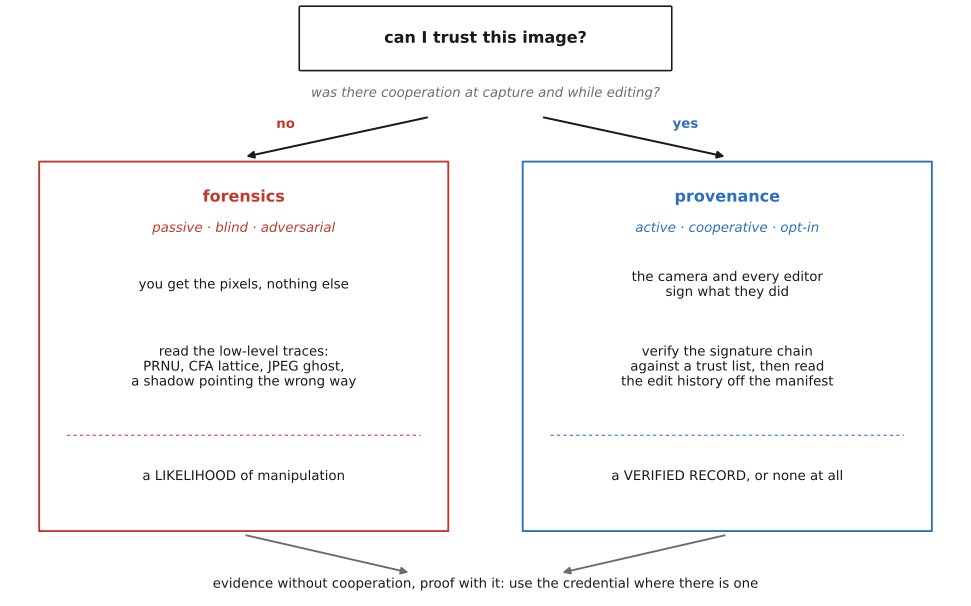
Forensics is a race that, in the limit, you lose. Every detector in Image Forensics reads authenticity in the residual: sensor noise, the demosaicking lattice, the JPEG grid, and lighting cues, and every one of those tells is something a good-enough generator will eventually learn to reproduce. The arms race has no finish line. So at some point the pragmatic move is to stop relying on pixel traces alone and ask a different question entirely: instead of "does this image betray a fake?", ask "what does this image's signed record say, and does it check out?" That is authentication, or provenance, and it relies on a signed record bound to the asset, rather than on statistical clues alone.
At capture, and again at every edit, attach to the image a small, tamper-evident, cryptographically-signed record of what happened: who or what made it, when and where, which tools performed which edits, and whether a generative model was involved. Bind that record to the actual pixels so that changing one without updating the other is detectable. A reader then verifies a signature against a list of trusted signers instead of looking for artifacts. The image carries a signed, inspectable history (Figure 41.2.1).
The catch, which we keep in view for the whole chapter, is that this is opt-in. Provenance can authenticate a signed record and its binding to an asset; it does not establish that every assertion or depicted event is true. Missing credentials provide no such record, and most images, for years to come, will not. A missing or stripped record is not evidence of forgery. So authentication does not replace forensics; it handles the cooperative case cheaply and verifiably, and leaves the uncooperative case to the detectors. The two are complementary, and the fair position is to say so plainly.
41.2.1 From detection to attestation: trustworthy cameras and watermarking⧉
The shift from detection to attestation is older than the deepfake panic that made it urgent. Back in 1993, long before anyone could synthesize a face from a sentence, Friedman proposed the trustworthy digital camera: a camera that holds a private key and digitally signs each photograph at the moment of capture. The signature is computed from the image bytes, so any later edit, even a single changed pixel, breaks it, and a verifier with the camera's public key can tell at a glance whether the file is the untouched original. This is the seed of all provenance: trust derived from cryptography and a known signer, not from a hunt through the pixels.
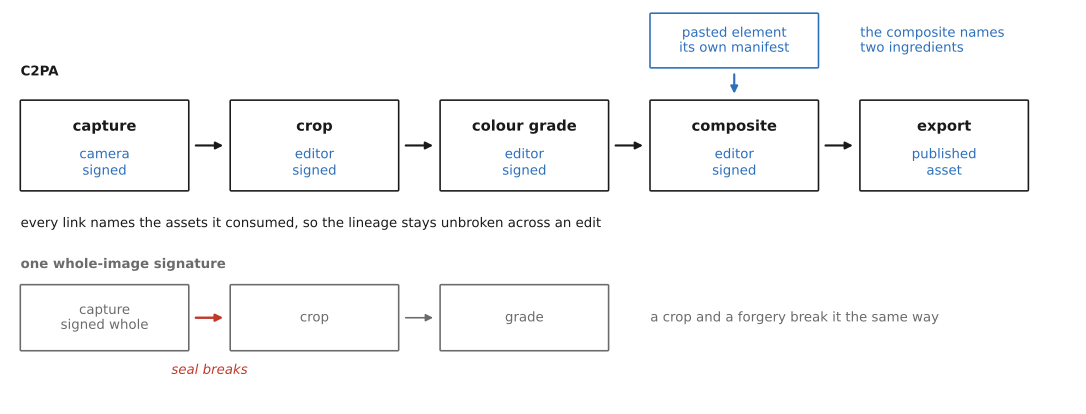
Why, then, if the idea is thirty years old, did your phone not ship with it? Two reasons. First, key management and standards: a signature is only as useful as the infrastructure that lets a stranger check it (public keys, certificates, agreed file formats), and none of that existed at consumer scale. Second, and more fundamentally, a naive whole-image signature is too brittle to be useful. Every edit invalidates it, including the entirely legitimate ones, such as crop, white-balance, or resize for the web. A signature that a routine crop destroys cannot distinguish legitimate editing from tampering; it just says "this is not the exact original," which is true of every published photograph. The modern fix, which C2PA embodies, is to sign not a frozen image but a running record of edits: each step re-signs, and the legitimate crop becomes a signed assertion that a crop happened rather than a broken seal.
The other classical tool is watermarking, the embedding of an imperceptible signal directly in the pixels (the standard reference is Cox, Miller and Bloom). Where a signature rides alongside the image in metadata, a watermark hides inside the pixels, which buys a different property: it can survive operations that strip metadata. Watermarks come in three flavors, and the distinction matters later:
- Robust watermarks are built to survive compression, cropping, resizing, even a screenshot, within the transformations and strengths they were designed to tolerate. They carry a persistent identifier (a content ID, a link to a provenance record) precisely because they are hard to remove.
- Fragile watermarks are the opposite: they break on any edit, by design. A damaged, previously verifiable fragile watermark can indicate alteration, but an absent or undetectable watermark alone does not prove tampering.
- Semi-fragile watermarks split the difference: they tolerate benign processing (a re-save, a mild compression) but aim to detect selected content edits (a paste, a content change), trying to draw the line between format changes and content changes.
Robust watermarking matters later because it lets provenance survive when metadata is gone, which is the whole problem with metadata, and the subject of "durable" credentials below.
41.2.2 C2PA and Content Credentials: the standard⧉
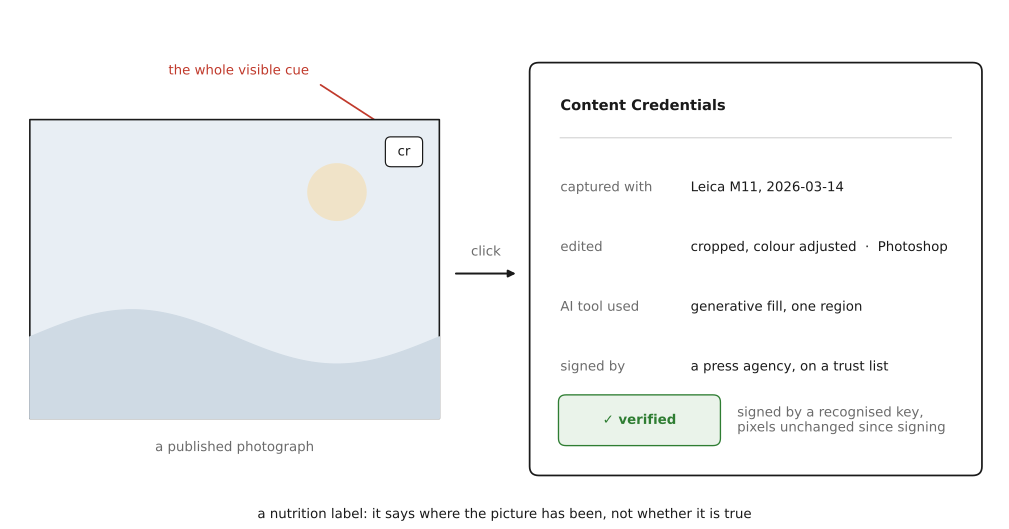
Who and what. The modern standard is C2PA, the Coalition for Content Provenance and Authenticity, developed with participation from the Content Authenticity Initiative (CAI) and Project Origin; these related initiatives are distinct from the standards organization. It is an open technical specification C2PA content-provenance spec, now backed by an unusually broad coalition: Adobe, Microsoft, the BBC, Intel, the camera makers Sony, Nikon, Leica and Canon, Truepic, Google, OpenAI and others. The consumer-facing brand is Content Credentials, pitched as "a nutrition label for digital content": a small, readable summary of where a piece of media came from and what was done to it.
The manifest. The heart of C2PA is the manifest: a tamper-evident, cryptographically-signed bundle attached to (or associated with) the asset. Inside it is a set of assertions, individual statements about the content. An assertion might record the capture device and settings, the date, time and location, the list of edits performed, thumbnails of intermediate states, an AI-generation disclosure (was a generative model used, and how), and who is doing the signing. The assertions are gathered into a claim, and the claim is signed. The crucial binding step is a hash: the manifest records a cryptographic hard binding over specified asset data, with exclusions such as the manifest container itself, so if someone changes covered data without creating a corresponding valid signed record, the stored hash no longer matches the image and the tampering is evident. The signature protects the record; the hash ties the record to the picture.
The claim signature and trust. The claim is signed with a private key whose public counterpart is identified by an X.509 certificate, the same kind that secures web traffic. Verification walks the certificate chain from the signer up to a trust list of accepted issuers (camera vendors, software makers, publishers). Be precise about what a green checkmark means, because it is narrower than people assume. "Verified" means: this manifest was signed by a key we recognize, and the covered asset data match the signed binding, with the relevant trust and validation checks satisfied. It does not mean the content is "true." It says the provenance record is authentic and intact, not that the scene in the photograph is truthful. A carefully staged photo, signed by a real camera, produces a perfectly valid credential. We will return to this gap; it is the most important caveat in the chapter.
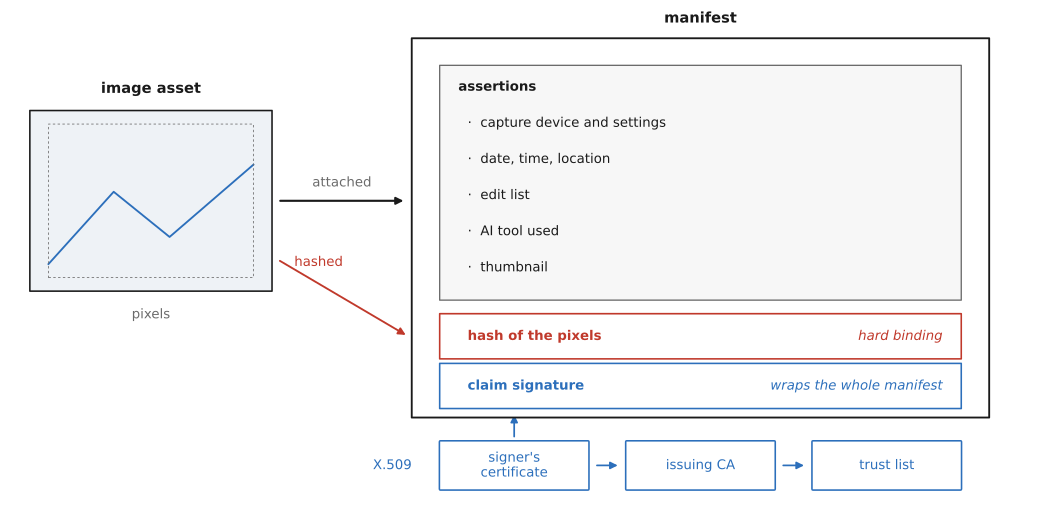
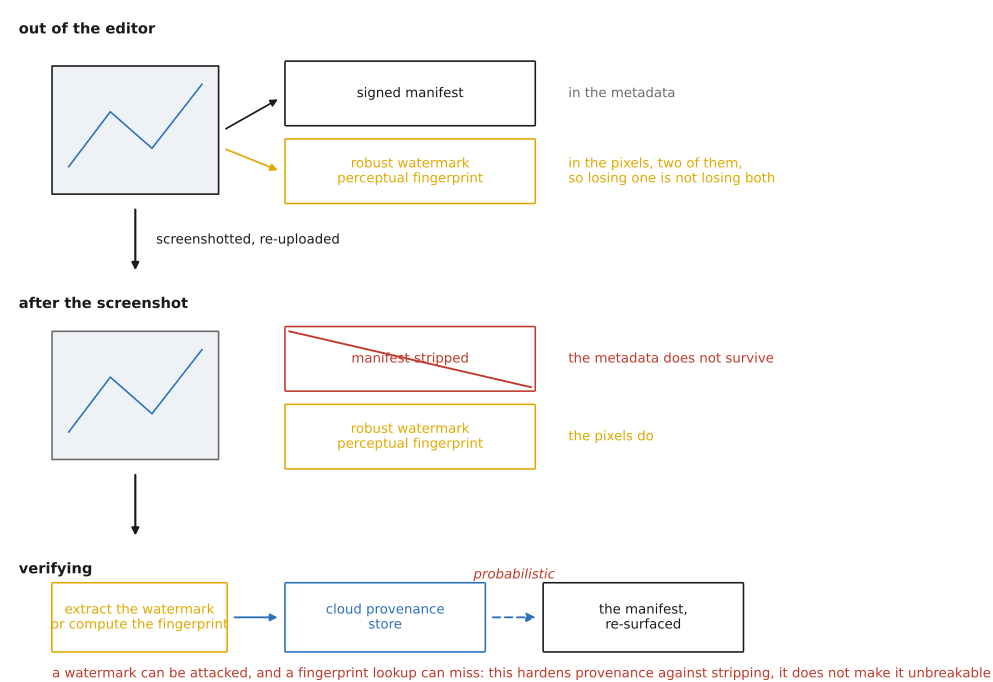
Hard versus soft binding. How tightly is the manifest tied to the pixels? C2PA supports two answers, and you need both. Hard binding uses the cryptographic asset binding just described: exact, unforgiving, and excellent at catching any change, but it has a practical weakness, which is that re-encoding generally changes the covered bytes, and removing an embedded manifest can make its record unavailable. Re-save the JPEG at a different quality, or take a screenshot, and the hash no longer matches the new bytes; the credential is simply gone. Soft binding is the remedy: an imperceptible robust watermark and/or a perceptual fingerprint (a compact, content-derived descriptor compared with stored records), so that a stripped or re-encoded asset can be re-matched to its manifest in a provenance store. Hard binding proves integrity; soft binding restores recoverability after routine internet re-encoding and reposting.
Ingredients and provenance chains. Real editing is not one step but many, and they compose: you open a photo, crop it, color-grade it, paste in an element from a second photo, export. C2PA records this as a chain. Each editing step lists its ingredients (the assets it consumed, which may or may not have credentials of their own) and adds a signed assertion describing what it did. The result is an auditable lineage running from capture all the way to publication, in which you can trace both the edits and the source of each piece. A participating editor can retain available source provenance, but the record need not contain every source or every earlier action. This is exactly the structural upgrade over Friedman's brittle single signature: the legitimate crop is no longer a broken seal but one more sound link in a signed chain.
Durable Content Credentials. A practical objection is: "but I can just screenshot it." A screenshot, a re-upload through a platform that scrubs metadata, a save in a format that does not carry the manifest: any of these strips the credential and leaves a clean-looking, history-less image. C2PA's answer, developed under the Content Authenticity Initiative, is Durable Content Credentials: pair the signed manifest with the soft-binding mechanisms so that all three reinforce each other: the manifest carries the record, an invisible robust watermark may survive a screenshot, and a perceptual fingerprint lets the asset be looked up even if the watermark is degraded. When the metadata is gone, a verifier extracts the watermark or computes the fingerprint, queries a cloud provenance store, and re-surfaces the manifest that the bare file no longer carries. It is not bulletproof. Watermarks can be attacked, and fingerprint matches are probabilistic. But it is the practical, layered response to "you can just screenshot it," which is why robust watermarking matters here.
Verification and UX. None of this matters if a reader cannot check it in one move, so the consumer end is deliberately simple. A supporting viewer can display a small "cr" Content Credentials pin beside an asset; clicking it, or dropping the file into a verifier such as verify.contentauthenticity.org, opens the manifest in human-readable form: the capture device, the sequence of edits, any AI-generation disclosure, and the identity of the signer. The whole design goal is a one-click, plain-language provenance view: the nutrition label, readable at a glance, by someone who has never heard the words "X.509 certificate chain."
41.2.3 AI disclosure, watermarking, and the regulatory push⧉
The most immediate use of all this machinery is disclosing synthetic content. When any image can be generated from a sentence (Chapter 7.4, Generative AI and diffusion), the cleanest place to label it is at the moment of creation, by the maker, rather than later by a detector fighting the arms race of the forensics chapter. So generative tools increasingly attach a C2PA manifest at creation, with an assertion that says, in effect, this was made (or edited) with a generative model. Supported products from Adobe, OpenAI, Microsoft, and Google can attach such disclosures; coverage varies by tool, output type, and export path. This flips synthetic-media labeling from an adversarial detection problem into a cooperative declaration: the generator volunteers what it is, rather than the world reverse-engineering it.
Complementing the metadata assertion is AI watermarking aimed specifically at generated content. Google DeepMind's SynthID Google DeepMind SynthID 2023 embeds an imperceptible watermark directly into a model's output (images, audio, and text) so the generated asset can be recognized as such even with no metadata attached. This is the same robust-watermark idea, now produced at the source by the generator and tuned for its own outputs, and it can complement signed provenance. A detector that recognizes generated content is not automatically a C2PA soft binding: reconnecting an asset to a particular manifest requires an additional identification and lookup mechanism. (Watermarking generated images is its own active research area, tied to the generative models of Chapter 7.3, Deep learning. The watermark has to be robust to downstream editing yet imperceptible and hard to forge.)
Regulation also motivates disclosure. Article 50 of the EU AI Act EU AI Act 2024 distinguishes provider obligations to make certain synthetic outputs machine-detectable from deployer obligations to disclose particular uses, including deepfakes, with qualifications and exceptions. C2PA and watermarking can support transparency workflows, but the law does not make a C2PA credential a universal proof of compliance. The applicable duties depend on the system, use, and legal timetable.
41.2.4 Limits, critiques, and the forensics partnership⧉
Provenance has hard limits, and naming them is part of using it responsibly.
- ⚠️ Opt-in: absence is not guilt. This is the central caveat, and it is easily forgotten. No credential does not mean fake. Most genuine images have none. And a valid credential does not mean "true": it certifies the origin and integrity of the record, not the truthfulness of the scene. A staged or misleading photograph can carry a flawless credential. Provenance answers "where did this file come from and was it altered since," never "is what it shows real."
- ⚠️ Strippable: mitigated, not solved. Plain metadata is removed by a screenshot or a re-upload. Durable Content Credentials (watermark + fingerprint + cloud store) recover it in many cases, but watermarks can be deliberately attacked and fingerprint matches are probabilistic. There is no metadata that an adversary cannot, with effort, strip.
- ⚠️ Governance and trust lists. "Verified" is only as meaningful as the trust list behind it, which raises a governance question with real teeth: who decides which signers are trusted? A centralized trust list concentrates power and is a single point of failure; a compromised signing key lets an attacker mint valid-looking credentials. Security depends on the cryptography, its implementation, protection of signing keys, and the institutions that decide which signers to trust.
- ⚠️ Privacy. Rich provenance is, by construction, a detailed record. That record can leak location, device serial numbers, and identity, the same privacy hazard as EXIF metadata (Chapter 45.13, EXIF and image metadata, the weak, unsigned predecessor of all this). The standard's response is to make most assertions optional and redactable, so a creator can sign "this came from a real camera and was edited thus" without also signing "and here is exactly where I was standing." The right amount of provenance is a genuine tension, not a solved setting.
Authentication provides a checkable record for participating cameras, editors, generators, and publishers. Forensics (Image Forensics) can investigate pixel evidence, including assets without credentials and suspicious claims in credentialed assets. They answer different questions: a valid record identifies what a signer asserted and binds that record to an asset; forensic analysis tests whether the image exhibits particular traces. Neither establishes the truth of a depicted event on its own. For consequential uses, source verification and contextual evidence remain necessary.
Provenance flips the burden from "prove it's fake" to "show me it's real." Forensics must defeat an adversary in the pixels, and as generators improve, that fight gets steadily harder, with no guaranteed win. Provenance lets legitimate actors carry verifiable truth with the asset: a signed manifest, bound to the pixels by a hash (hard binding) and to a watermark and fingerprint so it survives stripping (soft binding), checked in one click against a trust list. Instead of demanding the skeptic disprove every image, we let the creator attest and the viewer check. Neither half is a silver bullet: a credential can be absent or stripped, and absence is not guilt. But together, forensics and authentication move the trust question from a guess to a check. (Pairs with the forensics big lesson (authenticity read in the residual) in Image Forensics; connects to the transparency stance of Chapter 40.2, Ethics of computational photography.)
Recap: big lessons of this chapter
Provenance flips the burden from "prove it's fake" to "show me it's real." Forensics must defeat an adversary in the pixels, and as generators improve, that fight gets steadily harder, with no guaranteed win. Provenance lets legitimate actors carry verifiable truth with the asset: a signed manifest, bound to the pixels by a hash (hard binding) and to a watermark and fingerprint so it survives stripping (soft binding), checked in one click against a trust list. Instead of demanding the skeptic disprove every image, we let the creator attest and the viewer check. Neither half is a silver bullet: a credential can be absent or stripped, and absence is not guilt. But together, forensics and authentication move the trust question from a guess to a check. (Pairs with the forensics big lesson (authenticity read in the residual) in Image Forensics; connects to the transparency stance of Chapter 40.2, Ethics of computational photography.)