35.8 Coherent imaging⧉
Chapter 35.4, Separation of Direct and Global Illumination, split a photograph into direct and global light by subtraction: pattern the illumination and difference two images. There is an older, optical way to keep the direct light and throw away the global, and it does the rejection in the optics, before any pixel is recorded: the confocal principle. Where Nayar's separation says "compute the difference of two patterned images," confocal imaging says "build the instrument so that the desired spatial paths are favored before detection." Confocal selection is not itself coherent imaging: it can work without phase-stable illumination. This chapter compares it with coherence and time gating, then considers imaging through scattering media, where the global component is not a curiosity to be displayed but an obstruction to be defeated.
35.8.1 The confocal principle: rejecting out-of-focus light⧉
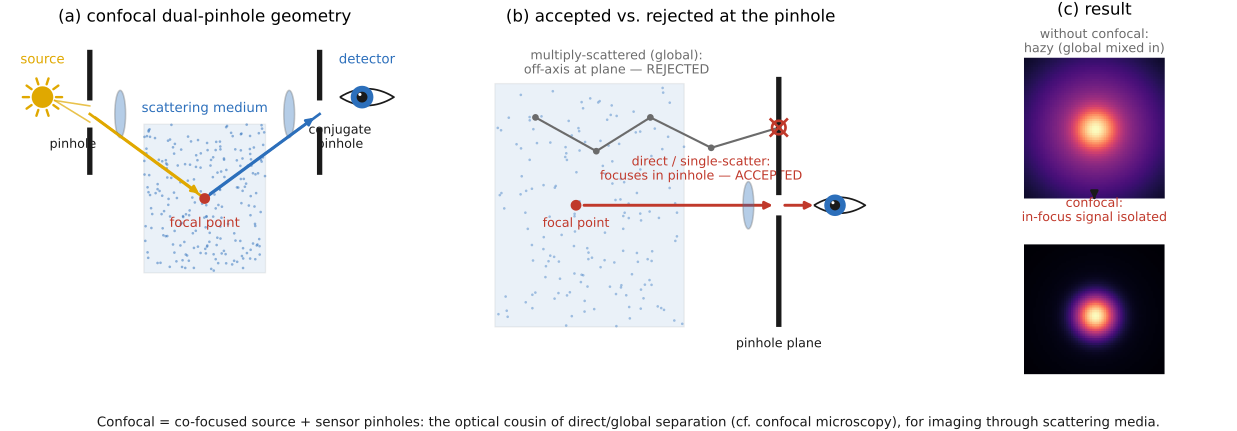
A confocal system focuses the light source onto a single point in the scene through a pinhole, and views that same point with the detector through a second, conjugate pinhole placed at the optically-matched location (Figure 35.8.1). The two pinholes are the whole idea. Consider where light can come from when it reaches the detector:
- Light that single-scattered (or directly reflected) at the focal point travels back along the optical path and arrives focused at the detector pinhole. It passes through and is recorded.
- Light that multiply scattered, having bounced through the medium at other depths and positions before heading toward the detector, arrives at the pinhole plane defocused and off-axis, because it did not originate at the in-focus point. The pinhole attenuates much of it, but multiply scattered paths can still pass through.
So the conjugate-pinhole geometry acts as a spatial filter that accepts in-focus, single-scattered light and rejects out-of-focus, multiply-scattered light. This is exactly the principle of the confocal microscope, which is why confocal microscopy produces such clean optical "sections" of thick translucent specimens: its illumination and detection responses overlap most strongly near the selected focus, suppressing out-of-focus background. Its optical section has finite thickness and residual scattered light. Scan the focal point through the volume and you assemble a stack of clean slices. The same selectivity, applied to macroscopic scenes, favors light consistent with the selected spatial focus, without guaranteeing the same decomposition as Chapter 35.4, Separation of Direct and Global Illumination, but by optical focus instead of computational subtraction.
35.8.2 Seeing through scattering media⧉
Push the confocal idea from a clear specimen to a genuinely turbid one, such as fog, smoke, tissue, milk, or murky water, and it becomes a hard, active research problem. In a scattering medium the global component is overwhelming: a photon leaving the source is far more likely to bounce many times through the medium than to reflect once off the object you care about and come straight back, so the direct signal is buried under a thick multiply-scattered glow. Recovering structure through scattering combines several of this part's threads. Gkioulekas and collaborators investigate interferometric transport probing as well as non-line-of-sight reconstruction; Xin et al.'s 2019 paper specifically develops Fermat paths for the latter Xin et al. 2019 (Fermat paths). Confocal-style gating selects light by where it focused; coherence gating (interferometric methods such as optical coherence tomography) selects light by how far it traveled, using the wave nature of light to measure the interference contribution from paths whose optical delay matches a reference arm within the coherence envelope. The reference delay and optical focus are distinct controls; and time-of-flight / transient gating selects by when it arrived, keeping the early, less-scattered photons and discarding the late, diffuse tail. Their selection criteria differ, but one common use is to favor photons that took a comparatively direct path to the point of interest and reject the many that did not, and modern work mixes them with computational inverse models of scattering to reconstruct structure inside or beyond the medium.
In a two-arm interferometer, the detector records the squared magnitude of the sum of sample and reference fields. Besides their separate intensities, this contains a cross term proportional to their mutual coherence. Varying reference phase or delay isolates that term. Short temporal coherence localizes optical path delay; it does not physically remove every unwanted photon, and multiply scattered paths with similar delay can remain. Optical coherence tomography uses this principle to resolve depth-dependent returns.
This places coherent imaging at the boundary of the book's reach into transient imaging and non-line-of-sight (NLOS) work, including femto-photography watching a light pulse propagate, and looking-around-corners recovering hidden scenes from indirect bounces (the transient/NLOS line of Chapter 35.7, Dual photography and the time-of-flight material; O'Toole et al. 2018's confocal NLOS illuminates and observes the same point on a relay wall. It deliberately measures multiply scattered light from a hidden object rather than simply rejecting that light). The unifying view: a scene's light transport mixes a small amount of useful, clean-path light with a large amount of scattered light, and coherent methods measure interference, while confocal and transient methods provide spatial and temporal selection. They can be combined, but are not interchangeable names for one technique. It is the optical, instrument-side complement to the computational direct/global separation that opened the back half of this part.
35.8.3 Illumination as a designed variable⧉
Flash, strobe, and dark flash control the light's timing and spectrum; illumination-based matting controls the background; direct/global separation controls the light's spatial pattern; light domes control its direction; aesthetic lighting controls its position; dual photography measures and transposes the transport between light and camera; and interferometric imaging probes field correlations, optionally combined with spatial or temporal gating. Every one of them treats the illumination as a designed variable rather than a given. That is the single thesis of COMPUTATIONAL ILLUMINATION, that controlling the light is a second axis of coding as rich as controlling the camera.