35.5 Light domes⧉
The flash chapter controlled one light's timing; the direct/global chapter controlled one light's pattern. This chapter controls a light's direction, exhaustively. The idea is simple: if you can photograph a subject under light coming from every direction, one direction at a time, you have sampled its response to those light sources from the captured viewpoint. Relighting can then reproduce combinations of that illumination basis. The device that does this is a light dome, a sphere or hemisphere studded with hundreds of individually controllable light sources, a subject near its center and one or more cameras looking inward, and the most famous instance is Paul Debevec's light stage.
35.5.1 The reflectance field and one-light-at-a-time capture⧉
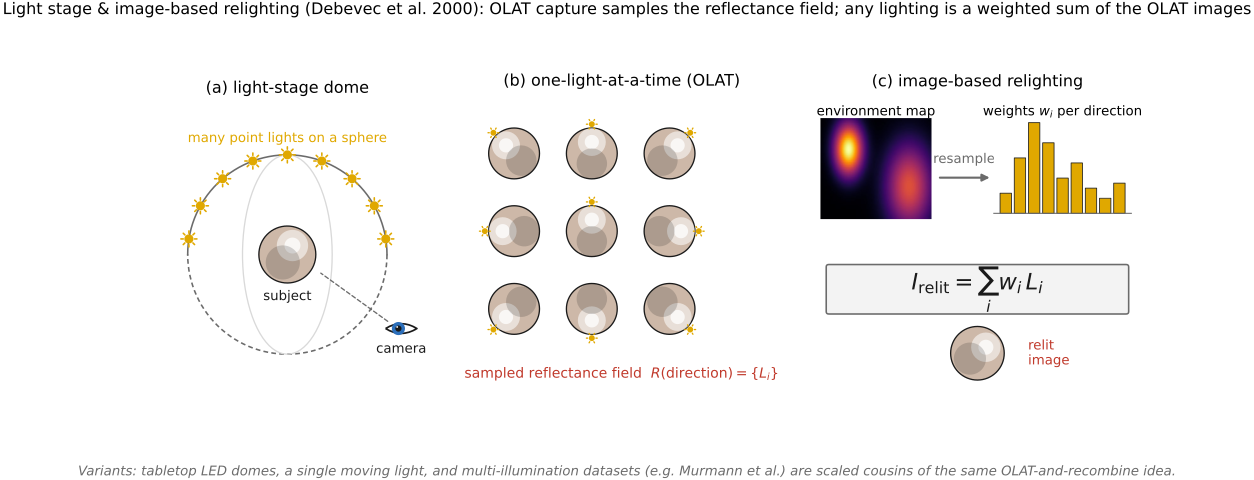
Fix the camera. For a given viewpoint, the subject's appearance is a function of the incoming illumination, and the object that captures this dependence is the reflectance field: for each lighting direction $i$, the image $L_i$ the camera records when the subject is lit only from direction $i$. Measuring it is mechanically blunt and conceptually clean: one light at a time (OLAT): turn on light 1 alone, take a picture; turn on light 2 alone, take a picture; sweep through all the dome's lights, and you have a stack of images, one per direction (Figure 35.5.1). Each captures how the subject's surface points reflect light arriving from that one direction, including shading, cast shadows, and specular highlights, all rendered for that single source. The stack is the (fixed-view) reflectance field, a discrete sampling of the subject's response to directional light.
Debevec, Hawkins, Tchou, Duiker, Sarokin and Sagar (2000) built this for human faces. Their light stage spun (or, in later versions, electronically scanned) a light around the face while a camera captured the OLAT stack in a few seconds, fast enough that the subject could hold still. From that stack they could not only relight the face but also fit reflectance models, separating the sharp specular response of skin from its softer subsurface diffuse response (related to, but different from, the direct/global distinction of Chapter 35.4, Separation of Direct and Global Illumination: surface reflection need not be specular, and diffuse appearance need not all arise from long indirect paths), and estimating surface normals, which is why the light stage became the foundation of photorealistic digital humans in visual effects: capture a real actor's reflectance field, then render their face under the lighting of any virtual scene.
35.5.2 Relighting by linear combination⧉
The relighting rests on one fact: light transport is linear. Radiance adds. If the subject lit by source $A$ gives image $L_A$ and lit by source $B$ gives image $L_B$, then the subject lit by both at once gives exactly $L_A + L_B$. This holds for linear, unsaturated, radiometrically calibrated measurements of an unchanged scene. Ambient offsets must be subtracted before summing, and noise statistics need not match those of one simultaneous exposure. Scale it: lighting source $i$ at intensity $w_i$ gives $w_i L_i$. So to render the subject under any target illumination, decompose that illumination into the dome's directions and assign each direction $i$ a weight $w_i$ (its intensity in the target lighting), and form the weighted sum of the OLAT images:
That is the entire relighting operation: a linear combination of pictures you already took (Figure 35.5.1). Want the face lit by a sunset? Take an environment map of that sunset (a panoramic HDR image of the incident light, as in the image-based-lighting tradition), read off how much light comes from each direction, use those as the weights $w_i$, and sum. The subject is now seated photorealistically in that environment, with correct shadows, highlights, and subsurface glow, without ever having been there, to the extent that the finite light basis approximates the target illumination. Sharp sources, near-field variation, source spectra, and uncaptured directions can reveal the approximation. This is image-based relighting: relighting by re-mixing measurements, no reflectance model or physics simulation required. (The same linearity is what lets Chapter 35.4, Separation of Direct and Global Illumination subtract two patterned images, and what lets HDR combine exposure-normalized measurements: light is linear, and this part exploits it throughout.)
35.5.3 Scaling down: tabletop LED domes⧉
The room-scale light stage has a bench-scale sibling. A tabletop light dome is a small hemisphere studded with controllable LEDs over an object on a stand. It is the same idea at smaller scale. Capture the object under each LED one at a time and you get its per-point OLAT stack, from which you can relight it, do photometric stereo (recover surface normals from how shading changes with light direction), and fit BRDF / normal maps for material capture. These domes are the workhorse of small-object reflectance acquisition for coins, cultural-heritage artifacts, materials samples, and manufactured parts, where you want the object's full appearance under arbitrary lighting for inspection, archiving, or insertion into a render. The physics and the math are identical to the light stage; only the scale and the actuator (cheap LEDs instead of studio strobes) change.
35.5.4 Scaling out: the dome taken into the wild⧉
The main limitation is that the dome is a laboratory setup. Murmann et al.'s multi-illumination dataset (Murmann et al. 2019) asks what happens if you take the OLAT principle into ordinary rooms. Instead of a fixed dome, they use a single flash bounced to a grid of directions (a programmable bounce, the technique of Chapter 35.6, Automatic aesthetic lighting), capturing roughly 25 illumination conditions per scene across 1000 real indoor scenes, as a no-dome stand-in for one-light-at-a-time capture, out of the lab and at the scale a learning algorithm needs. The dataset provides training data. Linear combinations of its calibrated bounce-light images still correspond to combinations of those measured illuminations, but 25 room-dependent conditions do not span arbitrary target lighting. A network trained on these multi-illumination scenes learns to do single-image relighting, illumination estimation, and reflectance separation from one ordinary photograph, predicting what a scene would look like under different light without ever having a dome around it. The dome's expensive, exhaustive measurement becomes a learned prior: capture the reflectance field once, for a thousand scenes, and let a network generalize the relighting to scenes it never measured. This repeats a pattern already seen elsewhere in the book: a hand-measured quantity becomes a learned one, here for the reflectance field itself.
35.5.5 The found dome: the eye⧉
There is a passive mirror image of this whole chapter. A light dome actively controls the illumination and records the response. But a curved, glossy surface in the scene, especially a person's eye, passively records the surrounding illumination, because the cornea is a spherical mirror reflecting a broad, but partial and occluded, view of the environment toward the camera. Nishino and Nayar's Eyes for Relighting (Nishino and Nayar 2004) reads the environment map straight off the reflection in a subject's eye and uses it to relight or to insert virtual objects consistently. It is a found light probe instead of a built one. The relationship is complementary: the dome controls the light and measures the subject's response to each direction; the eye merely records the light that happened to be there. The dome measures appearance responses to controlled illumination, while the eye provides evidence about the incident illumination; one paid for it with hardware, the other found it in the scene. That passive route is the subject of Chapter 38.2, Reflections in the eye (see Reflections in the eye#Eyes for relighting).