32.2 Bullet time⧉
The previous chapter, Chapter 32.1, Camera arrays: one rig, many instruments, used a grid of synchronized cameras for its aperture, summing or merging frames to synthesize one giant lens. There is another way to use the very same array, and it puts the rig to work along a different dimension entirely: its angular axis.
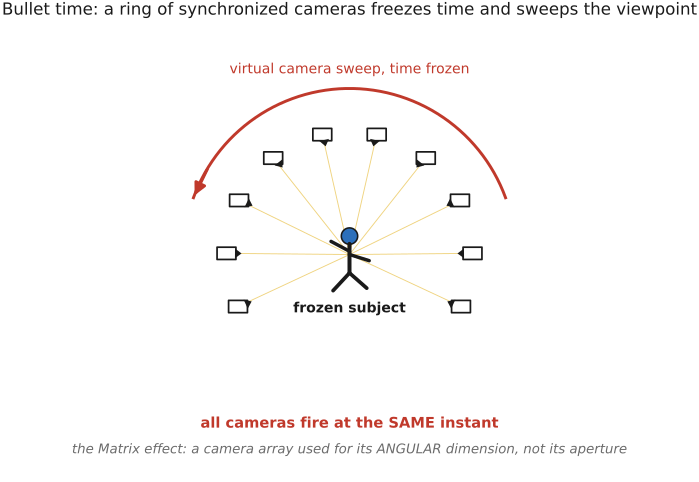
Bullet time, the effect made famous by The Matrix, fires a ring or arc of synchronized cameras at one single instant, freezing the moment, and then plays the frames back not in time order but in spatial order, sweeping the viewpoint around the frozen subject. The subject hangs motionless in mid-air while the camera appears to orbit it. Each camera holds the same frozen moment from its own viewpoint, so walking through the frames in spatial sequence shows that one instant from a moving camera.
This is the same camera array, but used for its angular dimension rather than its aperture. Synthetic aperture sums the views to build one giant lens; bullet time steps through the views one at a time to build an orbiting viewpoint. In the simplest playback no views are fused; production versions can interpolate between cameras and composite backgrounds. Staggered firing also permits slow motion rather than a completely frozen instant. The array is simply a way to occupy many viewpoints simultaneously so that a single instant can be seen from all of them. It shows that "many apertures" is really "many samples of the 4-D light field," and what you do with those samples is open: average them (synthetic aperture), interleave them in time (Chapter 32.1, Camera arrays: one rig, many instruments), or walk through them in space (bullet time).