28.10 Artistic projects with photo collections⧉
The methods in this part were built to use collections. Photomosaics tile one image out of thousands; retrieval finds the matching photo; curation throws the bad ones away; Photo Tourism and the photobio turn a heap of snapshots into a navigable space. This chapter is about the projects (fine-art ones) that take the collection itself as the object, and ask what it means as a whole. A photo collection has properties that exist only at the level of the set. Average a genre and its hidden rulebook appears; estimate the density of a place's photographs and the cliché is the peak. Two threads, one idea: both of them this part's retrieval, averaging, and curation tools turned to an expressive end rather than a practical one. (The perception-study cousin of these projects, Seeing Faces in Things, has its own chapter next: Chapter 28.11, Pareidolia.)
28.10.1 Statistical collage: Salavon⧉
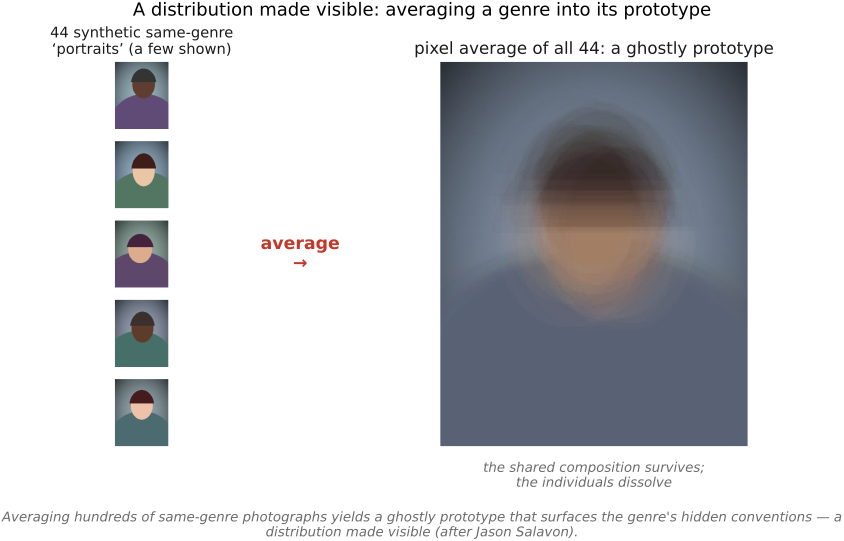
The artist Jason Salavon (salavon.com) treats a set of photographs as the work rather than any single frame. His signature move is to average hundreds of same-genre images into one image, such as newspaper wedding announcements, real-estate listing photos, or Playboy centerfolds tabulated by decade, and the result is an uncanny, ghostly prototype (Figure 28.10.1). Each contributing photograph dissolves into a soft haze, but what survives the averaging is precisely what every photograph in the genre shares: the standard pose, the standard framing, the standard lighting, the bride to the left and the groom to the right, the living-room-then-kitchen sequence of the home listing. The blur is not a defect; it is the genre's variation averaging out, leaving its convention visible. A statistical distribution that no individual photograph contains is rendered as a single picture you can hang on a wall.
The reason this works is the reason it belongs in this part rather than in an art-history one. Averaging a stack of aligned images is exactly the operation behind Chapter 13.2, Denoising by averaging: independent fluctuations shrink toward their mean while the common signal stays. In denoising the "signal" is the true scene and the "noise" is sensor randomness; in a Salavon average the "signal" is the genre's shared template and the "noise" is each couple's, each house's, each decade's particularity. The arithmetic is the same, but the interpretation flips: the averaging removes identity, and that removal is the work's subject. Salavon also sorts and recombines: tiling images by color, reorganizing a photograph's own pixels by hue, building grids that read as one thing far off and as a thousand things up close: the same perceptual fusion that makes Chapter 28.1, Photo Mosaics resolve at a distance, and the same appearance-similarity that drives Chapter 28.2, Retrieval, here used as an aesthetic act rather than a search.
There is also a perceptual consequence, and it ties this thread to the others. The averaged face or scene tends to look not just typical but uncannily attractive and prototypical, a known effect in Human vision, where averaged faces are rated as more appealing than most of the faces that went into them. The collection, averaged, produces a hyper-normal exemplar that exists nowhere in the world. That is the cleanest possible demonstration of the emergent-content thesis: the prototype is real, it is computed straightforwardly from the set, and yet it is no photograph that was ever taken.
28.10.2 Anticliché camera⧉
The cliché is the most-photographed view: the postcard angle on the Eiffel Tower, the exact overlook everyone shoots at sunset, the framing that millions of phones have already captured. The anticliché camera is the contrarian inversion of Chapter 28.3, Auto curation. Where auto-curation asks "is this a good, canonical shot?" and keeps the frame that best matches the prototype, the anticliché camera asks the opposite question, whether this is unlike what everyone already has, and steers you toward the un-photographed angle, the overlooked detail, the view no one bothered to take. It is the photographic cousin of the blind / candid camera ideas elsewhere in the book: both are machines that decide what to shoot, one optimizing for the canonical and the other against it.
One possible computational version uses a density estimate as a novelty score. Score a candidate frame against a distribution of existing photographs of the same place, whether a personal collection or a geotagged web corpus of the millions of shots already taken there, using the retrieval descriptors of Chapter 28.2, Retrieval. This is not the usual curation objective: aesthetic ratings and diversity need not favor dense regions of descriptor space. The anticliché camera rewards low density instead: a frame whose nearest neighbors in the collection are few and far, a view the crowd has missed. Novelty rather than canonicality becomes the score, with retrieval and density estimation put to a deliberately contrarian aesthetic end.
The thread matters because it exposes a bias the rest of the part quietly carries. A learned aesthetic scorer can inherit a community’s preferences and undervalue unfamiliar work. But this is a dataset-dependent tendency, not an equivalence between aesthetic quality and frequency. The anticliché camera is the clear-eyed counterweight: a reminder to distinguish learned approval from novelty, and that an interesting photograph is often the one that is atypical of it. The same emergent property (the place's distribution of photographs) is read here not for its peak (the cliché) but for its valleys (less represented views, which may be interesting, poor photographs, or simply missing from the database).
A collection has emergent content that no single photograph in it holds. Average a genre and its hidden rulebook (pose, framing, lighting) appears as a ghostly prototype that was never photographed. Estimate the density of a place's pictures and the cliché is the peak, the worthwhile shot a valley. Each project is this part's own machinery, alignment-then-average (Chapter 28.1, Photo Mosaics, Chapter 13.2, Denoising by averaging) and retrieval-and-density (Chapter 28.2, Retrieval, Chapter 28.3, Auto curation), turned from a practical means into an expressive or critical end. The recurring move of the whole part has been the data is the prior; the recurring move of this chapter is its mirror image: the data is the message. What the set knows, no element of it knows alone. (The next chapter, Chapter 28.11, Pareidolia, turns the same lens on perception: a collection of accidental faces that measures the viewer rather than the world.)
Recap: big lessons of this chapter
A collection has emergent content that no single photograph in it holds. Average a genre and its hidden rulebook (pose, framing, lighting) appears as a ghostly prototype that was never photographed. Estimate the density of a place's pictures and the cliché is the peak, the worthwhile shot a valley. Each project is this part's own machinery, alignment-then-average (Chapter 28.1, Photo Mosaics, Chapter 13.2, Denoising by averaging) and retrieval-and-density (Chapter 28.2, Retrieval, Chapter 28.3, Auto curation), turned from a practical means into an expressive or critical end. The recurring move of the whole part has been the data is the prior; the recurring move of this chapter is its mirror image: the data is the message. What the set knows, no element of it knows alone. (The next chapter, Chapter 28.11, Pareidolia, turns the same lens on perception: a collection of accidental faces that measures the viewer rather than the world.)