17.6 HDR+ and burst imaging on phones⧉
The published HDR+ pipeline captures a burst at a common exposure, chosen to protect important highlights, and combines raw frames before demosaicking (Hasinoff et al. 2016). Repeated measurements reduce noise in shadows that look dark in an individual frame. This is a specific capture design, not a description of every phone mode. Night Sight extends burst imaging with motion-aware exposure choices for low light (Liba et al. 2019).
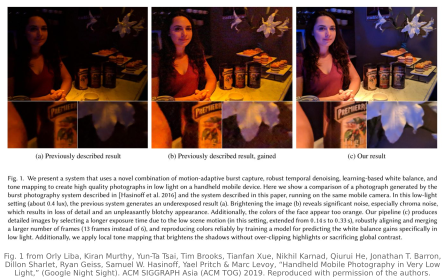
Fixed exposure simplifies comparison between frames. Short integration reduces motion blur, while repeated frames collect additional photons. The merge must still handle registration errors, moving subjects and regions with insufficient signal.
These systems connect several parts of the book through a shared engineering investment. HDR+ uses repeated short exposures to improve shadow precision while protecting highlights. Night Sight adapts capture to very low light and motion. Super Res Zoom additionally exploits shifted sampling to resolve fine structure. Alignment, rejection and raw-domain reconstruction recur across them, even though the capture policies and fusion algorithms differ. That common foundation explains why a camera improvement may affect noise, dynamic range and detail together.
17.6.1 Why a phone shoots a burst, and why it underexposes⧉
A handheld camera faces both limited light collection and motion. Longer exposures improve photon statistics but can blur, while shorter exposures require more frames to collect the same total light and pay read noise repeatedly. Capture policy therefore depends on scene motion, illumination and sensor characteristics.
HDR+ uses equal-exposure raw frames to reduce noise while preserving the highlight range of its chosen short exposure. It improves usable shadow range; it does not extend the saturation threshold by measuring brighter highlights at a second exposure. This differs from a conventional bracket, whose frames cover different radiance intervals.
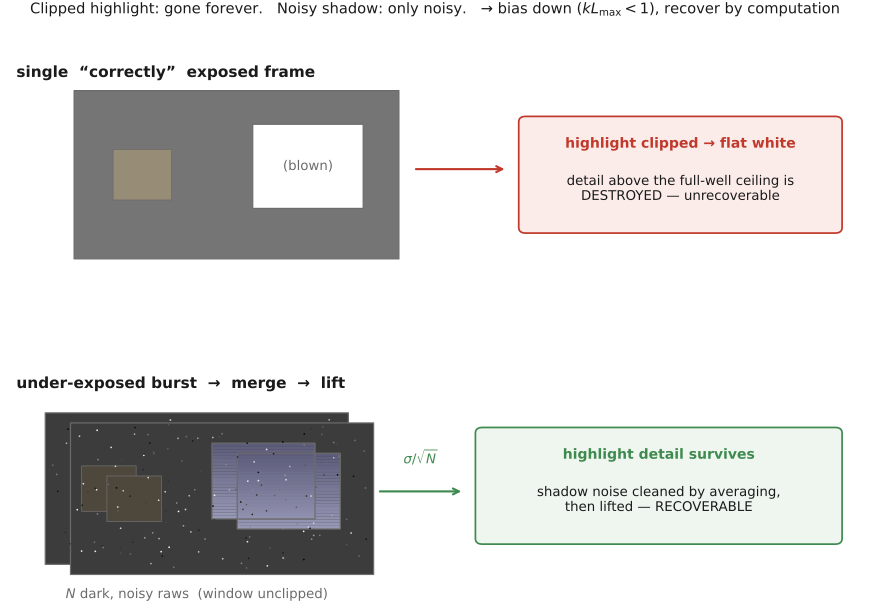
An exposure chosen to protect highlights may leave noisy shadows. Independent repeated measurements can reduce that uncertainty, whereas a highlight clipped in every frame remains only bounded from below. In a normalized noiseless model, protecting a chosen maximum radiance requires
Noise and uncertain metering require a margin; transient or deliberately unprotected highlights may still clip. Extra frames do not guarantee usable shadows under a fixed time budget. Choose which highlights matter rather than imposing an unconditional no-clipping rule.
The burst is L13.1 on a phone: capture many identical frames now and defer the noise-versus-range tradeoff to a downstream merge. (L13.1 first appears in this part's introduction; the light-field/plenoptic camera (Part 33, Computational optics and coded imaging) is the same idea for the focus/viewpoint axis, the special case.)
Noise-optimal bracket design (Hasinoff et al. 2010) and HDR+ both account for noise, but they solve different capture problems. A uniform short burst is not the universal optimum of the earlier shutter/ISO optimization. Motion, latency and available buffering also influence the deployed design.
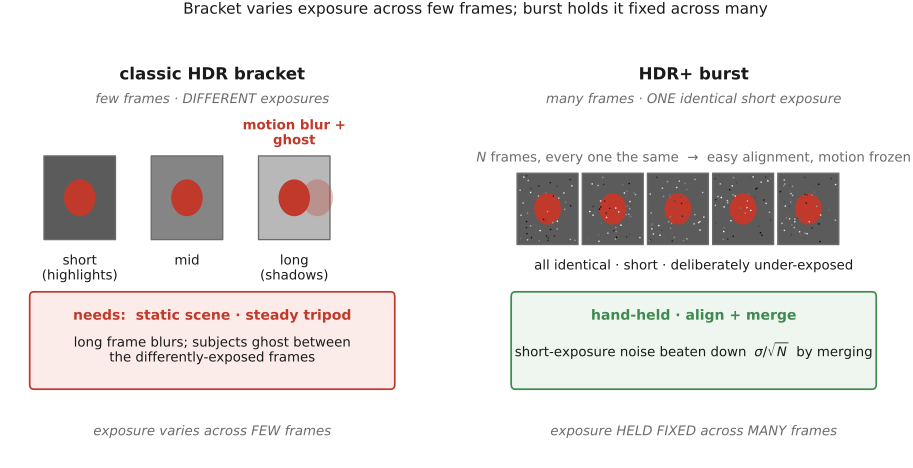
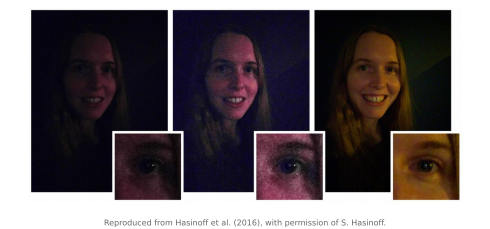
The paper's own teaser shows what the underexposed burst buys at the hardest extreme: a near-dark, hand-held portrait.
Compare a shadow patch with a lamp that is saturated in every frame. The shadow measurements can vary around a useful underlying signal, so combining independent observations can make that signal more precise. The clipped lamp values do not vary with how far the true signal exceeded the ceiling; averaging the ceiling repeatedly supplies no measurement of that excess. This asymmetry motivates reserving highlight headroom and paying some of the cost as shadow noise. It does not make arbitrarily short exposures desirable: read noise, total capture time, rejected frames, and values lost below the usable floor still constrain what the burst can recover.
17.6.2 The HDR+ pipeline: align and robust-merge in raw⧉
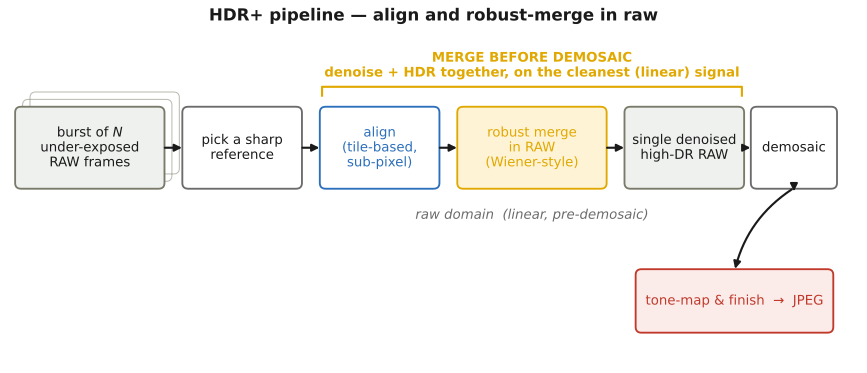
Choose a reference, estimate local alignment and combine consistent raw samples. Maintain CFA phase, black-level and gain conventions. After raw merging, demosaic and render the result. The exact interpolation and alignment precision depend on the implementation; the original HDR+ and later burst-super-resolution pipelines should not be conflated.
Raw merging retains access to sensor-domain measurements and a calibrated noise model. Interpolation and merging can still introduce correlations. Joint reconstruction or a suitably modeled RGB pipeline are alternatives; pre-demosaic processing is a design choice rather than a universal optimality result.
A simplified spatial-weighted model illustrates exposure normalization, although the actual HDR+ merge operates on tile transforms:
HDR+ uses a transform-domain merge on aligned tiles, with shrinkage informed by estimated noise and differences from the reference. This differs from simply assigning a per-pixel inverse-variance weight. Large inconsistencies reduce temporal averaging; a reference fallback sacrifices noise reduction to limit motion artifacts. Equal averaging provides a useful independent-noise reference case:
This approximation assumes equal noise and independent, correctly registered samples. Rejection, adaptive filtering and correlated errors change it.
Local alignment handles some motion that a global transform misses. Occlusions and varying exposure blur remain difficult, so the merge needs confidence and fallback even after alignment. For a merged image, inspect both detail and the spatial variation in noise rather than reporting burst length as the number of useful samples everywhere.
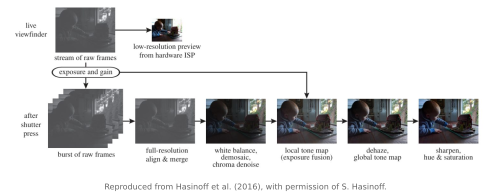
The original paper draws the same flow on a real scene, and shows both why alignment is decisive and how the finished pipeline compares to a conventional ISP.
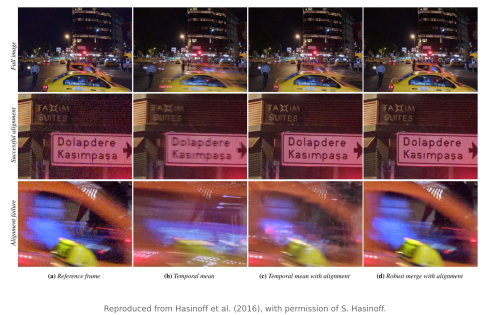
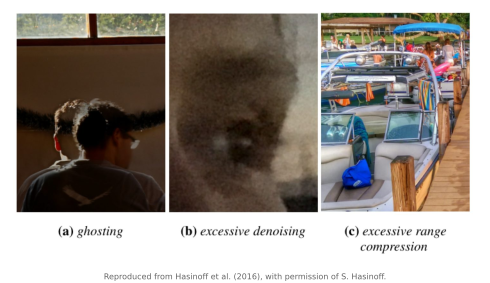
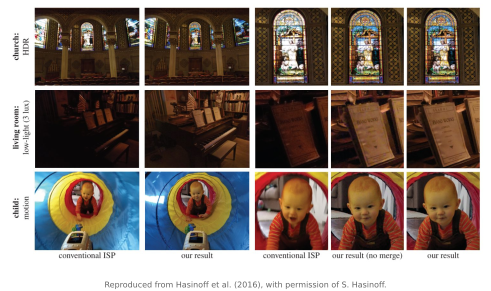
Tile alignment makes a local motion approximation. A tile on a stationary wall and a tile on a moving arm can choose different displacements, whereas one global translation must compromise between them. But a tile straddling the arm boundary contains two motions. No single displacement aligns both, and a newly revealed background patch has no corresponding foreground sample to average. The robust merge handles some of these failures by reducing inconsistent contributions. Where fewer observations survive, more noise remains. The alignment and merge therefore need to be understood together: locally different noise levels can be the visible consequence of preserving moving structure.
17.6.3 From burst HDR to burst super-resolution⧉
Wronski and colleagues reconstruct color from a shifted raw burst using a fusion model designed for nonuniform sampling (Wronski et al. 2019). Burst super-resolution requires more than changing output size: it needs accurate sampling geometry, usable subpixel phases and a reconstruction rule matched to those samples.
Hand motion can place scene samples at complementary subpixel locations. Accumulating them on a finer grid can improve resolution when the optics retain useful high-frequency information. Repeated or inaccurate offsets provide less benefit, and independently moving content may require a reference fallback (Chapter 14.2, Multi-frame super-resolution).
Different offsets give aliased components different phases, supplying additional constraints. Recovery depends on rank, optical transfer and noise; image priors still influence the answer. Raw burst reconstruction can jointly perform color reconstruction, avoiding a separate single-frame demosaicking stage (Chapter 14.3, Learned burst methods).
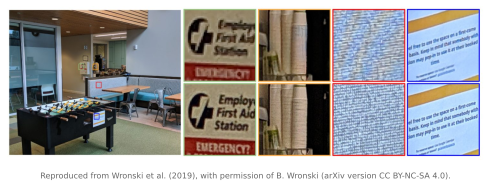
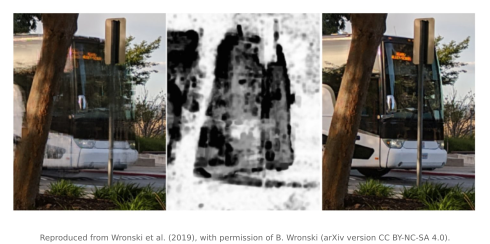
HDR merging, burst denoising and burst super-resolution share registration and combination machinery. Their forward models and capture objectives differ. Preserve those distinctions when comparing quality, capture time and processing cost.
Recap: big lessons of this chapter
The burst is L13.1 on a phone: capture many identical frames now and defer the noise-versus-range tradeoff to a downstream merge. (L13.1 first appears in this part's introduction; the light-field/plenoptic camera (Part 33, Computational optics and coded imaging) is the same idea for the focus/viewpoint axis, the special case.)