💬Comments welcome. To leave a note, select any text and click the note / highlight button that pops up — or open the panel with the tab at the top-right (‹). Notes are visible only inside our private review group.
Computational Photography, an AI-powered Slopendium — 38 Revealing the invisible
expand to📖 Full book outline1 parts · 8 chapters · 34 sections · 5 figures embedded · 0 placeholders · double-click a figure to enlarge
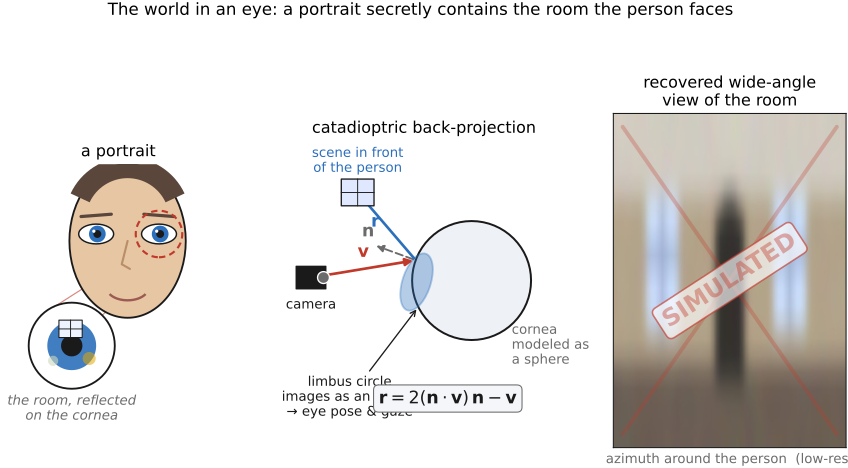
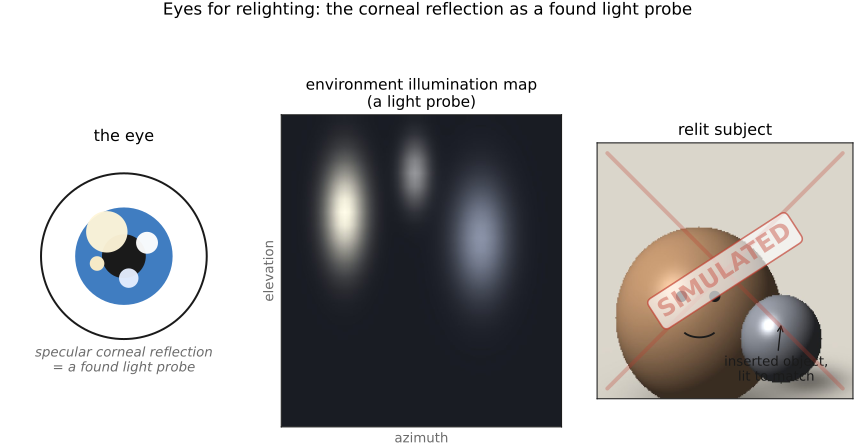
• the same corneal reflection, used not as a *picture of the room* but as a **light probe**: the eye captures a wide-FOV sample of the **environment illumination**, which can be turned into an **environment map** and used to **relight** the face, or to **insert a synthetic object** lit consistently with the real scene — all from an ordinary portrait, no chrome-ball probe required (Nishino & Nayar, *Eyes for Relighting*, 2004) [@nishino-nayar-2004-relighting].
• the eye is thus a **found light dome**: where a [[Light domes|light dome]] *controls* illumination from every direction to capture a reflectance field, the eye *passively records* the illumination already present — the read-it-out counterpart of the dome's measure-it-out. (Cross-ref [[Light domes]].)
• caveat: the probe is low-resolution and frontal-biased (you only see the light the cornea reflects toward the camera), and you must first **separate the specular corneal reflection from the iris texture** beneath it (a specular/diffuse split — cross-ref [[Polarization imaging]]).
• **the setup**: no laser, no time-of-flight — only **ambient light** from the hidden scene spilling onto a **relay surface** you can see (a floor, a wall). An **accidental occluder** — a vertical **edge**, a **doorframe**, an opaque object — selectively blocks rays, so different parts of the visible surface "see" different parts of the hidden region. The occluder is what makes the problem solvable: a fully open scene blurs everything together.
• **occluder as a crude lens / coded aperture**: the edge or object **modulates** the hidden light, much like a **pinhole or coded aperture** modulates a normal scene. The light measured on the visible surface is (hidden image) **convolved** with the occluder's transfer/visibility function — so recovering the hidden image is a **deconvolution / inverse problem**, where the **occluder geometry** is itself part of the unknown.
• **corner camera (1-D)**: at a wall corner, the vertical edge acts as a 1-D **angular** aperture — the **penumbra** gradient on the floor encodes a 1-D image of the hidden scene **vs. angle around the corner**; differencing/inverting the penumbra yields a 1-D **video** of motion in the hidden room (Bouman et al. 2017). Cross-ref `[[#Corner camera]]`.
• **computational periscopy (2-D, single photo)**: with an **opaque occluder** of known or estimated shape between the hidden scene and the wall, a **single photograph** of the wall contains enough structure to **invert** for a full **2-D image** of the hidden scene — the occluder's cast shadow plays the role of a coded aperture (Saunders, Murray-Bruce & Goyal 2019).
• **passive vs active — the contrast**: **active** NLOS (above) sends a controlled light pulse and times its return, buying strong signal and depth at the cost of specialized hardware; **passive** NLOS is **photon-starved and ill-conditioned** (faint penumbra signal, unknown occluder), trading robustness for working with **ordinary cameras and existing light** — and it degrades gracefully as the accidental occluder becomes less ideal.