BookNotesSlidesP-sets Syllabusdraft · v0.2.49.1
💬Comments welcome. To leave a note, select any text and click the note / highlight button that pops up — or open the panel with the tab at the top-right (‹). Notes are visible only inside our private review group.
Computational Photography, an AI-powered Slopendium — 04 Color spaces and color technology
expand to📖 Full book outline1 parts · 10 chapters · 91 sections · 1 figures embedded · 1 placeholders · double-click a figure to enlarge
▸Part 4 COLOR SPACES AND COLOR TECHNOLOGY⧉
<!--uid: color-spaces-and-color-technology-->
This part turns the perception of the previous part into technology. Once color is three cone responses, how do we measure it, encode it, capture it on a sensor that on its own cannot tell colors apart, reproduce it faithfully across devices, and keep it consistent from camera to print? These are the questions every color pipeline answers before it makes a picture.
• **Linear color reproduction and CIE XYZ** — measuring color (CIE XYZ), the chromaticity diagram, the type-system discipline, and linear RGB.
• **White balance and white point** — the two different "whites," chromatic adaptation, the Bradford and CAT16 transforms, and spectral sharpening.
• **Encoding: linear, gamma or log** — how the three numbers are stored as bits; why "gamma correction" is a misnomer; gamma as encoding vs as a contrast operator; what gamma buys and costs.
• **RGB color spaces** — why a family rather than one: primaries, gamut, and bit budget; sRGB / Adobe RGB / Display P3 / Rec.2020 / ProPhoto.
• **Advanced color: opponents, perceptually-uniform, and preferred** — the opponent split, the tensions pulled together, cylindrical UI spaces (HSV/HSL), perceptually-uniform spaces (CIELAB, Oklab), and preferred / memory colors (skin, sky).
• **Sensing color: multiplexing strategies** — how a monochrome sensor is made to see color: Bayer mosaic, 3-CCD prisms, stacked and dispersive sensors.
• **Synthesizing color** — reproducing color from primaries: additive vs subtractive, gamut mapping, displays, printing, color film, simple display calibration.
• **Recap: the full color pipeline, color management and ICC** — the end-to-end chain, the ICC machinery, and soft proofing.
• **Color TLDR** — the whole part in one page: all color spaces are coordinates on one 3-D space, converted by small matrices plus a few curves; plus a survey of what real software does and a practical what-space-for-what-task reference.
• **Color terms** — a reference glossary for the whole part (placed last): the color vocabulary grouped by what it measures (radiometry, photometry, colorimetry, color appearance, color spaces and encoding), plus tables of the chronic confusions and the terms that mean different things in different chapters.
In a hurry? Skip straight to the **Color TLDR** at the end of the part: it is the whole story in one page, with a decision table for choosing a space and a tour of what real pipelines actually do with color.
▸4.1 Linear color reproduction and CIE XYZ⧉
▸4.2 White balance and white point⧉
4.2.3 How do you know the illuminant?⧉
4.2.4 White balance with mixed illuminant⧉
▸4.3 Encoding: linear, gamma or log⧉
4.3.3 Color and encoding in real pipelines⧉
4.3.4 What gamma buys, and what it costs⧉
4.3.5 Gamma the contrast operator (gamma adjustment)⧉
4.3.7 Log encoding⧉
4.3.8 PQ, the perceptual quantizer⧉
4.3.9 HDR encoding⧉
▸4.4 RGB color spaces⧉
4.4.1 Two different words for impossible⧉
4.4.2 Reference: primaries, matrices, and transfer functions⧉
▸4.5 Advanced color: opponents, perceptually-uniform, and preferred⧉
4.5.5 Recap: a zoo of color spaces⧉
4.5.6 Color appearance models⧉
4.5.8 Color names and the prototypes behind them⧉
▸4.6 Sensing color: multiplexing strategies⧉
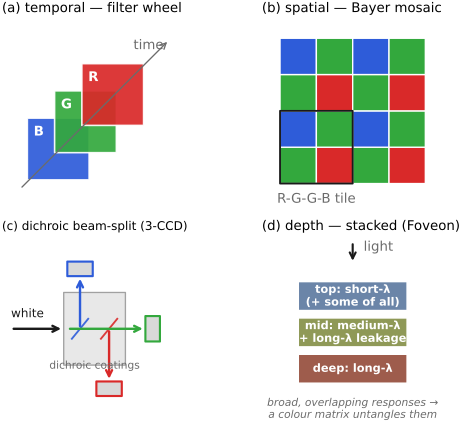
fig-color-multiplexing
fig-color-multiplexing · four color-sensing multiplexing strategies: temporal, spatial (Bayer), **dichroic 3-CCD** beam-split, depth (Foveon, with realistic broad/overlapping layer colors + color-matrix note) 🟨
⬜ figure not yet created
Prokudin-Gorskii color fringes fig-prokudin-gorskii
• four ways to turn a monochrome sensor into a color one: time, space (Bayer), prism (3-CCD), depth (Foveon), plus spectral/Lippmann and hybrids
• trichromatic vs spectral (multispectral) capture
4.6.1 Multiplexing in time⧉
4.6.2 Multiplexing in space: the color filter array⧉
4.6.3 Multiplexing across separate sensors: the beam-splitter⧉
4.6.4 Multiplexing per pixel by dispersion: color routers and nano-prisms⧉
4.6.5 Multiplexing per pixel by tunable absorbers: quantum dots⧉
4.6.6 Multiplexing in depth: stacked photodiodes⧉
4.6.7 Hybrid strategies⧉
4.6.8 Beyond trichromatic capture: full spectrum and multispectral⧉
4.6.9 Spectral sensitivity: matching the eye, catching photons, and white balance⧉
▸4.7 Synthesizing color⧉
▸4.8 Recap: the full color pipeline, color management and ICC⧉
▸4.9 Color TLDR⧉
• one 3-D space (human vision → 3 numbers); every color space is coordinates on it
• short sections: cones/LMS/metamerism; XYZ; chromaticity+gamut; linear RGB & why many; white point & balance; gamma for encoding; sRGB; RAW; log for HDR/video; opponents; HSV for UI; perceptually uniform for differences
• then two reference sections folded in: **Color and encoding in the real world** (ISPs, PyTorch/OpenCV, comp-photo pipelines, computer graphics, gamma & interpolation) and **What color space and encoding to do what?** (the task→space table and the by-space list)
4.9.1 Physical color⧉
4.9.2 Cones, LMS, and metamerism⧉
4.9.3 Light and chromatic adaptation⧉
4.9.4 XYZ⧉
4.9.5 Chromaticity and gamut⧉
4.9.6 Linear RGB, and why there are many⧉
4.9.7 White balance and white point⧉
4.9.8 Gamma is for encoding (and doesn't hurt processing much)⧉
4.9.9 Respect the encoding⧉
4.9.10 sRGB⧉
4.9.11 RAW files⧉
4.9.12 Log is for high dynamic range, video, and some processing⧉
4.9.13 Log and HDR⧉
4.9.14 Opponent (luma-chroma) spaces⧉
4.9.15 HSV is for UI⧉
4.9.16 Perceptually uniform spaces are for differences⧉
4.9.17 The full chain: from physical color to perceptual color to color names and memory⧉
4.9.18 Capture and rendering⧉
4.9.19 Color and encoding in the real world⧉
4.9.20 In camera ISPs⧉
4.9.21 In PyTorch and OpenCV⧉
4.9.22 Computational-photography pipelines⧉
4.9.23 Computer graphics and lighting simulation⧉
4.9.24 Gamma, cross-fading, and linear operations⧉
4.9.25 What color space and encoding to do what?⧉
4.9.26 The same list, by space⧉
4.9.27 Keep the working master⧉
▸4.10 Color terms⧉
4.10.1 Radiometry: physical light, no observer⧉
4.10.2 Photometry: physical light weighted by the eye⧉
4.10.3 Colorimetry: color via the standard observer⧉
4.10.4 Color appearance: perceptual, observer-dependent⧉
4.10.5 Color spaces and encoding⧉
4.10.6 Chronic confusions, named⧉
4.10.7 One word, several meanings⧉