<!--uid: color-spaces-and-color-technology-->
This part turns the perception of the previous part into technology. Once color is three cone responses, how do we measure it, encode it, capture it on a sensor that on its own cannot tell colors apart, reproduce it faithfully across devices, and keep it consistent from camera to print? These are the questions every color pipeline answers before it makes a picture.
• **Linear color reproduction and CIE XYZ** — measuring color (CIE XYZ), the chromaticity diagram, the type-system discipline, and linear RGB.
• **White balance and white point** — the two different "whites," chromatic adaptation, the Bradford and CAT16 transforms, and spectral sharpening.
• **Encoding: linear, gamma or log** — how the three numbers are stored as bits; why "gamma correction" is a misnomer; gamma as encoding vs as a contrast operator; what gamma buys and costs.
• **RGB color spaces** — why a family rather than one: primaries, gamut, and bit budget; sRGB / Adobe RGB / Display P3 / Rec.2020 / ProPhoto.
• **Advanced color: opponents, perceptually-uniform, and preferred** — the opponent split, the tensions pulled together, cylindrical UI spaces (HSV/HSL), perceptually-uniform spaces (CIELAB, Oklab), and preferred / memory colors (skin, sky).
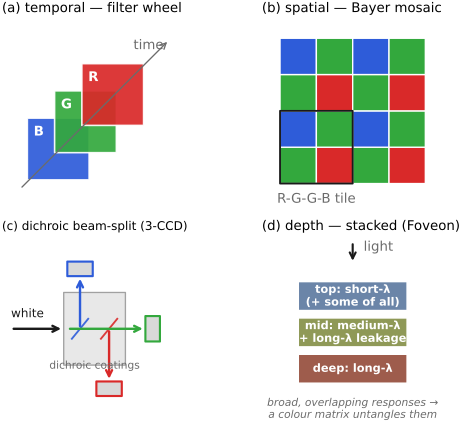
• **Sensing color: multiplexing strategies** — how a monochrome sensor is made to see color: Bayer mosaic, 3-CCD prisms, stacked and dispersive sensors.
• **Synthesizing color** — reproducing color from primaries: additive vs subtractive, gamut mapping, displays, printing, color film, simple display calibration.
• **Recap: the full color pipeline, color management and ICC** — the end-to-end chain, the ICC machinery, and soft proofing.
• **Color TLDR** — the whole part in one page: all color spaces are coordinates on one 3-D space, converted by small matrices plus a few curves; plus a survey of what real software does and a practical what-space-for-what-task reference.
• **Color terms** — a reference glossary for the whole part (placed last): the color vocabulary grouped by what it measures (radiometry, photometry, colorimetry, color appearance, color spaces and encoding), plus tables of the chronic confusions and the terms that mean different things in different chapters.
In a hurry? Skip straight to the **Color TLDR** at the end of the part: it is the whole story in one page, with a decision table for choosing a space and a tour of what real pipelines actually do with color.