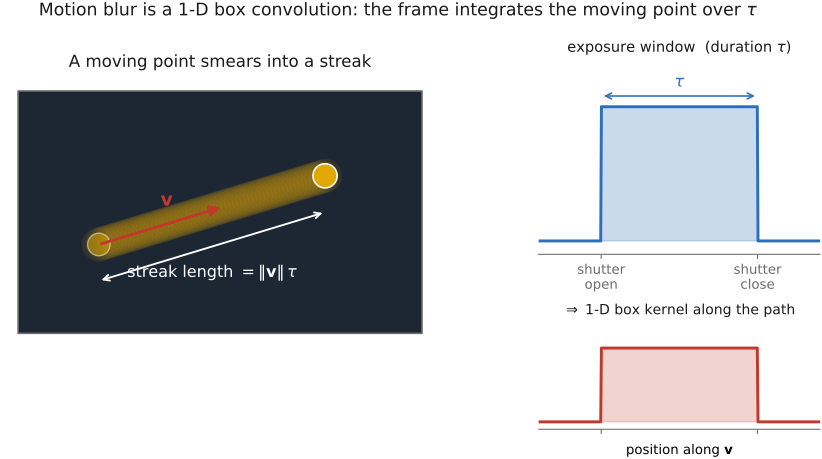
fig-motion-blur-integral · a frame is an integral over the exposure — a bright point traversing the frame while the shutter is open records a streak of length $\lVert\mathbf v\rVert\tau$; motion blur is a 1-D box convolution along $\mathbf v$ 🟨fig-blur-spatial-vs-temporal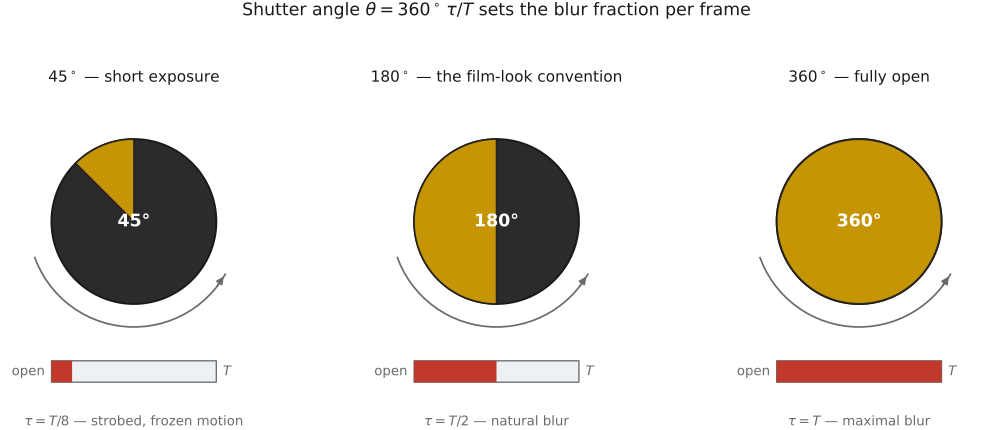
fig-shutter-angle · shutter angle sets the blur — a rotating-disc shutter at $0°/180°/360°$ admitting a smaller/larger fraction of the frame interval $T$; $180°$ ($\tau=T/2$) is the cinematic film-look, small angles strobe 🟨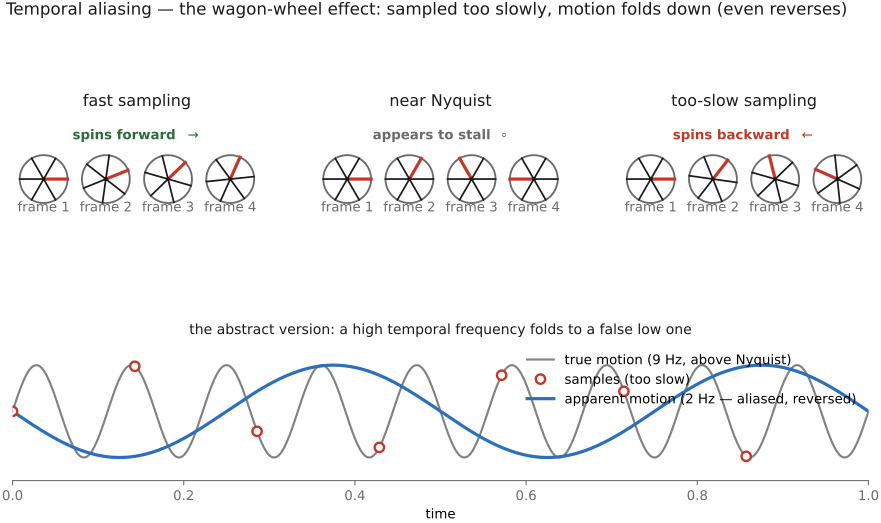
fig-temporal-aliasing-wagonwheel · the wagon-wheel effect — a spoked wheel sampled below temporal Nyquist appears to stall near it and spin backward past it; the temporal twin of moiré 🟨fig-temporal-nyquist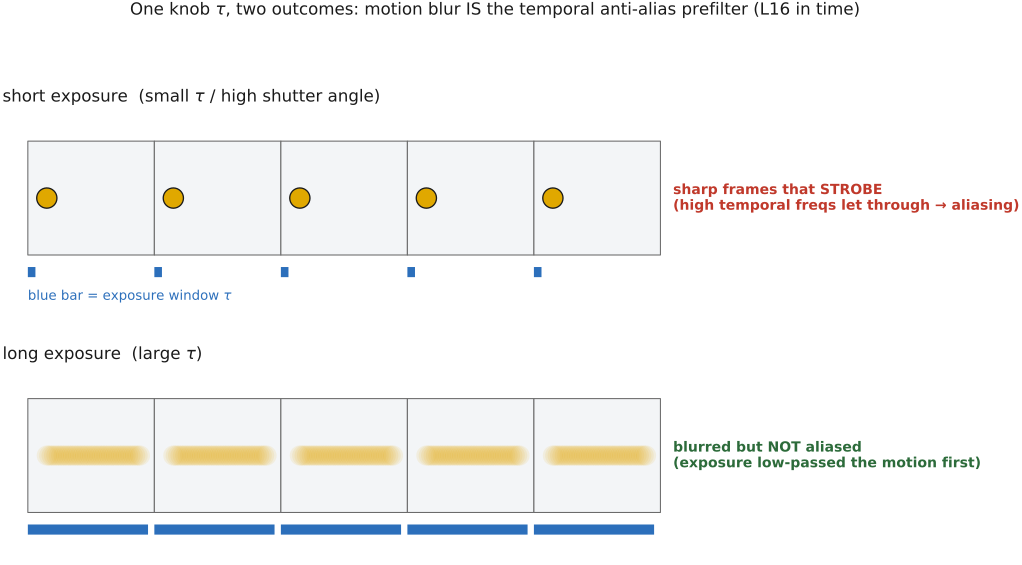
fig-blur-as-temporal-prefilter · one knob, two outcomes — the same fast motion captured long (blurred but not aliased; the window low-passed before sampling) vs short/high-angle (sharp but strobing); the exposure window is the temporal anti-alias filter, L16 in time 🟨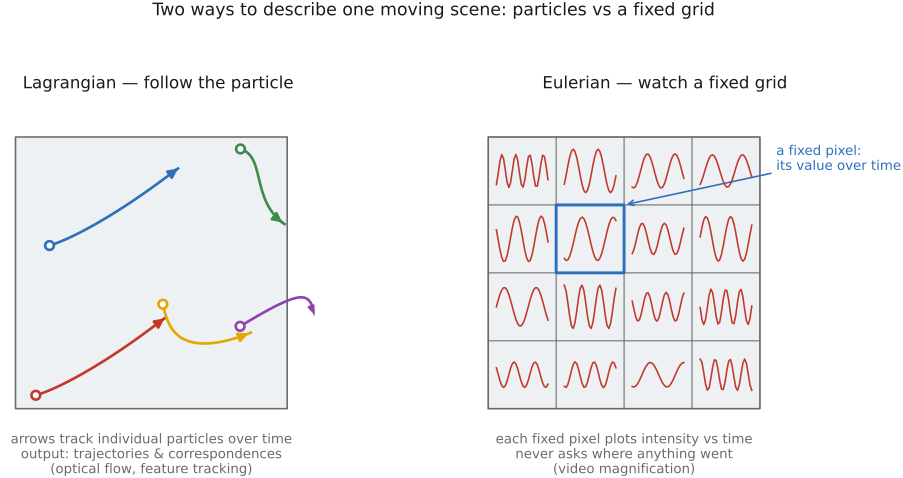
fig-lagrangian-vs-eulerian · the organizing diagram — Lagrangian (arrows following particles over time → flow and tracking, output trajectories) vs Eulerian (a fixed grid, each pixel plotting intensity-over-time → magnification, never asking where anything went) 🟨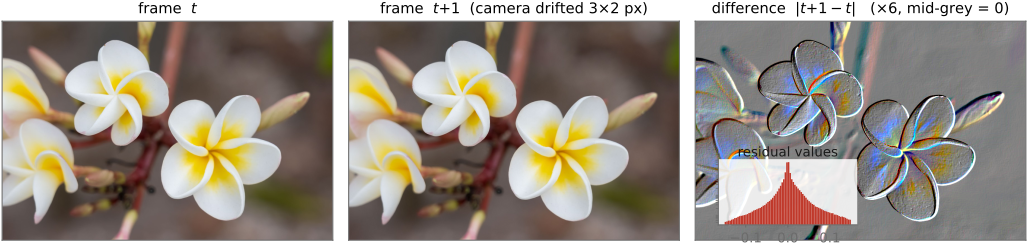
fig-video-temporal-redundancy · temporal redundancy made visible — three near-identical consecutive frames whose per-pixel difference $I_t-I_{t-1}$ is near-black except a thin fringe at moving edges and a disoccluded patch; the only new information to code 🟨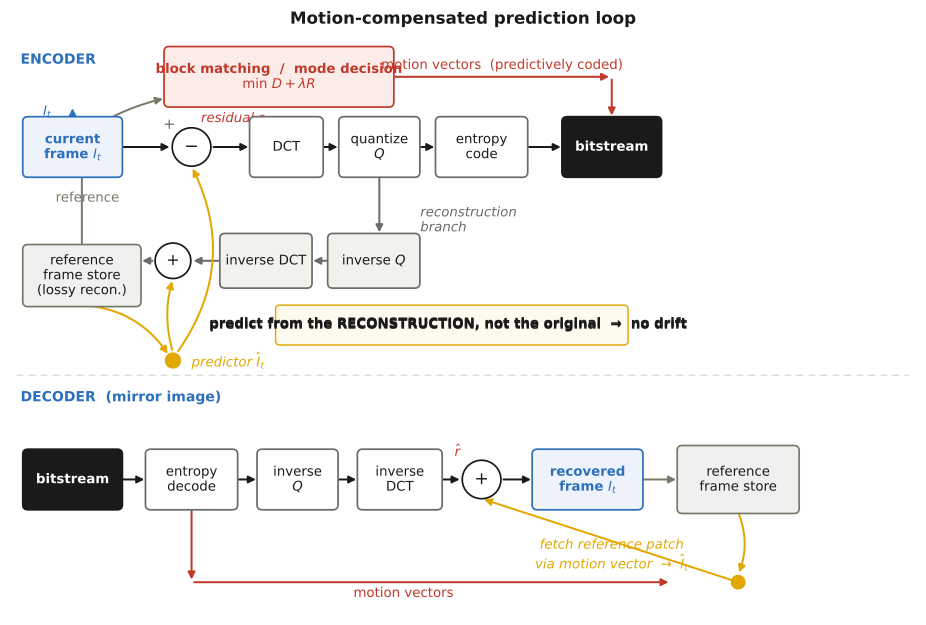
fig-mc-prediction-loop · the motion-compensated prediction loop — encoder (block-match → motion vectors, residual $r=I_t-\hat I_t$ → DCT → quantize → entropy-code, plus a reconstruction branch storing the lossy reference) and the mirror-image decoder; $\min D+\lambda R$ in the mode-decision box 🟨fig-block-matching-searchfig-residual-vs-naive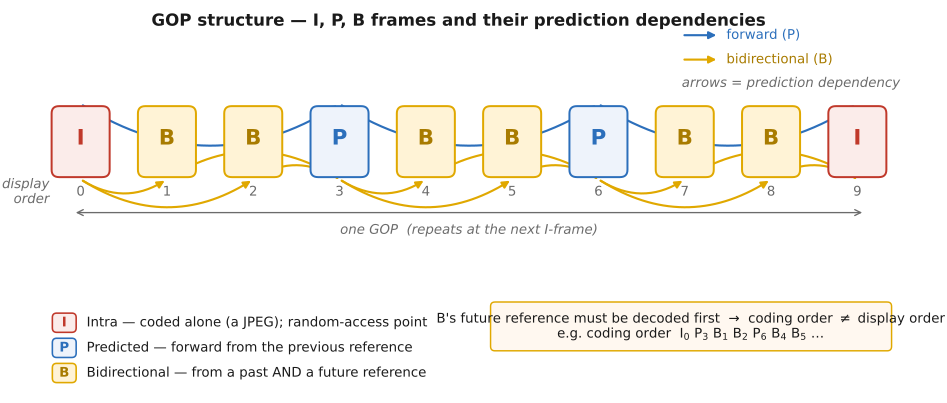
fig-ipb-gop · a GOP timeline — an I-frame opening the group, P-frames predicting forward, B-frames predicting from past and future references; arrows are prediction dependencies, so coding order $\neq$ display order 🟨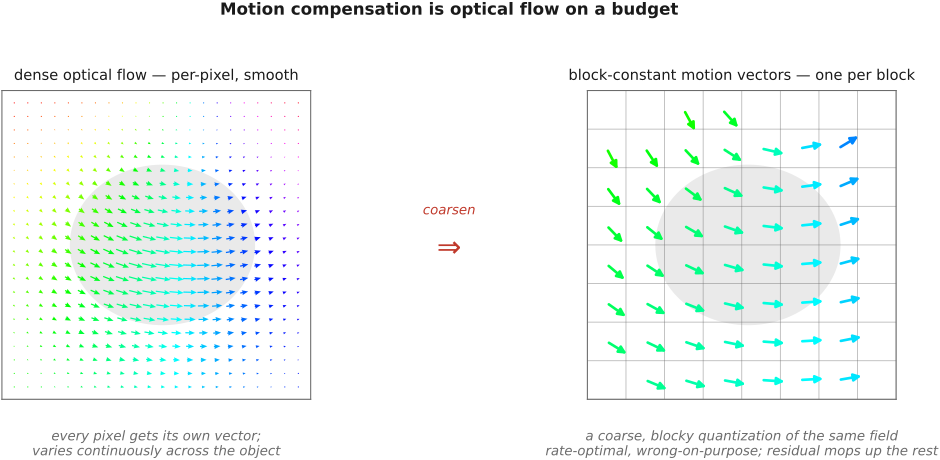
fig-mc-as-flow · same correspondence, two budgets — a dense smooth optical-flow field vs the codec's one-constant-vector-per-block field; the same "where did this come from?" coarsened to what is cheap to estimate and transmit 🟨fig-eulerian-vs-lagrangian-mag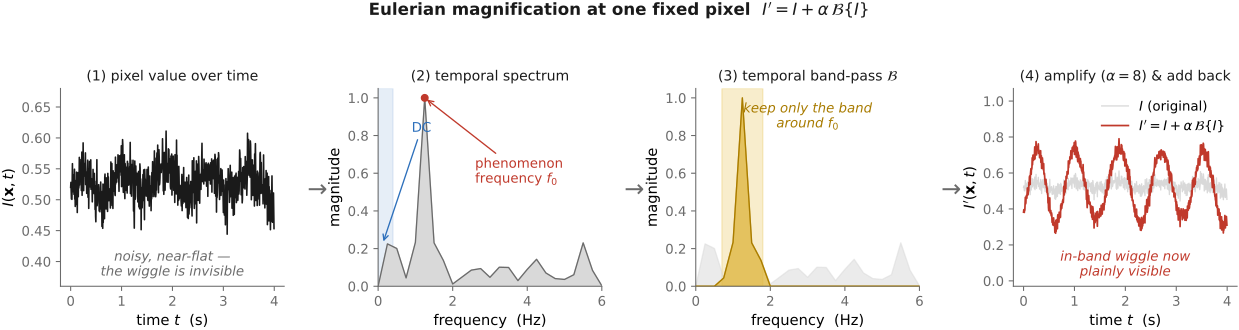
fig-pixel-timeseries-bandpass · one fixed pixel, signal to output — its value over time, its temporal spectrum (a small in-band peak among DC and noise), a band-pass keeping that band, and the band scaled by $\alpha$ and added back; identical at every pixel 🟨fig-pulse-color-mag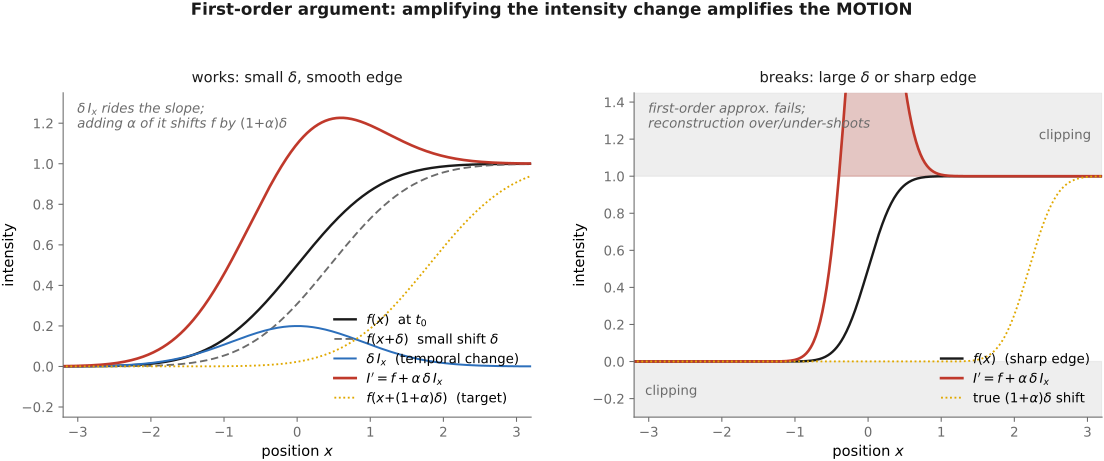
fig-firstorder-motion-mag · intensity amplification is motion amplification to first order — a 1-D edge displaced by $\delta(t)$ giving temporal change $\delta(t)I_x$, amplified to a $(1+\alpha)\delta(t)$ shift; right panel where a large $\delta$ or sharp edge breaks it (haloing, clipping) 🟨fig-phase-vs-linear-mag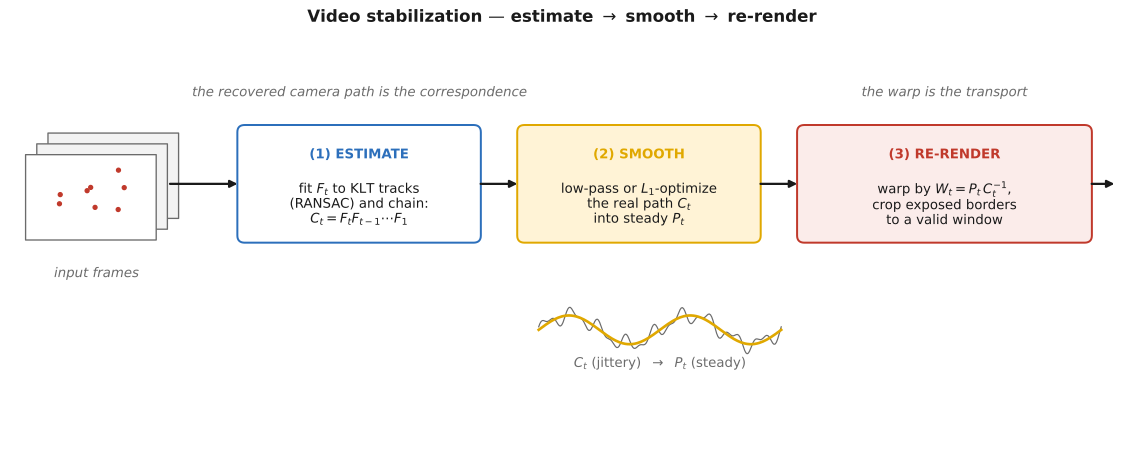
fig-stab-pipeline · the stabilization pipeline — estimate (fit inter-frame $F_t$ from KLT/RANSAC, chain into the real path $C_t$) → smooth ($C_t\to P_t$) → re-render (warp by $W_t=P_t C_t^{-1}$, crop to a valid window); the path is the correspondence, the warp the transport 🟨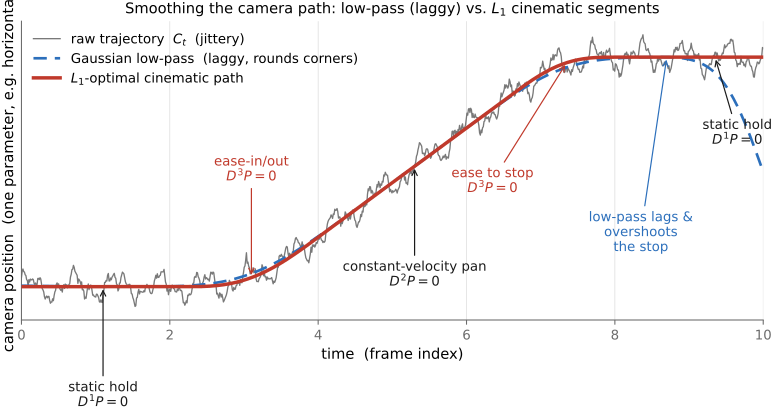
fig-stab-trajectory-smoothing · smoothing the camera-path signal — a jittery raw trajectory $C_t$, a Gaussian low-pass that removes tremor but lags/overshoots at pans, and an $L_1$-optimal path snapping to static/constant-velocity/eased segments with sharp transitions 🟨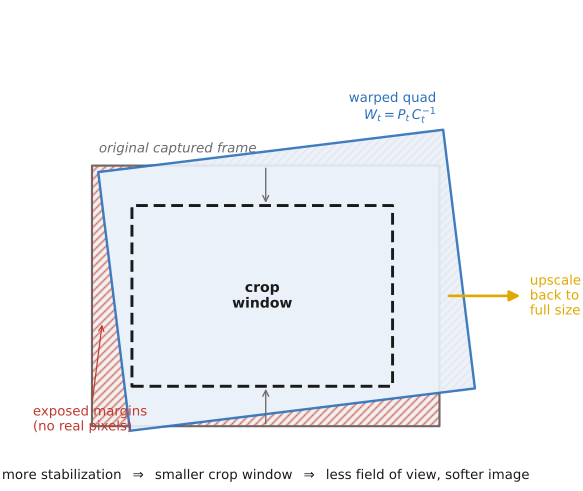
fig-stab-crop-window · the stabilization↔crop tradeoff on one frame — the captured rectangle warped by $W_t$ to a tilted quad with empty margins, the crop window the largest rectangle valid for every frame (upscaled back); more shake removed forces a smaller crop 🟨fig-l1-cinematic-paths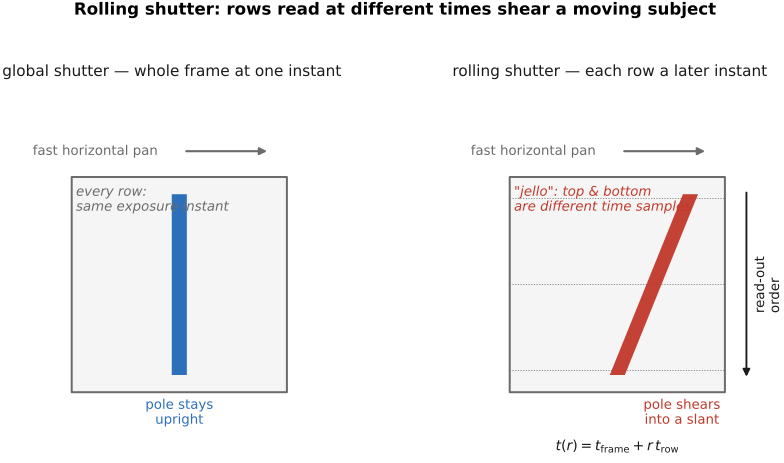
fig-rolling-shutter-skew · rolling-shutter distortion — a global shutter keeping a vertical pole upright under a fast pan vs a rolling shutter where per-row readout $t(r)=t_\text{frame}+r\,t_\text{row}$ shears the pole and smears fan blades (the jello effect) 🟨fig-rolling-shutter-perrow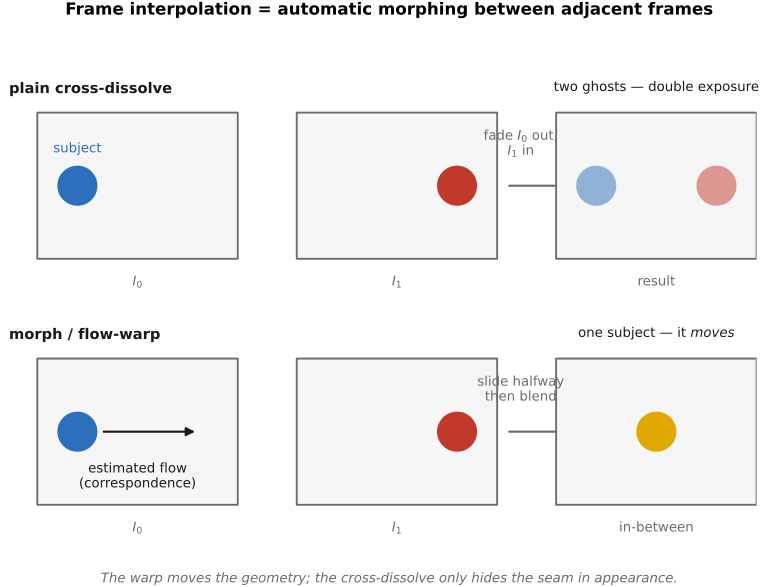
fig-interp-as-morph · interpolation as a morph — a plain cross-dissolve of two frames yielding two ghosts vs a flow-warp where corresponded points slide halfway before blending so the subject moves rather than fades; the correspondence here is automatic optical flow 🟨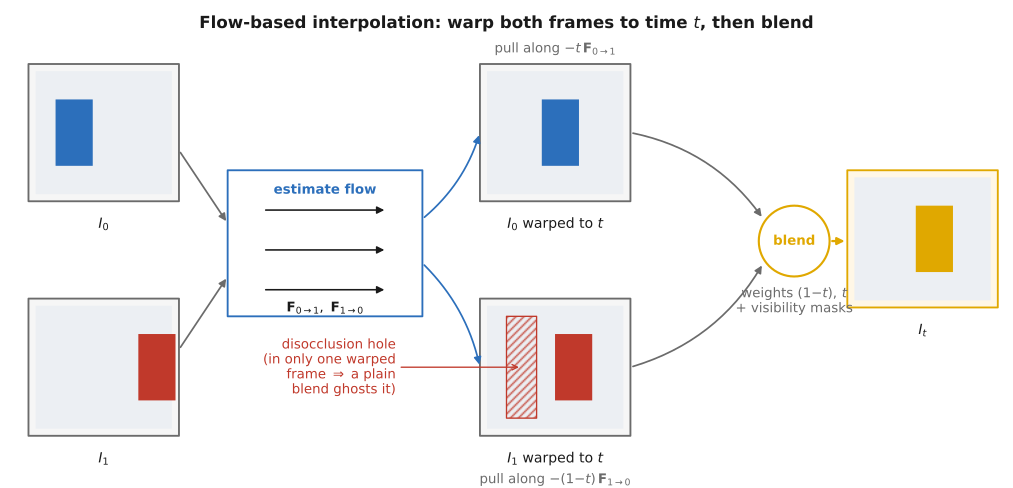
fig-flow-warp-blend · the flow-based interpolation pipeline — estimate bidirectional flow, backward-warp each frame to time $t$ ($-t\mathbf F_{0\to1}$ and $(1-t)\mathbf F_{1\to0}$), convex-blend by $(1-t),t$; a highlighted disocclusion hole present in only one warped frame 🟨fig-forward-vs-backward-warpfig-occlusion-disocclusion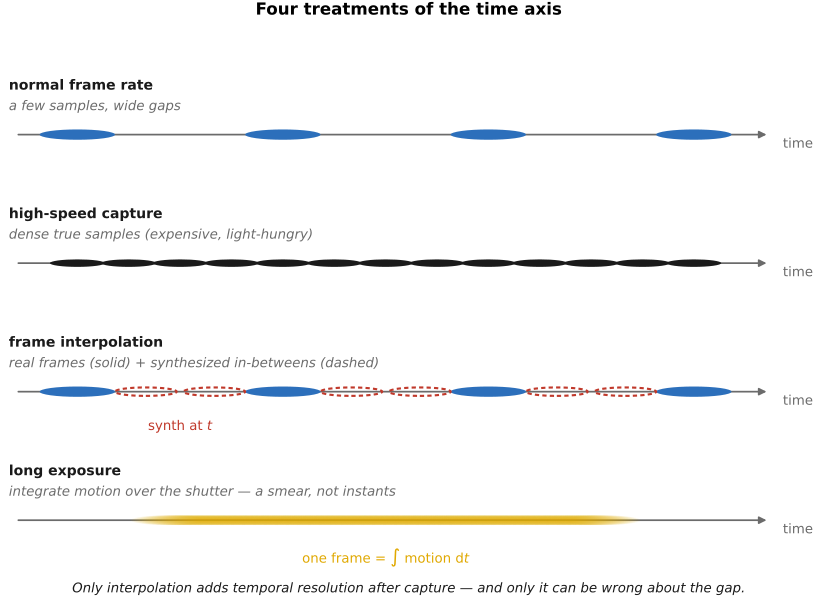
fig-slowmo-axis · four ways to treat the time axis on a shared timeline — normal capture (sparse), high-speed (dense true samples), interpolation (sparse reals with synthesized in-betweens), and long-exposure blur (the integral); only interpolation adds resolution after capture and can be wrong 🟨fig-film-largemotion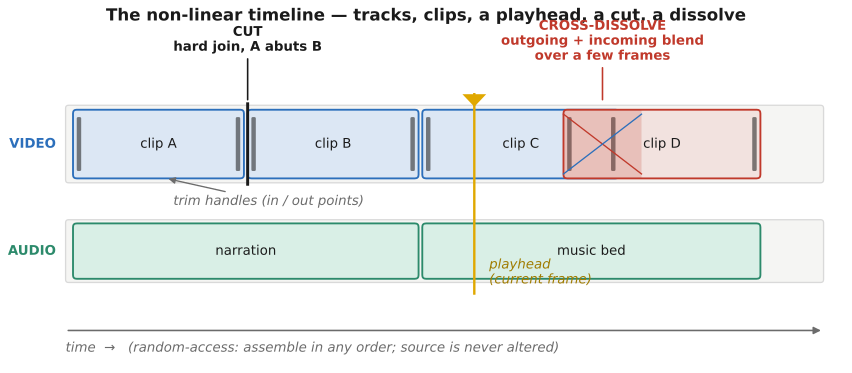
fig-nle-timeline · the non-linear timeline — parallel video/audio tracks, clips with trim handles, a playhead, a labelled hard cut and a cross-dissolve transition; the random-access reference-list model that replaced sequential tape splicing 🟨fig-reduce-over-timefig-median-deghostfig-everyone-smiling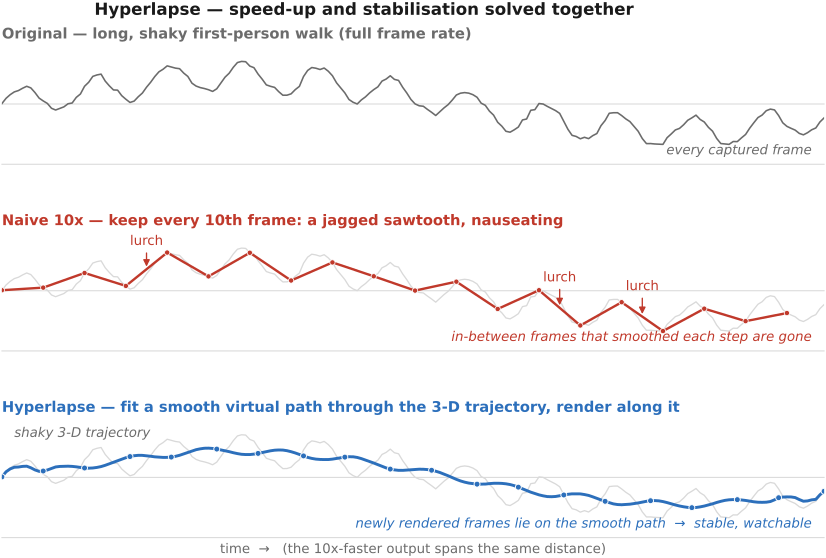
fig-hyperlapse · hyperlapse vs naive fast-forward — a shaky first-person walk, a jagged frame-dropping $10\times$ speed-up (nauseating), and a hyperlapse that reconstructs the 3-D trajectory, fits a smooth virtual path, and renders along it (stable); speed-up and stabilisation together 🟨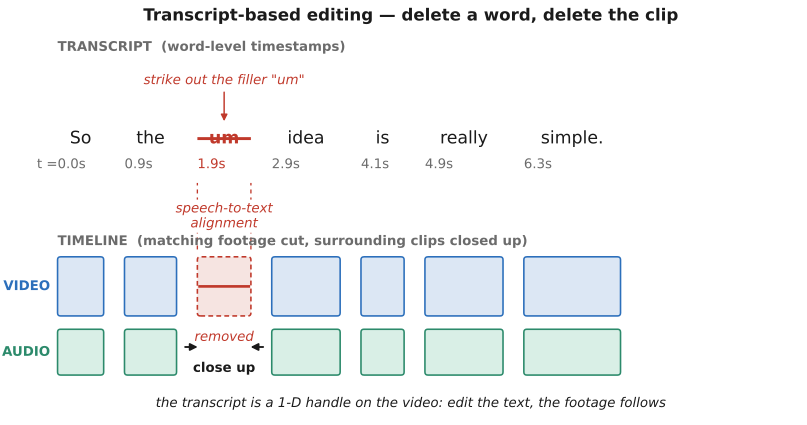
fig-transcript-edit · transcript-based editing — a word-timestamped transcript with a filler "um" struck through, and the timeline below with the aligned micro-segment removed and clips closed up; speech-to-text as a 1-D handle on video 🟨