💬Comments welcome. To leave a note, select any text and click the note / highlight button that pops up — or open the panel with the tab at the top-right (‹). Notes are visible only inside our private review group.
Computational Photography, an AI-powered Slopendium — 15 Revealing the invisible
expand to📖 Full book outlinejump to1 parts · 8 chapters · 0 sections · 4 figures embedded · 0 placeholders · double-click a figure to enlarge
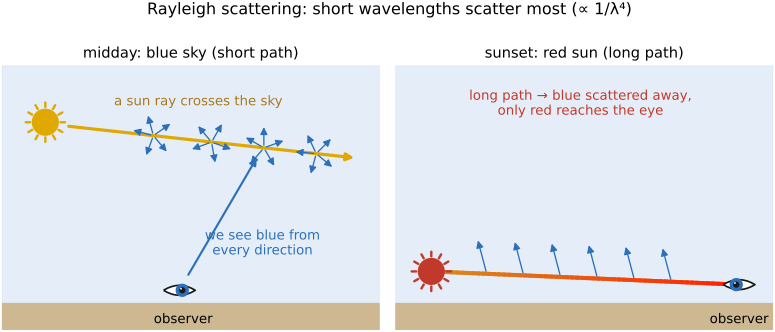
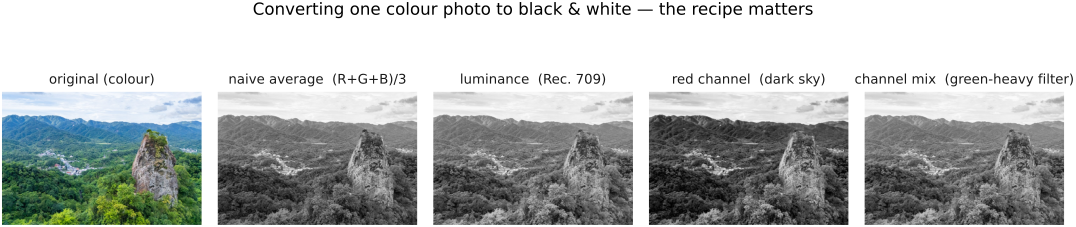
fig-atmospheric-scattering · Rayleigh scattering: blue sky (short path) vs red sunset (long path) 🟨fig-bw-conversions · one colour photo → black & white several ways: single channel (R/G/B) · average · weighted luminance · red-filter channel mix (dark sky) · an isoluminant pair collapsing to one grey — the choices differ (Converting to B&W, Color technology) ✅
• **how**: silicon photodiodes respond well into the **near-infrared**, so every camera ships with an **IR-cut filter** to keep IR from contaminating color. Two routes to NIR imaging: (1) **convert the camera** — remove the internal IR-cut filter (and optionally replace it with clear glass or an IR-pass filter); (2) **filter the lens** — an **IR-pass (visible-blocking) filter** (e.g. R72 / 720 nm) on a stock camera, at the cost of long exposures since most IR is being thrown away by the still-present internal cut filter.
• **what changes — the look**: **foliage glows bright white** (chlorophyll/leaf cell structure reflects NIR strongly) — the classic **"Wood effect"** (after R. W. Wood, 1910); **skin** goes smooth and waxy (NIR penetrates the surface, veins show); **blue sky darkens** and **haze is cut** (less Rayleigh scattering at longer wavelengths → see further); **water** goes inky black.
• **false-color IR**: since NIR is invisible, render it by **mapping bands to visible channels** (e.g. NIR→red, red→green, …) — the surreal magenta-foliage "Aerochrome" look; a channel-remapping choice, not a measurement.
• **uses beyond art**: **forensics & art conservation** (read faded ink, underdrawings, alterations beneath paint); **agriculture / remote sensing** — **NDVI** $=(\text{NIR}-\text{Red})/(\text{NIR}+\text{Red})$, the vegetation-health index that exploits the foliage-glows-in-NIR effect; **astronomy** (NIR pierces dust, redshifted light — e.g. JWST); and as an **extra channel** for computational photography (NIR-assisted denoising / dehazing / dark flash, cross-ref).
• **the setup**: no laser, no time-of-flight — only **ambient light** from the hidden scene spilling onto a **relay surface** you can see (a floor, a wall). An **accidental occluder** — a vertical **edge**, a **doorframe**, an opaque object — selectively blocks rays, so different parts of the visible surface "see" different parts of the hidden region. The occluder is what makes the problem solvable: a fully open scene blurs everything together.
• **occluder as a crude lens / coded aperture**: the edge or object **modulates** the hidden light, much like a **pinhole or coded aperture** modulates a normal scene. The light measured on the visible surface is (hidden image) **convolved** with the occluder's transfer/visibility function — so recovering the hidden image is a **deconvolution / inverse problem**, where the **occluder geometry** is itself part of the unknown.
• **corner camera (1-D)**: at a wall corner, the vertical edge acts as a 1-D **angular** aperture — the **penumbra** gradient on the floor encodes a 1-D image of the hidden scene **vs. angle around the corner**; differencing/inverting the penumbra yields a 1-D **video** of motion in the hidden room (Bouman et al. 2017). Cross-ref `[[#Corner camera]]`.
• **computational periscopy (2-D, single photo)**: with an **opaque occluder** of known or estimated shape between the hidden scene and the wall, a **single photograph** of the wall contains enough structure to **invert** for a full **2-D image** of the hidden scene — the occluder's cast shadow plays the role of a coded aperture (Saunders, Murray-Bruce & Goyal 2019).
• **passive vs active — the contrast**: **active** NLOS (above) sends a controlled light pulse and times its return, buying strong signal and depth at the cost of specialized hardware; **passive** NLOS is **photon-starved and ill-conditioned** (faint penumbra signal, unknown occluder), trading robustness for working with **ordinary cameras and existing light** — and it degrades gracefully as the accidental occluder becomes less ideal.