3.11 Denoising⧉
PS2–PS3 implement bilateral and burst (align-and-average) denoising. → Problem sets (appendix).
Take a photo in a dim room — a birthday cake with the candles guttering, a city street at night — and pull it up at full zoom. The smooth wall behind the cake is not smooth: it crawls with a fine grain of speckle, a slightly different color at every pixel where there should be one flat tone. That grain is noise, and it is the price of light being scarce. Denoising is the craft of removing it, and it rests on a single, almost embarrassingly simple idea: if you have several measurements of the same thing, average them. All the subtlety of the field lives in one follow-up question — which measurements are of the same thing? Average the wrong ones and you do not remove noise; you destroy the picture. This chapter is about getting that question right.
3.11.1 what is noise?⧉
We met noise when we followed photons through the sensor (see image formation and its noise section); here we need only the working picture. A pixel does not record the true light level $L$ that fell on it. It records $L$ plus a random fluctuation that is different every time you press the shutter — put the camera on a tripod, shoot ten frames of a perfectly still scene, and the same pixel reads ten slightly different values.
There are two ways to see this fluctuation, and both are how you debug it. The first is over time: fix a pixel, shoot a burst, and watch its value jitter from frame to frame. The second is over space: photograph a flat grey card — which should be one constant value — and look at the histogram of a small patch. Instead of a single spike you get a fat bell, smeared out by exactly the noise we are after; its width is the noise standard deviation. The same thing shows up in a single scanline: plot one row across that flat patch and it is not a flat line but a ragged one, oscillating about the true value with an amplitude that is the noise. These two pictures — the histogram of a flat patch and a scanline through it — are the first things to look at before you trust any denoiser.
Where does the fluctuation come from? Three sources, in roughly descending order of how often they bite. The dominant one — photon (shot) noise, also called Poisson noise — comes from the light itself: photons arrive at random, and if a pixel collects $N$ photons on average, the fluctuation in that count has standard deviation $\sqrt N$. On top of it sits read noise, a fixed additive electronic fluctuation from the sensor's amplifier and analog-to-digital converter; it does not care how much light there was. Far behind, mattering mostly for long exposures, is thermal noise (and assorted fixed-pattern quirks) — which is why astronomy sensors are cooled.
The crucial fact about shot noise is that it grows with brightness in absolute terms ($\sigma = \sqrt N$) but slower than the signal, so the signal-to-noise ratio $\text{SNR} = N/\sqrt N = \sqrt N$ actually improves with light. This explains why noise is the scourge of the shadows and not the highlights: a bright pixel has the most absolute noise but the best ratio, while a dark pixel has little absolute noise but a terrible ratio — and the eye reads the ratio. Read noise, being a fixed additive term, only sharpens the contrast: it dominates precisely where the light is faintest. A good working model, in linear light, is therefore affine — the affine-noise big lesson from the noise chapter (where it is measured directly from a burst): the noise variance is a constant (read) plus a term proportional to the signal (shot):
In words: even in pitch black there is a noise floor $\sigma_\text{read}$, and on top of it the noise variance climbs in straight-line proportion to how much light the pixel caught. One last fact from image formation completes the picture: the sensor saturates at both ends — it clamps at zero and at its maximum well capacity — so near pure black the noise is no longer symmetric, a subtlety that quietly biases naive averaging (we return to it below). Bright pixels saturate; dark pixels drown in noise; between those two walls is the camera's dynamic range.
3.11.2 denoising by averaging multiple shots⧉
Start with the lucky case. Suppose the scene holds still and you can take not one photo but many — a burst of $N$ frames of exactly the same view. Each frame measures the same true image, corrupted by its own independent draw of noise. The denoiser writes itself: add the frames up and divide by $N$. Where the true signal is the same in every frame it reinforces; where the noise is independent it partly cancels. Watching this happen is more convincing than any equation — go from 1 frame to 3 to 5 and beyond and the grain visibly melts away while the picture stays razor sharp (Figure 3.11.1). Nothing is blurred, because we never averaged a pixel with a different pixel; we averaged each pixel with itself, measured again.
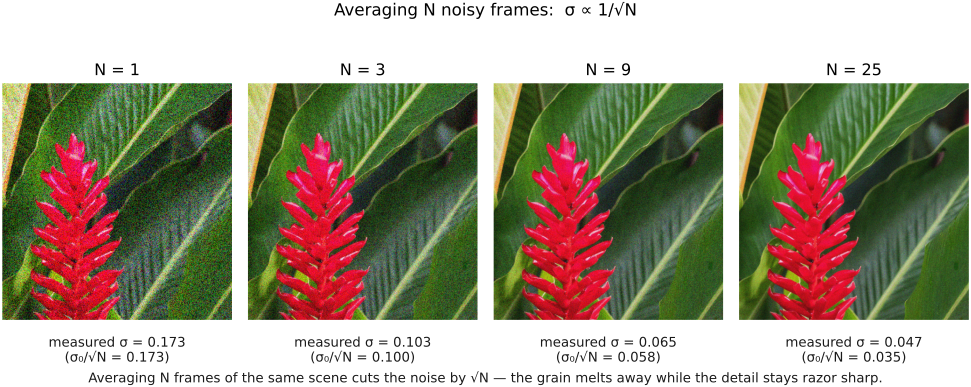
Why does it work, and how fast? This is worth doing carefully once, because the same statistics underlie every denoiser in the chapter. Model a single pixel's measurement as a random variable $X$ with mean $\mu$ (the true value we want) and variance $\sigma^2$ (the noise power). The $N$ frames give us independent draws $X_1, \dots, X_N$ with the same $\mu$ and $\sigma^2$, and we form their average. Two basic facts about variance do all the work (we borrow them from the probability refresher): scaling a random variable by a constant $k$ scales its variance by $k^2$, and the variance of a sum of independent variables is the sum of their variances. So the average $\bar X = (1/N)\sum_i X_i$ has variance
In words: pull the $1/N$ out front (it squares to $1/N^2$), add up $N$ copies of $\sigma^2$, and you are left with $\sigma^2/N$. The variance of the averaged pixel is $N$ times smaller than that of a single shot. Because the standard deviation — the noise level we actually perceive — is the square root of the variance, the noise drops as $1/\sqrt N$: average four frames to halve the noise, a hundred to cut it tenfold. This is the single most important number in denoising, and the metrics follow it directly — SNR and PSNR climb as the variance falls. It also carries a sobering corollary: beating the noise down by another factor of two costs you four times as many frames. There are sharp diminishing returns to throwing photons at the problem.
To average frames you need not know $\sigma$; to evaluate your denoiser you do. The same burst hands it to you: for each pixel, the spread of its values across the frames is an estimate of $\sigma$. One subtlety — divide the summed squared deviations by $N-1$, not $N$ (the Bessel correction). Using the same samples to estimate both the mean and the variance sneaks in a correlation that biases the variance downward; the $N-1$ exactly undoes it. (A two-flip coin makes it concrete: estimate the variance of a fair coin from two flips and the naive $\div N$ gives $0.125$ on average against a true $0.25$, while $\div(N-1)$ gives $0.25$ — unbiased.) A practical guard: variance estimates occasionally come out at zero for no good reason, so clamp them to a small floor before dividing by them.
There is one catch that turns frame averaging from a thought experiment into the engine of modern phone cameras: the frames must be aligned. Hand-held, the scene shifts by a few pixels between shots, and averaging misaligned frames blurs exactly as badly as a careless spatial filter. The fix is to register the frames first — in the simplest form, brute force: try every small shift within a range and keep the one that minimises the sum of squared differences between frames (alignment is developed properly in the resampling and burst chapters). This align-and-average loop is the heart of every phone that brightens a dark scene by quietly stacking a dozen frames behind the shutter button — the burst / high-dynamic-range (HDR) pipelines treated under multiple-exposure imaging.
This is the truncation big lesson from the noise chapter coming home to roost. Recall that the sensor clamps at zero. In a very dark region the true value sits near the floor, and the noise that would have pushed a reading below zero gets clipped away, so the surviving noise is one-sided and its mean is biased upward. Average many such frames and the dark region converges not to black but to a slightly-too-bright grey (and, symmetrically, clipped highlights converge too dark). Camera makers know this — one classic fix adds a small constant offset to the raw signal so the noise stays symmetric and zero-mean before any averaging. It is a good reminder that "average independent noise away" assumes the noise is actually zero-mean, which the physics does not always grant you for free.
3.11.3 denoising from a single image⧉
Usually you are not so lucky. You have one photograph — the moment is gone, the subject moved, there was never a burst. We can no longer average a pixel with other measurements of itself, so we must find our redundant measurements somewhere inside the single image. The governing observation is simple and powerful: most pixels look a lot like their neighbours. A patch of sky, a cheek, a wall — these are regions where the true signal is nearly constant, so neighbouring pixels are very nearly repeated measurements of the same value, each carrying its own independent noise. Average a pixel with its neighbours and you get the same $1/\sqrt N$ benefit as frame averaging, for free, from a single shot.
That is the whole idea, and it immediately explains both the easy wins and the hard problem. In flat regions, neighbours genuinely are samples of the same value, and averaging cleans them up beautifully. But at an edge — the boundary between the dark cake and the bright wall — neighbours are not samples of the same value, and averaging them smears the two sides into a muddy band. Single-image denoising is the long story of building filters that average aggressively inside flat regions and refuse to average across edges. Everything below is a different answer to the one question: which neighbours count as the same value?
3.11.4 Spatial averaging and its limits⧉
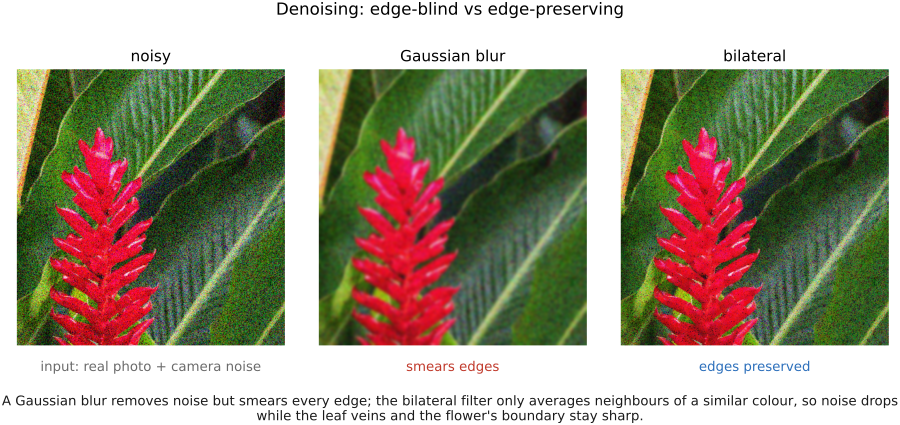
The bluntest neighbour-average is one we already have a name and a tool for: a Gaussian blur (from the convolution chapter). Replace each pixel by a weighted average of a window around it, weighting nearby pixels more than far ones. Since noise is high-frequency — it changes wildly from pixel to pixel — and the true image is mostly low-frequency — it changes slowly — a low-pass filter knocks the noise down and leaves the broad structure standing. And it works: blur a noisy image and the grain is mostly gone (Figure 3.11.2, centre).
It is also, of course, blurry. A Gaussian filter has no idea where the edges are; it averages the cake into the wall as happily as it averages the wall into itself, trading a noisy sharp image for a clean smeared one. This is the central tension of single-image denoising, and it is worth naming as a bias–variance trade-off: a wider filter averages more neighbours, so it cuts noise harder (less variance) but blurs more (more bias — detail systematically lost); a narrower filter keeps detail but leaves noise. With a plain Gaussian you only get to slide along that trade-off, never escape it. A median filter — replace each pixel by the median of its neighbourhood rather than the mean — does noticeably better on the same budget, because the median ignores the odd wildly-different neighbour instead of letting it drag the average; it is the cheap first upgrade and is excellent against speckle and salt-and-pepper noise in particular.
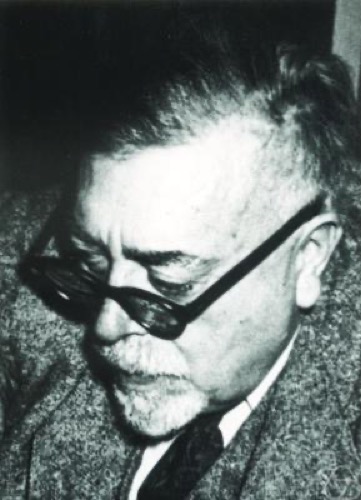 If we insist the denoiser be a single fixed convolution — the same blur everywhere — there is a provably best one, the Wiener filter. Frequency by frequency (think back to Fourier), it keeps a frequency in proportion to how much of it is signal rather than noise: where the true image has strong content it passes through, where the spectrum is mostly noise it is attenuated. It is the right answer to the wrong question — "what is the best shift-invariant filter?" — and its very optimality is the proof that we must leave the world of fixed linear filters to do better. A blur that is the same everywhere can never both smooth the wall and keep the edge crisp. The next idea breaks shift-invariance on purpose. Norbert Wiener (1894–1964) — MIT mathematician, founder of cybernetics — derived this optimal filter from his World War II work on anti-aircraft fire control. Portrait: Konrad Jacobs, Oberwolfach, CC BY-SA 2.0 DE, via Wikimedia Commons.
3.11.5 The bilateral filter: averaging by affinity⧉
Here is the fix, and it is one of the most quietly important ideas in the book. A Gaussian blur decides a neighbour's weight from one thing only: how far away it is in space. The problem at an edge is that a spatially-close neighbour on the other side of the edge has a completely different value, and letting it vote pollutes our estimate. So add a second condition. Weight a neighbour by two factors: how close it is in space, and how close it is in value. A neighbour that is nearby and a similar color gets a strong vote; a neighbour that is nearby but a very different color — across an edge — gets almost no vote at all. Edges are preserved automatically, because the filter simply declines to average across them. This is the bilateral filter (Tomasi & Manduchi 1998), introduced for exactly this purpose; we build only the intuition here and develop it fully in the edge-preserving chapter.
Concretely, the spatial Gaussian $f$ (a function of position difference, the familiar one) is multiplied by a second range Gaussian $g$ (a function of the value difference between the centre pixel $I(p)$ and the neighbour $I(q)$):
In words: for each output pixel $p$, sweep over neighbours $q$; give each a weight that is the spatial closeness $f(p-q)$ times the value closeness $g(I(p)-I(q))$; take the weighted average; and divide by $k(p)$, the sum of those weights. Two things are worth flagging. First, the normaliser $k(p)$ must be recomputed for every pixel, because — unlike a convolution — the weights depend on the local content and so differ at every location. That makes the bilateral filter non-linear and not a shift-invariant convolution; you cannot reuse your convolution code, and you should recompute the range weights $g$ for each pair of values (the spatial $f$ you may still tabulate and truncate at a few $\sigma$). Second, for a color image the "value difference" is a distance in color space — typically the 3-D distance in RGB — so the affinity reflects the full color, not just brightness.
The move that makes the bilateral filter work recurs throughout the book, so name it. Use the color / intensity difference between two pixels as a measure of how much they "belong together" — their affinity. Pixels with high affinity are treated as measurements of the same underlying thing and get averaged; pixels with low affinity (across an edge) are kept apart. The bilateral's range weight $g$ is the first instance of an affinity: a similarity computed from a value difference. Once you see denoising this way, the question "which neighbours count as the same value?" has a clean answer — the ones with high affinity — and the same affinity idea will go on to drive edge-aware tone mapping (the halo fix), edge-aware selections, joint / cross filtering, the bilateral grid, the guided filter, non-local means, colorization, matting and segmentation. We register the lesson here, in denoising, where it first earns its keep; the full edge-preserving treatment — the family of methods and the optimization form — is the subject of the EDGES MATTER part. Edge-preserving is affinity.
A good way to feel the filter — and to debug an implementation — is to push its range parameter to the extremes (Tomasi & Manduchi's own check). Make the range Gaussian very wide, so every value difference counts as "similar," and the value condition stops mattering: the bilateral filter degenerates into a plain Gaussian blur. Make it very narrow, so only near-identical values count, and it refuses to average across even faint differences, leaving edges — and, unfortunately, much of the noise near them — untouched. The useful regime is in between, and the right width is set by the noise level: tell the filter to treat differences up to about $\sigma$ as "the same," and it will smooth the noise while respecting any real edge that exceeds it. A half-black / half-white test image, with a little noise added, makes all of this visible at a glance.
3.11.6 Self-similarity: non-local means and BM3D⧉
The bilateral filter still only looks nearby — its spatial Gaussian confines it to a small window. But natural images are repetitive in a deeper way: a given little patch of texture — a fleck of brick, a strand of hair, a bit of the cake's frosting — tends to recur all over the image, not just next door. Non-local means (NLM) (Buades et al. 2005) takes the affinity idea and drops the "nearby" requirement: to denoise a pixel, it compares the small patch around it to patches around every other pixel in (a large region of) the image, and averages the centre pixels of the patches that match well (Figure 3.11.3). The affinity is no longer a single value difference but a whole-patch similarity, which is far more discriminating — it can tell that two pixels belong to the same kind of texture even when their individual values, corrupted by noise, happen to differ.
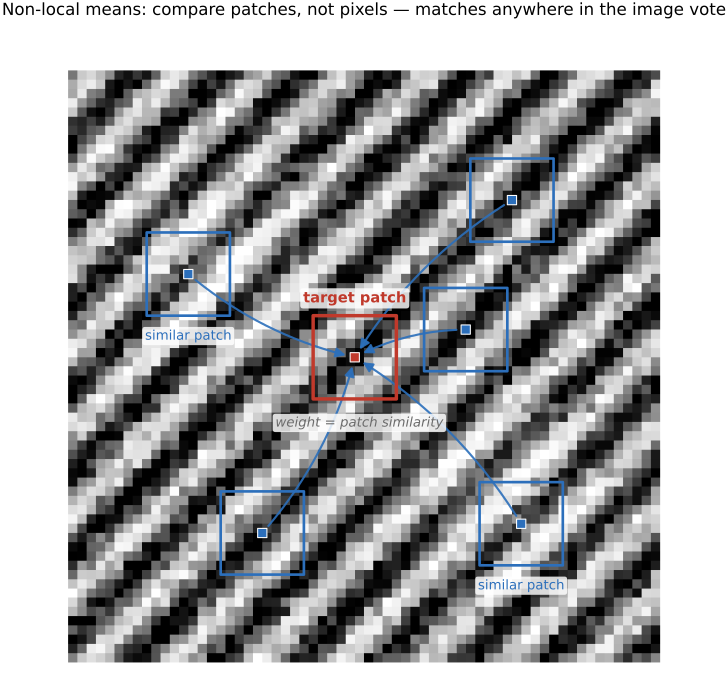
This is the same lesson at a higher resolution: instead of "average neighbours that are a similar color," it is "average pixels whose surroundings look alike." Block-matching and 3-D filtering (BM3D) is the celebrated refinement — it gathers groups of similar patches into a stack and filters them jointly in a transform domain — and for years it was the benchmark every learned method had to beat. You can read non-local means as a bilateral filter in the space of patches: same affinity principle, richer notion of "the same."
A different and very practical single-image denoiser lives in the wavelet / Laplacian pyramid. On natural images the band-pass (detail) coefficients are sparse: a few large coefficients carry the real edges and texture, while a sea of small ones is mostly noise. Coring simply zeroes the small coefficients and keeps the large ones, then reconstructs. It is cheap, it respects edges (the large coefficients survive), and it remains one of the most widely deployed denoisers in real pipelines. See the pyramids chapter for the construction; the affinity here is "is this detail coefficient big enough to be real?"
The current state of the art is learned: train a neural network (typically a U-Net) on pairs of noisy and clean images and let it discover, from data, both the structure of natural images and the structure of the noise. These now beat BM3D comfortably, and they shade into generative priors — a network that has learned what clean images look like can hallucinate plausible detail where the noise destroyed it, for better (stunning low-light results) or worse (invented detail that was never there). The link runs deep: diffusion models — the engines behind modern image generators like Stable Diffusion — are trained as denoisers, repeatedly removing a little noise, and a strong denoiser is a strong prior on natural images. We take this up in the machine-learning part; here we only flag that the humble averaging idea, pushed to its limit, becomes the most powerful image priors we have.
3.11.7 Denoise color more than brightness⧉
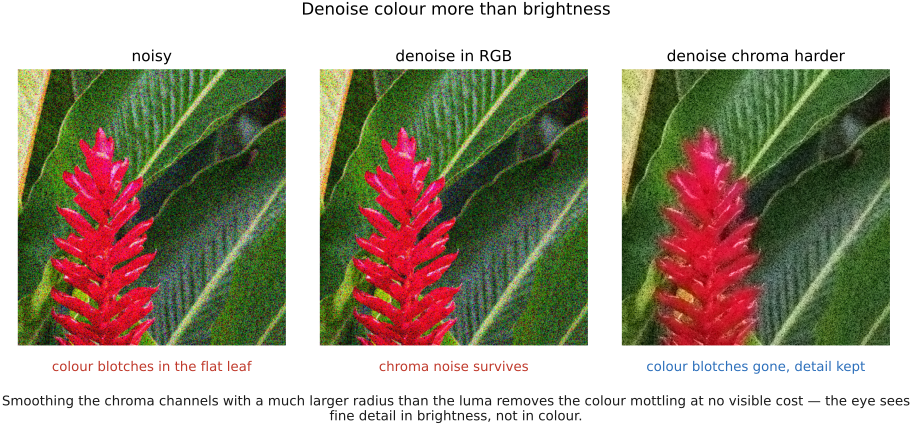
There is a perceptual shortcut that every real denoiser exploits, and it follows straight from how our eyes work. The visual system has much coarser spatial acuity for color than for brightness — we see fine detail in luminance but only blurry, low-frequency color (the same fact that lets the joint photographic experts group (JPEG) format subsample chroma, and that shaped the Bayer mosaic). Noise has both a luminance component (light/dark speckle) and a chrominance component (the blotchy red/green/blue mottling you see in dark areas), and the chrominance noise is both the uglier of the two and the one we can attack hardest without anyone noticing — because we cannot see fine color detail anyway, there is no fine color detail to protect.
So a good denoiser does not work in RGB. It splits the image into a luminance channel and two chrominance channels (a YUV-like space) and denoises them differently: a gentle filter on luminance, where real detail lives and over-smoothing would be obvious, and a much more aggressive one on chrominance — a far larger spatial radius — where heavy smoothing removes the color blotches at no perceptible cost. Run a bilateral filter in YUV with a big spatial $\sigma$ on the chroma channels and the color mottling vanishes while the image stays crisp; the same filter in RGB has to compromise on every channel at once and leaves visible chroma noise behind (Figure 3.11.4). Spend your smoothing budget where the eye won't miss the detail — this is the recurring theme that ties denoising back to human perception.
3.11.8 noise estimation⧉
Every filter above needs to know the noise level: the bilateral's range $\sigma$, the coring threshold, the strength of any smoothing all scale with how much noise there is. Get it wrong and you either leave noise behind (too timid) or erase real detail as if it were noise (too aggressive). There are two ways to find it. The clean way is to calibrate: photograph a flat, evenly-lit field at every ISO setting once, measure the noise variance as a function of signal level, and store a per-ISO noise model (recall the affine read + shot form) that the camera looks up at capture time. The other way is to estimate from the image itself — find patches that look flat and read off their standard deviation, or take a high-frequency residual (the image minus its own blur) and measure its level where there is no real detail. Modern pipelines, knowing the ISO from the exchangeable image file format (EXIF) metadata, mostly use the calibrated model; image-blind estimation is the fallback when you are handed a stray photo with no provenance.
3.11.9 The limits of denoising⧉
It is tempting to think a clever enough denoiser could recover any clean image from any noisy one. It cannot, and it is worth being honest about why. Denoising works by exploiting redundancy — neighbours that agree, patches that recur, frequencies that are mostly signal. Once the noise is strong enough to swamp the local structure, that redundancy is gone: there is no longer a reliable signal in the neighbourhood to average toward, and a pixel's true value is genuinely unrecoverable from the data alone. Levin et al. made this precise, bounding how much any denoiser — present or future — can recover as a function of the noise level and the statistics of natural images. The bound says there is a floor, and near it the only ways forward are the two we cannot fake: collect more photons (a longer exposure, a bigger sensor, more frames to average) so the signal genuinely rises above the noise, or bring a stronger prior — a model of what real images look like, which is exactly what learned and generative denoisers supply, at the risk of inventing detail that was never measured. There is no free lunch; past the floor, you are either gathering more light or guessing.
There is an ethical edge to all this that an engineer should see coming. Push denoising too far — especially on skin — and you stop removing noise and start erasing texture: pores, fine lines, the micro-detail that makes skin read as skin. The result is the familiar "plastic" or wax-figure look, and at that point a noise filter has quietly become a beauty filter. The line is genuinely blurry, because skin smoothing, blemish removal, and outright "beautification" are the same operation — suppress the high-frequency variation in regions a face / skin detector has flagged — just dialled further up. Many phones now apply aggressive skin smoothing by default, often without the subject choosing it or even noticing. That should give us pause: it silently imposes a single standard of flawless skin, it is a form of automatic, non-consensual retouching that makes the photograph no longer faithful to the person in front of the lens, and it measurably affects how people — especially the young — see themselves and others. It is worth deciding, when you build a denoiser, where your pipeline draws the line between cleaning an image and editing a face. The book picks this thread up in Human factors, under the honest premise that a photograph was never quite the truth to begin with.
Big lessons of this chapter
The recurring principles from this chapter, gathered for review.
The move that makes the bilateral filter work recurs throughout the book, so name it. Use the color / intensity difference between two pixels as a measure of how much they "belong together" — their affinity. Pixels with high affinity are treated as measurements of the same underlying thing and get averaged; pixels with low affinity (across an edge) are kept apart. The bilateral's range weight $g$ is the first instance of an affinity: a similarity computed from a value difference. Once you see denoising this way, the question "which neighbours count as the same value?" has a clean answer — the ones with high affinity — and the same affinity idea will go on to drive edge-aware tone mapping (the halo fix), edge-aware selections, joint / cross filtering, the bilateral grid, the guided filter, non-local means, colorization, matting and segmentation. We register the lesson here, in denoising, where it first earns its keep; the full edge-preserving treatment — the family of methods and the optimization form — is the subject of the EDGES MATTER part. Edge-preserving is affinity.