9.2 Aberrations correction⧉
Every aberration in the opening catalogue — spherical, coma, astigmatism, field curvature, and distortion among the monochromatic five, plus axial and lateral chromatic aberration — has a cure, and the cures fall into two complementary families. You can fight the defect in the glass, by shaping and combining elements, choosing glasses, and stopping down; or you can let the optics get only close and finish the job in software, by remapping, rescaling, and deconvolving in the image-signal processor. This chapter takes the two families in turn. It is the analytic heart of the part: the place where the bill for being a lens is finally paid — half by the optician, half by the computer.
9.2.1 The two families of cure⧉
The descriptions are settled; what is left is the engineering. A useful way to organise it is by what the defect did to the light, because that decides which family of cure can reach it. Geometric defects — distortion, vignetting, and lateral chromatic aberration — leave every point sharp and merely misplace energy across the frame; they are a clean remapping, so once measured they come off almost perfectly in software, and increasingly the optics is designed expecting that. Blur defects — spherical aberration, coma, astigmatism, and axial chromatic aberration — genuinely spread a point into a blob, which is much harder to undo after the fact; they are fought first in glass (the right surface shapes, the right glass pairings, a smaller aperture) and only what the glass leaves behind is handed to a calibrated deconvolution. So the chapter goes glass first, then computation, and within each, the cures are organised by the defect they target — because in a real lens, every added element, every special surface, and every glass choice exists to cancel one specific entry in the catalogue.
9.2.2 Correction in glass⧉
The first line of defense is the optics itself, and the strategy is always the same: add free parameters until you have enough to cancel the aberration you care about. Four classic moves cover almost all of it.
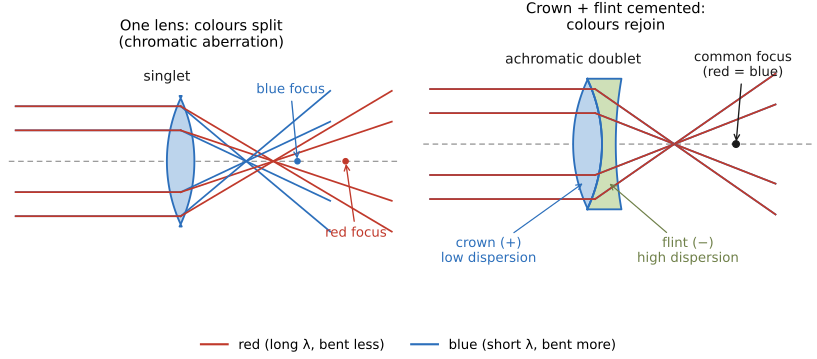
The headline move for color is the achromat, the cemented crown-plus-flint doublet that is the minimum system able to correct chromatic aberration. The idea is to make the dispersion of two elements cancel while their focusing power adds. Pair a positive (converging) element of low-dispersion crown glass with a negative (diverging) element of high-dispersion flint glass. The crown does most of the focusing; the flint, being weaker in power but stronger in dispersion, undoes the crown's color spreading without undoing all of its focusing. Quantitatively, if the two thin elements have powers $\phi_1, \phi_2$ (power $=1/f$) and Abbe numbers $V_1, V_2$ (the dispersion measure $V_d=(n_d-1)/(n_F-n_C)$ defined in the challenges chapter), the combined chromatic error vanishes when
the achromat condition: the powers, each weighted by the glass's dispersion (divided by its Abbe number), sum to zero. Since $V_1, V_2 > 0$, the two powers must have opposite sign — one converging, one diverging — which is why an achromat is always a positive crown cemented to a negative flint. Solving the condition jointly with the requirement that the total power $\phi_1 + \phi_2$ hit the desired focal length pins down both elements. An achromat makes two wavelengths (say blue $F$ and red $C$) share a focus exactly, with the in-between green error (the residual secondary spectrum) reduced to a tiny fraction of the original. As a bonus, the extra surfaces let the designer also tame the doublet's spherical aberration, which is why the achromatic doublet is the workhorse front element of so many lenses.
When two wavelengths is not enough — long telephotos and astrophotography, where the residual secondary spectrum is visible as a faint color halo on highlights — the apochromat (or superachromat) corrects three or more wavelengths at once. This needs glasses with unusually favorable dispersion curves: extra-low-dispersion (ED) glass, special-dispersion "fluorite-equivalent" glasses, or actual fluorite (calcium fluoride) crystal, which has both very low dispersion and an anomalous dispersion curve that lets the designer flatten the color error across the whole visible band. ED elements are why a modern super-telephoto can render a backlit bird's feather edges without a magenta-and-green seam; they are expensive (hence the price and the white barrels), which is precisely the kind of cost that motivates handing the residual to software instead.
The headline move for spherical aberration is the aspheric element. As described in the challenges chapter, a spherical surface focuses its edge rays short; an aspheric surface, whose profile departs from a sphere by a designed polynomial, gives the designer an extra knob to kill spherical aberration (and to flatten the field) with far fewer elements than the alternative of splitting power across many spherical surfaces. This is the enabling technology of compact fast primes and especially of cell-phone cameras, whose tiny stacks of five-to-eight molded elements would be impossible with spheres alone. There is a manufacturing sidebar worth keeping: spherical surfaces are easy to make precisely because any two surfaces ground together with abrasive between them naturally wear toward a sphere — geometry hands you the sphere for free. Aspheres have no such self-generating process, so they arrived late and depend on precision molding (pressing glass or plastic against a figured die). That is exactly why cheap molded plastic and glass aspheres were the breakthrough that gave phone cameras their optical edge: the surface that is hardest to grind is easy to mold in volume.
Finally, the universal, free, no-new-glass fix: stopping down. Most of the aberrations that matter — spherical, coma, lateral color, and the optical (cat's-eye) part of vignetting — scale with how far out in the aperture the offending rays travel, so closing the iris to use only the well-behaved central zone reduces all of them at once. This is why nearly every lens is sharpest a couple of stops down from wide open rather than at its maximum aperture. The catch, from FUNDAMENTALS, is that you cannot keep stopping down forever: at small apertures diffraction takes over and softens everything, so there is a sweet spot — typically two to three stops down — where the aberrations have shrunk but diffraction has not yet bitten. Beyond it, closing further trades aberration blur for diffraction blur and the image gets worse. Stopping down is the photographer's blunt instrument; the elegant fixes live in the glass, and what neither the glass nor the iris can reach economically is handed to computation.
9.2.3 Computational correction⧉
Everything above fights the aberration in the optics. The computational-photography move is to let the optics get the image only close and finish the job in the image-signal processor (ISP) — shifting the design's operating point on the cost-versus-quality front (cross-ref Lens optimization). Two tools do the bulk of it, and they map cleanly onto the two kinds of aberration: geometric (a sharp image in the wrong place) versus blur (light spread out of place).
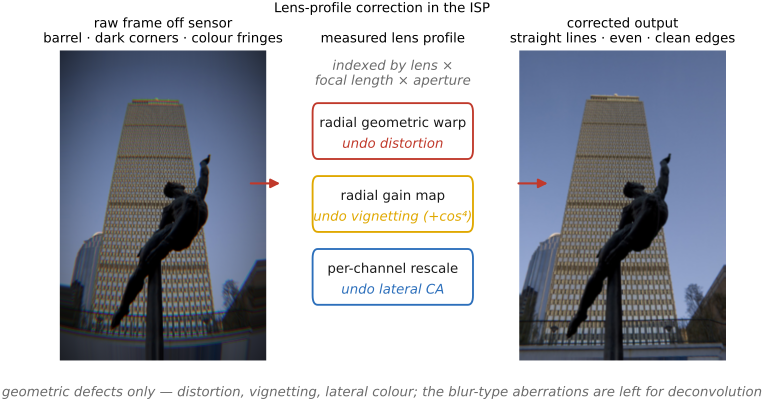
The first tool is lens-profile correction, and it handles all three of the geometric defects. For each lens — and, since the defects change with settings, for each combination of focal length and aperture (and focus distance) — the manufacturer or a community database measures a profile: a table of how that lens distorts, vignettes, and color-fringes. Then the ISP simply plays the profile in reverse on every frame. Geometric distortion is undone by a radial warp, resampling each pixel along a corrective function of its distance from center, $r' = r\,(1 + k_1 r^2 + k_2 r^4 + \cdots)$ — the exact inverse of the Brown–Conrady (or division-model) bow fit per lens in the challenges chapter, and since distortion moved no energy, this restores straight lines with no loss of sharpness. Vignetting is undone by a radial gain map, brightening the corners back to the center's level — and the same map corrects both the lens's optical vignetting and the FUNDAMENTALS $\cos^4$ falloff in one pass (cross-ref the natural-illumination falloff there). Lateral CA is undone by rescaling each color channel radially about the center by the tiny per-channel factor the profile records, collapsing the red-to-blue fringe back to a single edge. All three are cheap, robust, and run on essentially every photo you take — phone lenses in particular are designed expecting this correction, deliberately leaving in heavy barrel distortion (it lets the optics be smaller and faster) on the understanding that software will straighten it. This is the everyday, invisible face of optics-plus-computation.
The second tool reaches the blur-type defects, and it is where this chapter rejoins the deblurring machinery from the single-image part. An aberrated lens does not just displace points — for spherical aberration, coma, astigmatism, and axial CA it genuinely spreads each point into a small blob, the lens's point-spread function (PSF). The forward model is the one convolution we keep returning to: the recorded image is the ideal scene convolved with the PSF,
If we know the PSF, we can try to invert that convolution — deconvolution — and recover the sharp scene. And for a known lens we can know the PSF, by measuring it (shoot a point source or a calibration target through the lens). This is the crucial difference from blind motion deblurring: here the kernel is calibrated, not guessed, so the inversion is a non-blind deconvolution — the easier problem. It uses exactly the regularized-inverse toolbox from the Fourier/deblurring chapter, the Wiener filter prototype
which at each frequency divides the blur back out where there is signal worth recovering and leaves it alone where the lens crushed the signal below the noise. The one twist particular to lenses is that the PSF is spatially varying — it is tight in the center and grows comatic and stretched toward the corners — so the deconvolution must use a different kernel per region of the frame, a calibrated map of PSFs rather than one global blur.
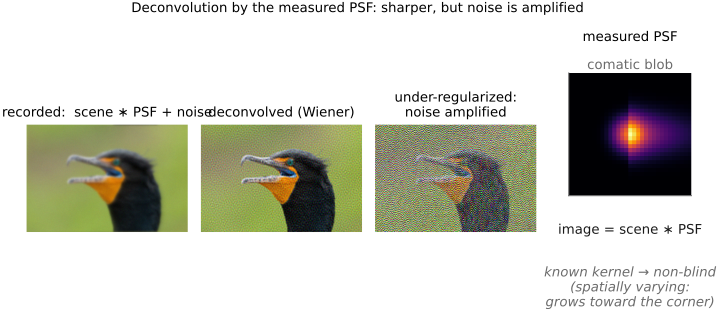
The limits are the same limits deblurring always has, and they are worth stating plainly. Deconvolution amplifies noise at exactly the frequencies the lens attenuated most — its modulation transfer function (MTF) dips toward zero there — so it can sharpen what was merely attenuated but cannot recover what was destroyed: information the optics drove below the noise floor is gone, and pushing the inverse harder there only manufactures grain and ringing. The spatial variation adds bookkeeping (a grid of kernels, blended across the frame). And axial CA, being a differently-defocused-per-color blur, is partially correctable this way but never as cleanly as lateral CA's one-line warp.
All of this fights the blur the lens accidentally made. The forward-looking inversion of the whole chapter — and the bridge to the Advanced part — is to stop fighting and instead engineer the PSF: design the lens (or a coded aperture, or a phase mask) so that its blur is deliberately chosen to invert cleanly, with no near-zero frequencies to amplify noise, and even to encode depth in its shape. That is wavefront coding and coded-aperture imaging (Dowski and Cathey, 1995), and the end-to-end / differentiable-optics idea of optimizing the lens and the reconstruction algorithm together — the destination this part has been pointing at since its first page. Aberrations, in that light, are not only a defect to be cancelled but a signal to be designed.
9.2.4 Radial distortion correction⧉
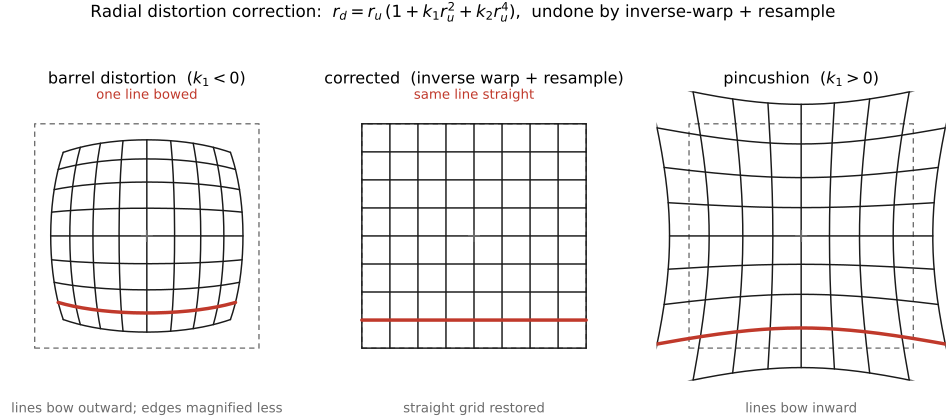
Of all the defects in the catalogue, radial distortion is the one that surrenders most completely to software, and it is worth its own treatment because it is both the most visible and the most cleanly correctable. Alone among the aberrations it moves no light energy at all: every point stays perfectly sharp, the lens has merely mis-placed it radially, bending world-straight lines into gentle curves. Restoring them is therefore not a deconvolution — with all of deconvolution's noise-amplifying limits — but a clean remapping that loses no sharpness. It is so reliable that modern designs lean on it: a phone or compact wide-angle lens is routinely allowed to leave heavy barrel distortion in the raw frame — which lets the optics be smaller, faster, and cheaper — on the understanding that the image-signal processor will straighten it on every shot.
The symptom is bowed lines. A real lens images world-straight lines as gentle curves. In barrel distortion the lines bow outward and the frame seems to fatten — magnification falls with radius — the signature of wide-angle lenses; in pincushion distortion they bow inward as magnification rises with radius, typical of telephoto; a blend of the two is mustache distortion. The defect is radially symmetric about the principal point and worst at the edges, and its extreme case is the fisheye, where the bending is so strong it is no longer a defect to remove but the intended projection.
The model is a per-radius remap. Because the effect is radially symmetric, the correction is a one-dimensional function of radius $r$ — the distance from the optical center — applied along each ray: points move only in or out, never sideways. The two parametric forms are exactly the ones introduced in the challenges chapter, used here in reverse. The polynomial (Brown–Conrady) model writes the distorted radius forward as
with $k_1<0$ for barrel and $k_1>0$ for pincushion; correcting the image inverts this map numerically, per radius. One or two terms suffice for most lenses. The division (Fitzgibbon) model uses a rational form,
which captures strong wide-angle and fisheye distortion with fewer parameters and inverts more cleanly, which is why it is favored for calibration.
Where the parameters come from. Two routes. The first is a lens profile — a precomputed table of coefficients per (lens, focal length, aperture), shipped by Lightroom / Adobe Camera Raw, PTLens, or DxO and looked up automatically from the EXIF tags that name the lens; this is the very profile the lens-profile-correction pass above already plays back to undo vignetting and lateral CA, so distortion comes off in the same step. The second is to estimate the coefficients from the image itself by plumb-line calibration: find features that ought to be straight — a building edge, a horizon — and choose the $k_i$ or $\lambda$ that make the imaged lines straight, minimizing their residual curvature.
Applying it is an inverse warp. Once the radial map is known, it is applied by the same engine as every geometric resampling operation — inverse-warp and resample: loop over output pixels, push each back through the radial map to its source radius, and resample the input (the warping machinery developed in Warping and resampling in the motion-and-video part, which now points back here for this lens correction). The stretched and compressed edge regions carry the usual prefilter-before-downsample care, and the corners that read past the frame are handled by the boundary policy or simply cropped. Because the distortion displaced no energy, the straightened result loses no sharpness — the cleanest cure in the whole catalogue.