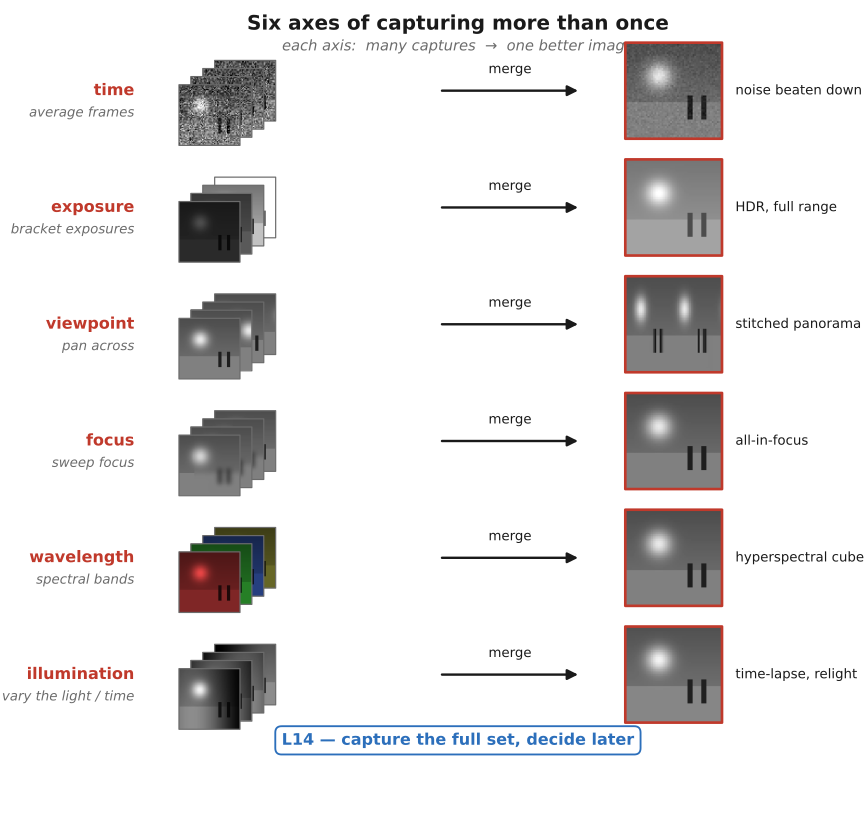
• **camera arrays** (Wilburn et al. 2005): a **grid of synchronized cameras** captures many viewpoints at once. Fuse them for **synthetic aperture** (below), **high-speed** video (stagger the triggers → interleave frames), **high dynamic range** (vary exposure per camera), or **super-resolution** (sub-pixel-shifted full-res views). The Stanford **multi-camera array** is the canonical research instrument.
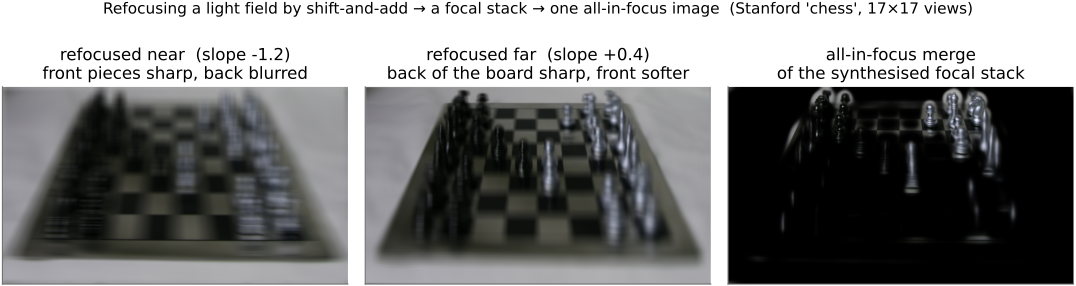
• **synthetic aperture**: align all the small-aperture array views to a chosen **focal plane** and **average** them. The result behaves like a **single lens with an aperture as wide as the whole array** — an extremely shallow depth of field that **blurs foreground occluders into oblivion**, letting you **see through** foliage/crowds to a subject behind them; refocus by choosing a different alignment plane. The array's signature trick.
• **multi-camera phones**: modern phones carry a **cluster of cameras of different focal lengths** — **ultrawide · wide · tele** (sometimes a periscope tele) — and **fuse** them: switch/blend between modules across the zoom range, borrow detail from the sharper module, and use the **disparity between cameras** for **depth / portrait-mode** background blur. Note the caveat: this is **discrete optical steps + computational interpolation**, *not* a continuous optical zoom — and parallax between modules must be reconciled in software.
• **light.co** — the (now-defunct) **Light L16**: sixteen small camera modules of mixed focal lengths in a phone-sized body, fused into one high-resolution image with computed depth — a commercial **multi-aperture array** product; instructive as both the promise and the difficulty of array fusion.
• **bullet time**: a **ring/arc of synchronized cameras** fired at once (or in rapid sequence) → a **frozen instant viewed from a sweeping viewpoint** (the *Matrix* effect). A camera array used for its **angular** dimension rather than its aperture — the most recognizable array demo.
• **plenoptic vs array — the tradeoff to land**: both sample the light field, but a **plenoptic** camera buys **fine angular** sampling at the cost of **spatial** resolution (angular samples come *out of* the sensor's pixels), while an **array** keeps each view at **full resolution** but samples angle **coarsely** over a **wide baseline** (→ stronger parallax, true synthetic aperture). Form factor (one body vs a rig) and baseline (mm vs cm–m) are the practical axes.