11.7 Photobios⧉
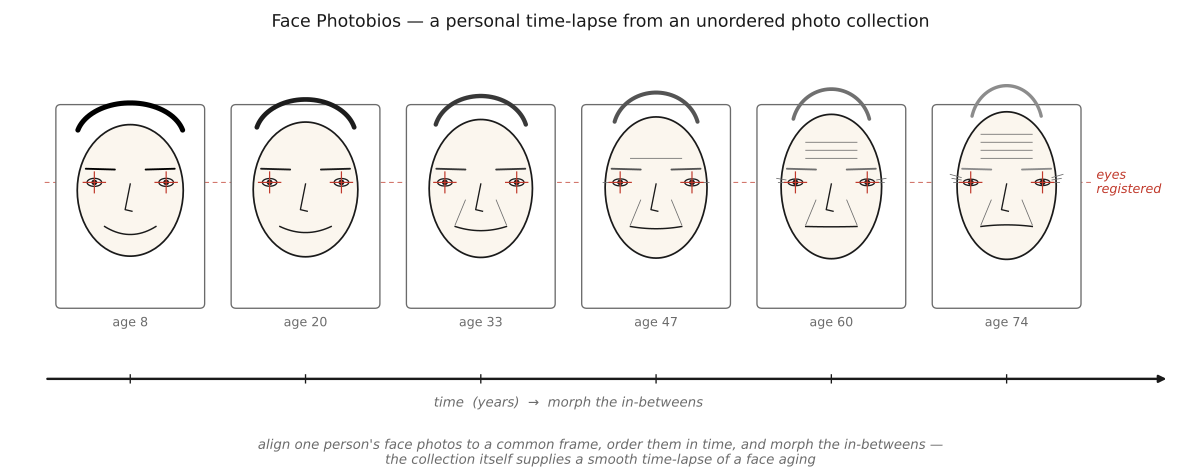
The seminal photobio is Kemelmacher-Shlizerman, Shechtman, Garg & Seitz's Exploring Photobios (2011). Its premise is the firehose of personal photography turned on a single subject: over decades, a person accumulates an enormous, completely unstructured set of pictures of their own face — every age, every expression, every hairstyle and lighting and camera. Left as-is the set is unusable as anything but a search target. The photobio reorganizes it into a continuous experience in three moves: align every portrait to a common frame, order them into a smooth path, and morph the in-betweens so consecutive real photos blend rather than jump. Run with the order set by time, the headline result is a seamless aging time-lapse; run with the order set by appearance, it is a continuous walk through a person's expressions and poses. Either way, a static gallery becomes something you move smoothly through (Figure 11.7.1).
11.7.1 Align and order the collection⧉
The first job is to strip away everything that is not the face. Two portraits taken twenty years apart differ in age and expression, yes, but they also differ in framing, scale, head tilt, and crop — and those nuisance differences swamp the signal. So the photobio begins by detecting facial landmarks (eyes, nose, mouth corners) in every picture and aligning each portrait to a canonical pose and scale (alignment), warping it so those landmarks land in the same places every time. Registered this way, the faces in the collection differ only by what actually changed between captures — age, expression, lighting — and not by the accident of how each photo happened to be framed. This common frame is the precondition for everything that follows: you can only morph between two faces, or fade one into the next, once they occupy the same coordinate system (Figure 11.7.1, middle panel).
With the portraits registered, the second job is to put them in a sensible order. The photobio defines a similarity between two aligned faces — how close they are in appearance, pose, and expression — and uses it to build a graph over the whole collection, every face a node, similar faces joined by short edges. A good viewing sequence is then a smooth path through that graph: a walk that never jumps abruptly from one face to a wildly different one, but instead steps between near-neighbors so the transitions stay gentle. The ordering criterion is a design choice with two natural settings. Order by time — exploit the capture dates — and the path becomes chronological, the substrate of an aging sequence. Order by appearance — ignore the dates and just follow the similarity graph — and the path becomes a continuous tour of expressions and poses, the same face smiling, frowning, turning, looking up and down, with no calendar attached. The ordering is the experience: choosing the path is choosing what kind of journey through the face the viewer will take.
11.7.2 Let the data fill the gaps⧉
Even a perfectly ordered, perfectly aligned sequence of real photographs still flickers. Consecutive captures, however similar, are discrete samples; played in order they jump-cut from one to the next, and the eye reads the discontinuity as a stutter rather than a flow. The remedy is to manufacture the missing frames between every adjacent pair. The photobio does this with feature-based morphing (Warping and morphing): it warps each face toward its neighbor so corresponding features (eyes to eyes, mouth to mouth) glide into alignment, and cross-dissolves between the two warped images, generating a short sequence of synthetic in-betweens that carries one real face smoothly into the next. The Beier–Neely feature morph (1992) is the classic engine for exactly this step. Stitched end to end across the whole ordered path, the morphs erase the seams between captures and the sequence flows instead of flickering.
This is the conceptual heart of the section, and it is worth stating bluntly: the data supplies the in-betweens. There is no aging model that knows how cheeks hollow or hairlines recede, no generative network hallucinating intermediate faces from learned statistics. Every transition is pure interpolation between two pictures the person actually has. The realism of a photobio is borrowed straight from the realism of the underlying captures — the method only rearranges and blends real photographs; it never invents new ones. That is the same data-as-prior wager that runs through this whole part, from scene completion borrowing real pixels in Inpainting Using Millions of Photographs to retrieval reading geography off real geotags: with a rich enough collection, you do not need a parametric model, because the collection itself already contains the answer, and your job is only to find the smooth path through it.
The headline payoff is the aging time-lapse. Order a lifetime of portraits by date, morph the in-betweens, and the result is a continuous, seamless rendering of a single face growing older — childhood to adulthood in one unbroken flow (Figure 11.7.1, right panel). The follow-on work, Illumination-Aware Age Progression (Kemelmacher-Shlizerman et al. 2014), pushed the idea one decisive step further: from the same kind of personal collection it synthesized future ages, predicting what a face will look like years on while correctly disentangling the change due to aging from the change due to lighting. Where the original photobio interpolates between photos that exist, age progression extrapolates past the newest one — but both rest on the same foundation of a person's own aligned collection as the source of truth about that particular face.
11.7.3 Collection as experience⧉
Step back and the photobio belongs to a recurring idea this part keeps circling: a collection re-rendered as something you move through rather than something you look at. As in Photo tourism, the value is not any single frame but the navigable whole — there a place browsed in three dimensions, here a face traversed through time. The same reframing animates the lifelogging archives and personal collections elsewhere in the part: the point of accumulating thousands of images is not the images, but the experience you can reconstruct from them once they are aligned, ordered, and smoothly connected. The photobio is that reframing applied to the most personal collection there is — the record of one's own face — and turned, by alignment and morphing alone, into a continuous life of the face.
The data supplies the in-betweens. A photobio never models how a face ages and never synthesizes a face from scratch — it only aligns, orders, and morphs photographs the person already has. The smooth aging time-lapse is borrowed entirely from the realism of the real captures; morphing just fills the gaps between them. This is the same data-as-prior creed as the rest of this part (Inpainting Using Millions of Photographs, Photo tourism): with a rich enough personal collection, you don't need a parametric model of the subject, because the collection is the model — and the method's whole job is to find the smooth path through it.
Big lessons of this chapter
The recurring principles from this chapter, gathered for review.
The data supplies the in-betweens. A photobio never models how a face ages and never synthesizes a face from scratch — it only aligns, orders, and morphs photographs the person already has. The smooth aging time-lapse is borrowed entirely from the realism of the real captures; morphing just fills the gaps between them. This is the same data-as-prior creed as the rest of this part (Inpainting Using Millions of Photographs, Photo tourism): with a rich enough personal collection, you don't need a parametric model of the subject, because the collection is the model — and the method's whole job is to find the smooth path through it.