11.4 Life logging cameras⧉
A life logging camera is an always-on wearable that photographs your whole day passively — clipped to a shirt or hung at the chest, firing automatically with no decision per shot. Where every other camera in this book waits for a person to choose a moment and press a shutter, this one removes the human from the loop entirely and simply records, all day, producing thousands of images that nobody framed. That single design choice is the whole story. It sets the volume (a firehose, not a roll), it sets the purpose (recall, not photography), and it sets the stakes (a searchable record of every person you passed). The seminal device, Microsoft's SenseCam, was studied less as a camera than as a tool for remembering — which is exactly the point, because a stream this large is worthless until it is curated, summarized, and made searchable. Passive capture, in other words, hands the rest of this part its hardest workload, and hands ethics one of its thorniest cases.
Passive capture inverts the economics of photography — and that inversion is what manufactures the big-data problem. Ordinary photography is expensive per shot and cheap to review: a human pays attention to frame each picture, so the camera roll arrives pre-curated by the act of shooting, and you can flip through a day's photos in a minute. Life logging flips both: capture is free (the device decides nothing and shoots everything) but review is impossible (no one can watch three thousand near-redundant frames a day). The labour that framing used to spend up front does not vanish — it moves downstream, onto the machine, as curation, summarization, and retrieval. This is why the lifelog is the purest motivation for Auto curation and Retrieval: those tools are not conveniences here but the only bridge from an unwatchable stream to a usable memory. Hold this inversion in view — every consequence below, technical and ethical, falls out of it.
11.4.1 The devices and how they fire⧉
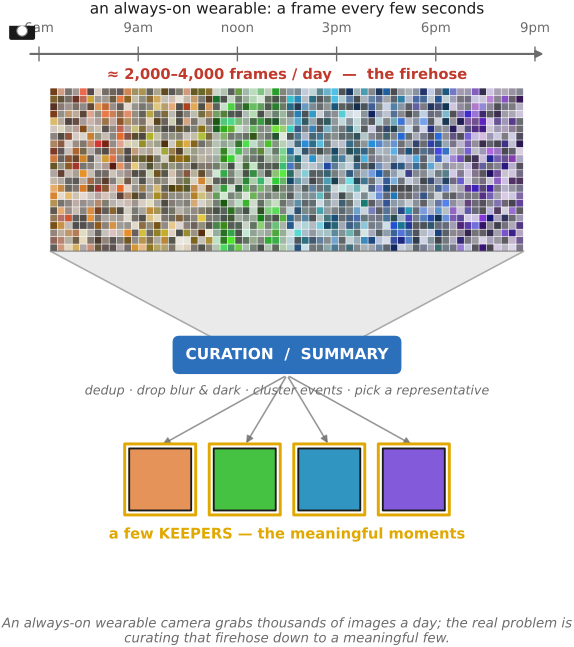
The defining feature is no shutter. A life logging camera is a small chest- or clip-worn device that captures continuously, with no human pressing anything — Microsoft's SenseCam, the Narrative Clip (formerly Memoto), and Google's Clips are the landmarks of the family. Instead of deliberate frames spaced minutes or hours apart, the output is a firehose of thousands of images per day, capturing the world as the body moves through it (Figure 11.4.1). The number is the thing to internalize: at one frame every twenty or thirty seconds, a waking day yields on the order of two to three thousand images, every day, indefinitely. A week of that is an archive larger than most people's entire deliberate photographic output for a year.
The seminal device, SenseCam (Hodges et al. 2006), set the template. It was a fish-eye, chest-worn camera that fired automatically from onboard sensors rather than on a timer alone — an accelerometer to catch changes in motion, an ambient-light sensor to notice when the scene changed (walking from a dark room into daylight), and a passive-infrared sensor to detect the body heat of a person stepping into view. Those triggers are a crude, sensor-level answer to the question this whole part keeps asking: when is something worth capturing? A change in light, motion, or the arrival of a person is a cheap proxy for "something just happened," and SenseCam grabbed roughly 2,000–3,000 images a day on that logic, with the wide fish-eye lens ensuring it caught whatever was in front of the wearer regardless of exactly where they were looking.
The consumer lineage refined the hardware but never resolved the central tension. The Narrative Clip shrank the device to a clip the size of a postage stamp and leaned on a simple interval trigger; Google Clips, years later, replaced sensor heuristics with on-device machine learning that tried to recognize good candid moments — a face it had learned, a pet, a burst of activity — and capture those. That progression, from accelerometer to learned moment-detector, is the part's machinery creeping forward into the trigger itself: the camera is no longer just recording, it is beginning to curate at capture time. But none of these products became commonplace, and the reasons are as much social as technical, which we return to below.
11.4.2 The memory-prosthesis reframing⧉
The decisive move in the SenseCam research was to stop treating it as a camera at all. It was built and studied as a memory prosthesis — a tool whose purpose is recall, where the value lies not in any single photograph but in reviewing the stream to re-consolidate experience. This reframing changes everything about how the system is evaluated. A camera is judged by the quality of its pictures; a memory prosthesis is judged by whether reviewing its pictures helps you remember your life. Those are very different yardsticks, and the second is the one that made the device interesting.
The clinical evidence is what gives the reframing its force. In studies of patients with severe amnesia, reviewing a SenseCam image stream of recent events produced markedly better recovery of autobiographical memory than the standard intervention of keeping a written diary (Hodges et al. 2006, and the rehabilitation trials that followed). The first-person, time-stamped, sensor-triggered stream of images apparently cued recall in a way that text could not — seeing the actual scene reactivated the memory of being there. That is a striking result: the unmanaged firehose, the very thing that makes the device impractical as a camera, turns out to be a uniquely effective memory aid precisely because it is dense and unedited.
This is why life logging belongs in a chapter about collections rather than about lenses. Framing capture as recall reframes the whole problem as one of re-experiencing a collection — exactly the data-driven "collection as experience" thread that runs through Photo tourism (navigate a place through strangers' photos) and Photobios (watch a face age through its own portraits). And it changes what curation is for: collapsing the stream is not just a storage convenience but a memory operation, deciding which moments are worth re-living. The honest tension, addressed in Human factors, is that a perfect external record can also distort memory rather than support it — but the clinical case for recall is what put life logging on the map.
11.4.3 The big-data problem passive capture creates⧉
Now the consequence the lesson promised: nobody can watch a firehose. Thousands of near-redundant, often poorly framed, frequently motion-blurred images a day make manual review flatly impossible — not tedious, impossible, because the time to review a day's capture exceeds the day. So the entire burden of turning the stream into something usable falls on curation, summarization, and retrieval, which here are not enhancements to a perfectly good camera roll but the only mechanism by which the archive becomes usable at all (Figure 11.4.1). Every technique in Auto curation — reject the technically broken, score the rest for quality, collapse near-duplicate bursts, then select a small diverse highlight set — reads, in the lifelog setting, as a survival requirement. The lifelog is the cleanest possible motivation for that machinery: it is the case where, without the machinery, you have nothing.
The two halves of the problem map directly onto the two earlier sections. Summarization — collapsing a day's thousands into a handful of keepers — is curation's diversity-and-coverage objective taken to its extreme, because the redundancy in a passive stream (a hundred near-identical frames of the same commute) is far heavier than in a deliberate camera roll. And retrieval — finding the one moment you need inside a year of frames — is the memory-prosthesis use case made operational: recall is exactly a query against the collection ("the lunch where we discussed the project"), answered by the content-based search of Retrieval rather than by scrolling. The firehose is what turns both of those from nice-to-haves into the product's actual job.
And so selection becomes the product. The real output of a life logging camera is not the raw stream but what it chose to keep — which means the editing is the feature. Google Clips made this explicit: it ran on-device ML to grab candid moments automatically and surface a small set, an automated candid camera where the curation is the deliverable. That places it as a sibling of the anticliché / candid camera projects in Artistic projects with photo collections — both are machines deciding what to shoot, with the human relegated from photographer to subject. The lesson's inversion has come full circle: capture went free, so the value migrated entirely to selection.
11.4.4 Privacy and ethics⧉
Always-on capture has a categorically different ethical footprint from deliberate photography, and the difference is consent. A passive recorder sweeps in bystanders who never agreed to be captured — strangers on the street, colleagues in a meeting, friends in a private home — in public and private spaces alike. Deliberate photography at least involves a person aiming a camera, a visible act that bystanders can notice and object to; a clip-worn device firing silently every twenty seconds removes even that signal. This is a recurring, and largely unsolved, reason these products struggle to ship: the social cost of wearing one is borne by everyone around the wearer, who got no say (see Human factors). It is the same structural problem that surfaced later and more loudly with always-on glasses, and life logging is its first clear instance.
The archive itself is a second, distinct liability. A searchable, geolocated, face-rich, time-stamped record of a person's every day is an extraordinarily sensitive dataset — arguably more sensitive than any deliberate photo collection, because it is comprehensive rather than selective. Its security, ownership, and retention are as much the design problem as the optics: who can query it, how long it persists, what happens to it in a breach or a subpoena, and whether the bystanders it captured have any rights over their own appearance in it. The very capabilities that make the lifelog valuable as a memory prosthesis — that it is dense, complete, and fully searchable — are exactly what make it dangerous as a record. This is the population-scale echo of the consent-and-likeness problem that Personalized priors raises for a single subject: the more faithfully a system captures a person, the more its governance, not its accuracy, becomes the central question.
Big lessons of this chapter
The recurring principles from this chapter, gathered for review.
Passive capture inverts the economics of photography — and that inversion is what manufactures the big-data problem. Ordinary photography is expensive per shot and cheap to review: a human pays attention to frame each picture, so the camera roll arrives pre-curated by the act of shooting, and you can flip through a day's photos in a minute. Life logging flips both: capture is free (the device decides nothing and shoots everything) but review is impossible (no one can watch three thousand near-redundant frames a day). The labour that framing used to spend up front does not vanish — it moves downstream, onto the machine, as curation, summarization, and retrieval. This is why the lifelog is the purest motivation for Auto curation and Retrieval: those tools are not conveniences here but the only bridge from an unwatchable stream to a usable memory. Hold this inversion in view — every consequence below, technical and ethical, falls out of it.