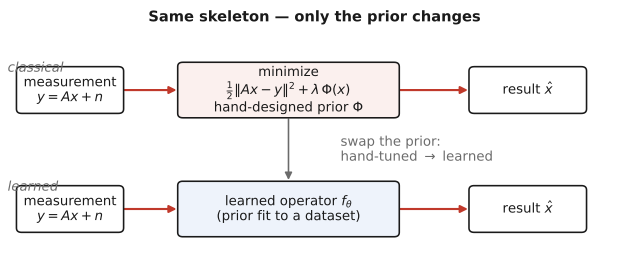
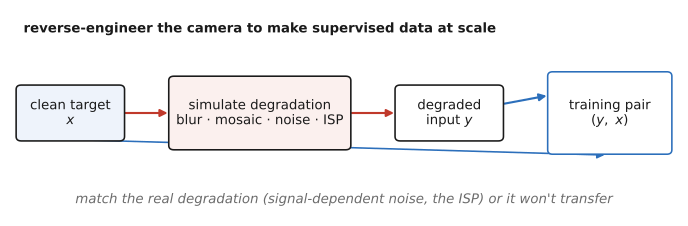
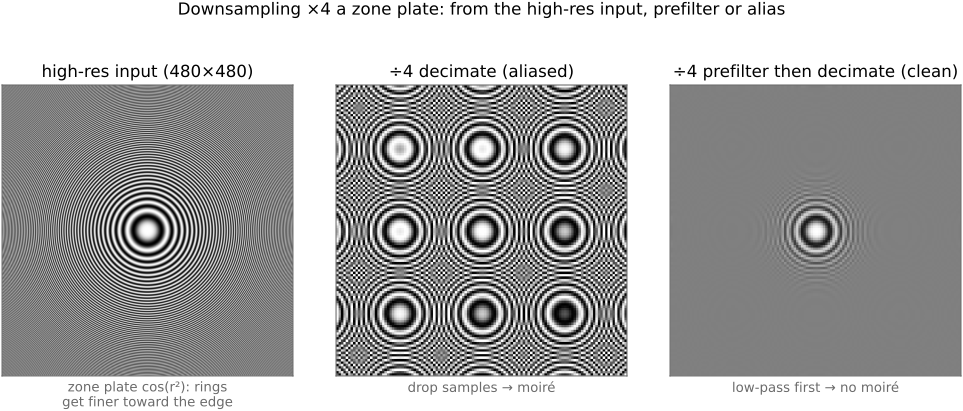
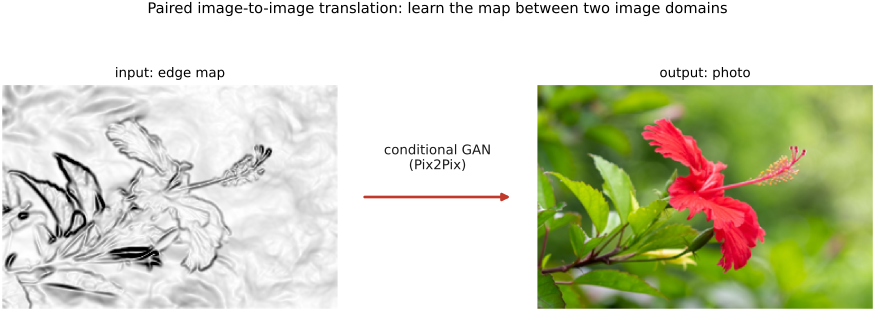
The bread-and-butter: an image-to-image net (typically a **U-Net** / encoder–decoder) maps a degraded or partial image to a restored one. Each task below is the *classical* chapter's task, now learned. [fig-learned-task-zoo]
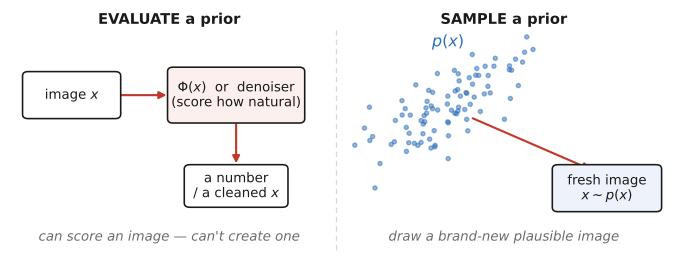
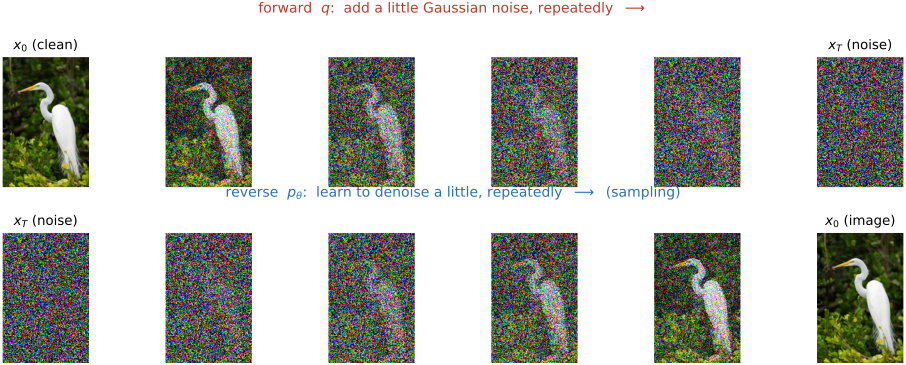
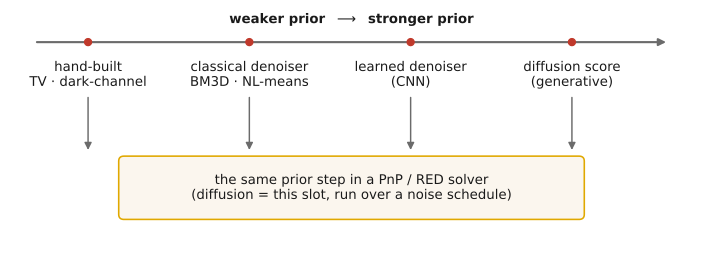
• **denoising.** Train on (noisy, clean) pairs → a learned denoiser that beats hand-tuned NLM/bilateral, *if* the training noise matches the real sensor noise (→ the data story, [[Machine learning]]). Forward-ref: the denoiser as a reusable prior ([[Super-resolution and image priors#Denoising as a universal prior â Plug-and-Play and RED|Denoising as a universal prior]] — PnP/RED) and diffusion as iterated denoising ([[Generative AI and diffusion]]).
• **demosaicking — and joint demosaick+denoise.** Gharbi et al.: a single net learns to go **mosaic → full RGB**, jointly with denoising, trained on hard cases mined from data — outperforming the hand-built interpolators of Book 2. The headline case that "learn the operator end-to-end" beats a decades-tuned pipeline stage. [fig-learned-task-zoo: mosaic→RGB cell]
• refs: Gharbi et al. 2016 (deep joint demosaicking & denoising).
• **super-resolution.** Pose low-res → high-res as a learned map. Lineage from **Freeman et al.** (example-based / patch-dictionary super-res — the pre-deep ancestor) to modern nets: **SwinIR** (transformer restoration backbone) and **Real-ESRGAN** (GAN-trained on a *realistic* synthetic degradation model for in-the-wild photos). Note: the deep treatment of SR + priors may live in [[Super-resolution and image priors]]; here it's one entry in the zoo with a forward-ref.
• refs: Freeman et al. 2002 (example-based SR); Liang et al. 2021 (SwinIR); Wang et al. 2021 (Real-ESRGAN).
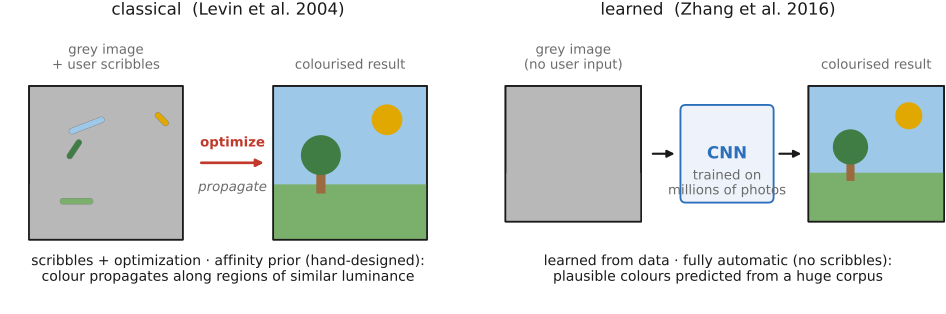
• **colorization — classical vs learned, side by side.** Two paradigms: **Levin et al. 2004** propagates a few user **scribbles** by optimization (edge-preserving — "same color where intensity is similar", an *affinity* prior, cross-ref L4); **Zhang, Isola & Efros 2016** learns **fully automatic** colorization from a huge corpus, posed as classification over quantized colors to fight desaturation. Contrast: hand-designed propagation vs learned-from-data plausibility. [fig-colorization-classical-vs-learned]
• refs: Levin, Lischinski & Weiss 2004 (colorization by optimization); Zhang, Isola & Efros 2016 (colorful image colorization).
• **monocular depth.** Estimate depth from a *single* RGB image — ill-posed, so the net learns a strong **scene prior**. **MiDaS**: trained across many datasets via a **scale/shift-invariant** loss to mix incompatible depth sources; **Depth Anything**: scale further with massive (pseudo-labelled) data → robust zero-shot depth. Note it's *relative* depth, and forward-ref geometric/dual-pixel depth (Books on geometry / multi-image). [fig-depth-anything]
• refs: Ranftl et al. 2019 (MiDaS); Yang et al. 2024 (Depth Anything).
• **learned exposure / retouch (tone & color adjustment).** Learn a photographer's **global/local adjustment** from before/after pairs. **Bychkovsky et al. (MIT-Adobe FiveK)**: the dataset of expert retouches that made this learnable. **HDRnet** (Gharbi 2017): predict the *coefficients of a bilateral-grid affine transform* — fast, edge-aware, runs on a phone (cross-ref the learned bilateral grid in edge-preserving). **Exposure** (Yuanming Hu 2018): learn a sequence of *interpretable* retouching operations (curves, white balance) rather than raw pixels — keep as the "learn the *operations*, not the pixels" variant.
• refs: Bychkovsky et al. 2011 (FiveK); Gharbi et al. 2017 (HDRnet); Hu et al. 2018 (Exposure).