9.10 The eye as an optical instrument: vision and its correction⧉
Everything this part has said about cameras was, quietly, also about you. The instrument reading these words is a lens that forms a real image on a light-sensitive surface, focuses itself, suffers aberrations, and — for most readers past a certain age — needs correction. It is worth closing the optics part by turning its whole apparatus on the eye, because two things fall out at once. First, the eye is a beautiful worked example: every concept in the part has a wetware counterpart, and naming them makes both the eye and the camera clearer. Second, the corrective optics that hundreds of millions of people wear every day — spectacles, contacts, the lens implanted after cataract surgery — are applied lens design, solving the part's exact problems (defocus, astigmatism, aberration) in the smallest, most personal optical system there is. We build the camera analogy, catalogue the four ways the eye falls out of focus and how each is corrected, and then follow the one error that has no simple fix — the age-related loss of focusing — from the bifocal to the electronically tunable autofocus lens.
9.10.1 The eye as a camera⧉
Map the eye onto a camera part by part and it lines up almost suspiciously well. The objective — the lens that gathers light and forms the image — is not one element but two in series: the cornea, the transparent front dome, and the crystalline lens behind the iris. The surprise for most people is that the cornea does most of the work: because it is the air-to-tissue interface where the refractive-index jump is largest, the cornea supplies roughly two-thirds of the eye's optical power, and the crystalline lens supplies the rest (and, crucially, the adjustable part). The aperture is the iris, whose central hole, the pupil, opens and closes to control how much light enters — from about f/2.1 wide open in the dark to roughly f/8 constricted in bright light, a range any photographer will recognize as a few stops of automatic exposure control. The sensor is the retina, the layer of photoreceptors lining the back of the eyeball, with its sharp central patch, the fovea, playing the role of the high-resolution center of the frame — except that here the "sensor" is sharp only at its center and the eye must constantly point that center at whatever it is examining. And the autofocus is accommodation: the ring-shaped ciliary muscle squeezes or relaxes, reshaping the soft crystalline lens to change its power and pull the focal point onto the retina as the gaze shifts from far to near (Figure 1). All of this was introduced anatomically under Human perception; here we read it as optics.
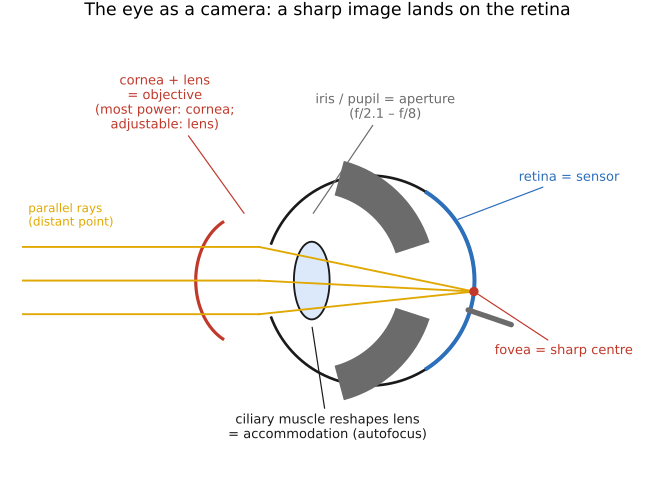
Reading the eye as a lens immediately predicts that it must have the defects every lens in this part has had. It does. The eye has aberrations — spherical aberration, coma, and a touch of chromatic aberration — and so even a perfectly focused, perfectly healthy eye does not image a point as a point but as a small blur, a diffraction-and-aberration-limited point-spread function exactly like the ones from Aberrations correction. The everyday measure of the eye's resolution, visual acuity — the familiar "20/20," meaning you resolve at 20 feet what a normal eye resolves at 20 feet — is nothing more than the eye's spec sheet, its angular resolution limit, the same number a lens designer would quote as the system's resolving power. The entire optical chain this part has built — objective, aperture, sensor, focus mechanism, aberrations, a resolution limit — exists in wetware, behind your cornea.
9.10.2 Refractive errors: the eye out of focus⧉
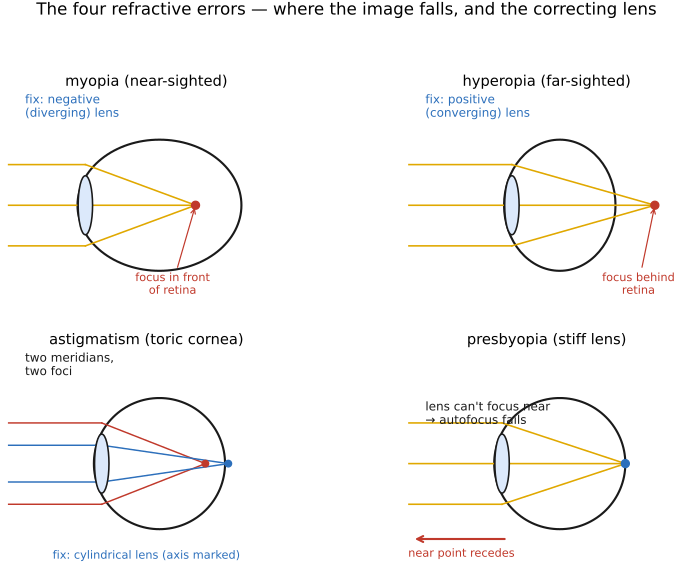
A "normal" (emmetropic) eye lands the image of a distant object exactly on the retina with the lens fully relaxed, and accommodates inward to hold focus as objects approach. A refractive error is simply a mismatch between the eye's optical power and the length of the eyeball, so the image lands somewhere other than on the retina. There are four common ones, and three of them are precisely the optical defects this part already named — the eye's own defocus and astigmatism (Figure 2).
Myopia (near-sightedness) is the eye being too powerful for its length — either the cornea and lens bend light too strongly or, more commonly, the eyeball is too long front-to-back. Light from a distant object therefore comes to a focus in front of the retina and is already spreading again by the time it reaches it, so distant objects blur while near ones (whose light needs more convergence) can still land correctly. The fix is to remove some power before the eye's own optics: a negative, diverging lens that spreads the incoming light slightly, pushing the focus back onto the retina. (Myopia is now near-epidemic in much of the world, an increase strongly linked to childhood near-work and, in particular, to a lack of bright outdoor light during development — a public-health story riding on a simple optical mismatch.)
Hyperopia (far-sightedness) is the opposite mismatch: the eye is too weak for its length, usually because the eyeball is too short, so the focus falls behind the retina. A young hyperopic eye can often accommodate to drag the focus forward and see clearly anyway, at the cost of constant focusing effort; as that reserve fades, near vision goes first. The fix is to add power with a positive, converging lens that does some of the eye's converging for it.
Astigmatism is this part's astigmatism, living in the eye. Instead of being a clean surface of revolution, the cornea (or sometimes the lens) is shaped more like the side of a rugby ball — toric, with more curvature in one meridian than in the perpendicular one. Different meridians then have different optical power and focus at different distances, so there is no single sharpened plane: vertical and horizontal detail cannot be brought into focus at once, exactly the off-axis astigmatism of Aberrations correction, here present on-axis because the eye's own surface is asymmetric. The fix is a cylindrical lens, which has power in only one meridian and so can add exactly the missing power along the weak axis, oriented to match — which is why an eyeglass prescription specifies not just a power but a cylinder and an axis angle.
Presbyopia is the odd one out — not a mismatch of power and length but a failure of the focusing mechanism itself. With age the crystalline lens stiffens and the ciliary muscle weakens, so accommodation gradually fails: the eye can no longer add power to focus up close, and the near point recedes until reading material must be held at arm's length and then beyond it. It is near-universal after about age 45, it accumulates on top of whatever other refractive error a person already has, and unlike the other three it cannot be fixed by a single fixed-power lens — because the problem is precisely that one power is no longer enough. Presbyopia is the eye losing its autofocus, and it drives the entire final section.
There is a useful aside that ties straight back to Depth of field: the pinhole effect. Squinting, or looking through an array of tiny holes (so-called pinhole glasses), sharpens a blurry world for any refractive error at once, because narrowing the effective aperture deepens the depth of field — the very same trade the camera makes when it stops down. A smaller pupil shrinks every defocus blur circle, so the uncorrected image tightens up. The catch is identical to the camera's: a smaller aperture passes far less light, so the pinhole trick buys sharpness by spending brightness. It is depth of field, demonstrated on your own retina.
9.10.3 Correcting vision⧉
Once the eye is read as a defocused (or astigmatic) lens, the corrections are just lens design applied at the smallest, most personal scale — and they span the same hardware-to-surgery range the rest of the part has explored, from a separate corrective element to editing the optic itself.
Spectacles are the original, computation-free fix: a thin corrective lens held a short distance in front of the eye, supplying the missing or excess power (negative, positive, cylindrical, or a combination) so the eye's own optics land the image on the retina. Contact lenses do the same job but sit directly on the cornea, riding the tear film. Because they move with the eye and sit at the cornea rather than a centimetre in front of it, contacts give a wider effective field of view and avoid the prismatic distortion and magnification changes that strong spectacle lenses introduce toward their edges — a meaningful advantage for strong prescriptions. Intraocular lenses (IOLs) go further and replace the optic: in cataract surgery the clouded crystalline lens is removed and an artificial lens is implanted in its place, with a power chosen to correct the eye's refractive error at the same time — the optical element itself swapped out rather than supplemented. And refractive surgery edits the cornea directly: LASIK (laser-assisted in-situ keratomileusis) lifts a thin corneal flap and uses an excimer laser to reshape the tissue underneath, while PRK (photorefractive keratectomy) ablates the surface directly after removing the outer layer. Either way the surgeon is reshaping the cornea to dial in a new prescription — surgically editing the eye's front surface the way a designer would respecify a lens surface.
Spectacle lenses themselves are a small showcase of this part's hardware tricks. They get anti-reflection coatings — the same thin-film destructive-interference stacks from Glare suppression — to cut the reflections that otherwise veil the wearer's eyes and waste light. They are made in high-index glass or plastic so that a given power can be achieved with less curvature and thus a thinner, lighter lens (the strong prescriptions that used to mean "Coke-bottle" lenses). They use aspheric surfaces to reduce the off-axis aberration and distortion of strong lenses, exactly as aspheres do in camera optics from Aberrations correction. And sunglasses borrow two more: photochromic lenses darken automatically under ultraviolet light, and polarized sunglasses cut glare from reflective surfaces using the same physics as the camera polarizing filter (cross-ref the polarizer treatment in the Photography part). Eyewear is lens design wearing a face.
9.10.4 Presbyopia and the bifocal problem: from bifocals to AF glasses⧉
Presbyopia is the error a single lens cannot fix, and the long, ingenious effort to fix it anyway is the most direct bridge from the eye back to the programmable optics of the Advanced part. The problem statement is purely optical: a presbyopic eye needs one power for distance and a different, stronger power for near (reading), and possibly intermediate powers in between — but a plain spectacle lens has exactly one focal length. You cannot serve both with a single fixed element. Every solution is some way of packing more than one power into the optics in front of the eye, and they fall into a clear progression (Figure 3).
The first answer was to put two zones in one lens: the bifocal, attributed to Benjamin Franklin, with a distance prescription filling most of the lens and a small near segment set into the lower part, where the eye naturally rotates to read. Trifocals add a third, intermediate zone. The scheme works, but the boundary between zones is a visible line and an optical discontinuity: as the gaze crosses it the image jumps (the "image jump" artifact), and there is no smooth handoff between the powers. The eye is given two cameras and a hard cut between them.
Progressive (varifocal) lenses smooth that cut away. Instead of discrete zones, the lens surface is ground so that its power increases continuously from top to bottom — distance power up where you look ahead, gradually adding power down toward where you read — with no line and no jump. The price is paid sideways: a surface that varies power vertically cannot also be optically clean horizontally, so progressives carry peripheral distortion and a narrow usable corridor of sharp vision down the middle, with soft, swimmy regions to either side that wearers must learn to point their nose around. It is a fixed lens making the best possible compromise among a continuum of powers it must hold all at once — and like the fixed lenses earlier in the part, the compromise is the cost of doing the whole job passively.
The active alternative is to make the lens's power change on demand, so that one element can be the distance lens or the reading lens as needed — the same move from a fixed compromise to a controllable system that recurs throughout computational optics. These are focus-tunable lenses, and they come in two families.
The fluidic / Alvarez family changes power mechanically. A liquid-filled lens can be pumped to change the curvature of a flexible membrane and hence its power; an Alvarez lens uses two specially-shaped plates that slide laterally across each other, their combined cubic profiles summing to a variable optical power as they shift. Set by a small dial or slider, these give adjustable-focus eyewear in which the wearer tunes their own prescription — an idea championed by physicist Josh Silver for self-refraction eyewear that could be fitted without an optometrist, aimed squarely at parts of the world where eye-care professionals are scarce. The power is adjustable, but the adjustment is manual: you set it and it stays.
The liquid-crystal (LC) / electronic family changes power electrically, with no moving parts — and this is the family that closes the loop with the rest of the book. A layer of liquid crystal sits in the lens; applying a voltage reorients the LC molecules, changing the layer's optical retardance and thus the phase it imposes on transmitted light. Pattern that voltage across the lens and you can switch in (or smoothly tune) an added reading power on command. This is precisely a programmable phase element — the same physics, at spectacle scale, as the liquid-crystal spatial light modulators (LC-SLMs) treated in the Advanced part, where a pixelated LC panel shapes a wavefront under electronic control. Pair such a tunable lens with an eye-tracker or rangefinder that detects when the wearer's gaze drops to a near object, and the glasses can switch on reading power automatically, focusing to wherever you look — autofocus eyewear, prototyped commercially under names like Deep Optics' "32°N". The eye-tracker plays the role of the camera's autofocus decision layer from Focus, autofocus; the tunable LC lens plays the role of the focusing mechanism.
That is the throughline, and the place to end the part. Autofocus glasses are accommodation re-implemented in hardware — the soft, self-reshaping autofocus the crystalline lens lost to age, rebuilt outside the eye as an electronically tunable lens driven by a gaze sensor. They are the wearable cousin of camera autofocus, and their LC phase element is the wearable cousin of the spatial light modulators that the Advanced part uses to compute with light. The eye began this chapter as a worked example of the part's optics; it ends it pointing forward, the lost biological autofocus restored by exactly the programmable, computational optics this book has been building toward.