9.1 Aberrations and optical challenges⧉
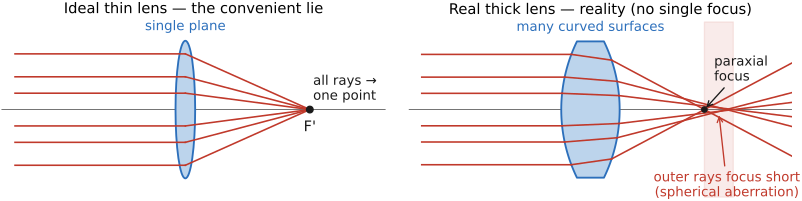
The thin lens of FUNDAMENTALS is a beautiful machine: feed it a point of light and it gives you back a point. Every real lens disappoints that promise, and it does so in a small, finite number of characteristic ways. The whole of this part is the study of those ways — how they arise, how the glass is shaped to fight them, and how, where the glass gives up, computation finishes the job. Before any of that, you need the bestiary: a name, a look, and a one-line cause for each defect, so that when you see a soft glowing highlight, a comet-shaped star in the corner, a purple fringe on a branch against the sky, or a bowed horizon, you can say which failure of the ideal lens you are looking at.
The organising fact is simple and worth stating once, plainly. The thin lens is right only because it keeps just the first term of everything. Snell's law of refraction, $n_1\sin\theta_1 = n_2\sin\theta_2$, is non-linear, but for small angles $\sin\theta \approx \theta$ and it goes linear; that linearization is what makes a single focal length $f$ and the clean equation $1/f = 1/u + 1/v$ work. Restore the next term of the expansion,
and the cubic correction means rays through the edge of the aperture no longer land exactly where the central rays do. Let the refractive index depend on wavelength, $n(\lambda)$ — dispersion — and red and blue focus in different places. Add that real glass has thickness, real lenses have many surfaces, and real barrels have mounts, dust, and air gaps, and you have the full set of challenges below. Every one of them is geometry or physics the thin lens chose to ignore; none is a manufacturing defect.
9.1.1 Taxonomy of challenges⧉
A single lens has essentially one free knob — its power, the focal length $f$ set by the curvatures and the glass. But a photograph demands that the lens satisfy many constraints at once: bring every field point to focus, at every wavelength, across the whole aperture, onto a flat sensor, with no stray light and no geometric warp. One degree of freedom cannot meet that many demands, which is the deep reason a real photographic lens is a stack of six, ten, or twenty elements (the subject of the next chapter). The defects sort into a few families:
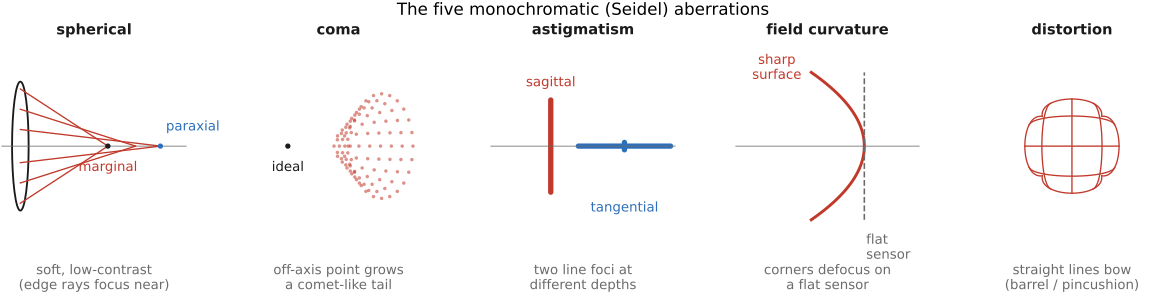
- Monochromatic aberrations — failures of geometry that survive even in a single color, because the spherical surfaces that are easy to grind are not the surfaces that focus perfectly. Restoring the cubic $\theta^3$ term of $\sin\theta$ produces exactly five of these, the classical Seidel aberrations: spherical, coma, astigmatism, field curvature, and distortion. This chapter treats the ones with the most distinctive photographic signatures.
- Chromatic aberration (CA) — a failure of color, because the index $n(\lambda)$ disperses, so each wavelength is effectively a slightly different lens.
- Wave effects — a failure rooted in the physics of light itself: even a geometrically perfect lens cannot beat diffraction, the fundamental blur set by the aperture and the wavelength.
- Radiometric and stray-light defects — vignetting (the image dims toward the corners) and flare (unwanted reflected and scattered light), which move or lose light energy rather than mis-focusing it.
A useful way to keep them straight is by what they do to the light. Most aberrations misplace energy — they take the rays that should have met at a point and spread them into a blur, so they cost sharpness and you cannot perfectly undo them after the fact. Distortion is the striking exception: it keeps every point sharp and merely puts it in the wrong place, which is why it is the one defect that software corrects almost perfectly. Vignetting loses energy unevenly across the frame. Flare adds energy where it does not belong. We meet them in roughly that order. Throughout, the look of each defect — the spot it paints on the sensor, its point-spread function (PSF), the lens's answer to a single point of light — is summarised in the part's master figure.
spherical aberration⧉
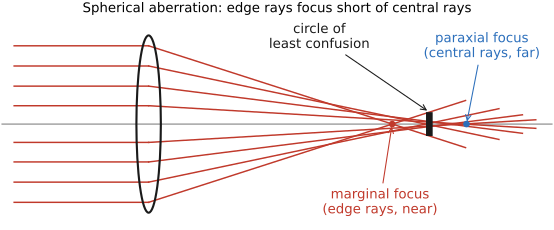
What it is. Rays that pass through the edge of the aperture are bent too strongly and cross the axis nearer the lens than rays through the centre. There is no single focal plane: the marginal rays focus short, the paraxial rays focus long, and in between they form a waist of least confusion. This is the most direct consequence of keeping the cubic $\theta^3$ term — a sphere refracts the outer rays a little too hard.
What it looks like. A soft, low-contrast image with a glowing halo around bright points and highlights — the sharp core sits on a luminous skirt of the mis-focused marginal rays. It is worst wide open, because that is when the aperture admits the outer rays at all, and it visibly cleans up as you stop down, which masks the offending edge of the lens. It also shows up as focus shift: the plane of best focus moves as you change aperture.
Why. The spherical surface, prized because any two pieces of glass ground against each other tend naturally toward a sphere, is simply the wrong shape for perfect focus; the correct surface is an asphere. The cure — an aspheric element, or splitting the optical power across several elements — lives in Aberrations correction. Some lenses leave it in on purpose: the dreamy soft-focus portrait look is under-corrected spherical aberration (see Special optics).
coma⧉
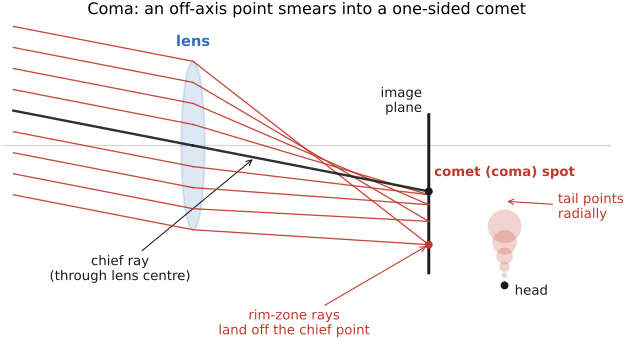
What it is. Coma is the off-axis cousin of spherical aberration: for a point that is not on the optical axis, the rays through different zones of the aperture image it at different magnifications, so instead of a clean point they pile up into a one-sided, comet-shaped smear (the name is from coma, a comet's tail). The blur is asymmetric — it has a bright head and a flaring tail pointing radially, toward or away from the centre of the frame — which is what makes it so recognisable and so ugly.
What it looks like. Stars, streetlights, and specular highlights toward the edges and corners of the frame grow little wings or tails; a field of night-sky stars that are crisp dots in the centre turn into tiny comets at the margins. Like spherical aberration it is worst wide open and improves on stopping down.
Why. It is one of the five Seidel terms — an inevitable consequence of the cubic expansion for off-axis points. It belongs to the family of odd aberrations that are cancelled automatically by building the lens symmetrically about the aperture stop (the double-Gauss design — the next chapter), which is exactly why symmetric designs dominate fast normal lenses. Full treatment of the cure is in Aberrations correction.
astigmatism⧉
What it is. Off-axis, even a lens corrected for coma "sees" its circular aperture foreshortened into an ellipse, and the upshot is that detail oriented radially (the sagittal direction, pointing toward the frame centre) and detail oriented tangentially (perpendicular to it) come to focus at two different depths. There is no single plane where both are sharp: at one focus the radial spokes of a wheel snap in while the rim blurs, and a little farther along it reverses. An off-axis point never collapses to a dot — it stretches into a short line that swings through ninety degrees as you rack focus.
What it looks like. You cannot get radial and tangential fine detail crisp at the same field position at once: a smear that changes orientation as you refocus, worst toward the corners. Together with field curvature (next), it is why uncorrected simple lenses are mushy off-centre even when the middle is sharp.
Why. The third of the five Seidel terms, again a consequence of the cubic expansion off-axis. Its cure — balancing element powers and the placement of the stop, and trading it off against field curvature on the Petzval surface — is in Aberrations correction.
field curvature⧉
What it is. Even when every point is individually in sharp focus, the surface on which those sharp points lie is not flat — it is a bowl, the Petzval surface, curving toward or away from the lens. But the sensor is flat. So if you focus to make the centre crisp, the corners fall off the curved focal surface and go soft; refocus for sharp corners and the centre softens.
What it looks like. Centre-sharp, corner-soft (or the reverse) in a way that no single focus setting fixes — the softness is built into the geometry, not into where you put the focus ring. It is the bane of flat subjects like document copying, brick walls, and star fields, and it is why a "flat-field" lens is a prized and specially corrected thing.
Why. The fourth Seidel aberration, governed by the Petzval sum of the elements' powers and glasses. The cure is a dedicated field-flattener element near the focal plane, treated in Aberrations correction.
chromatic aberration⧉
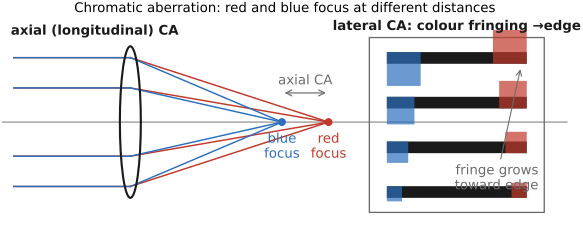
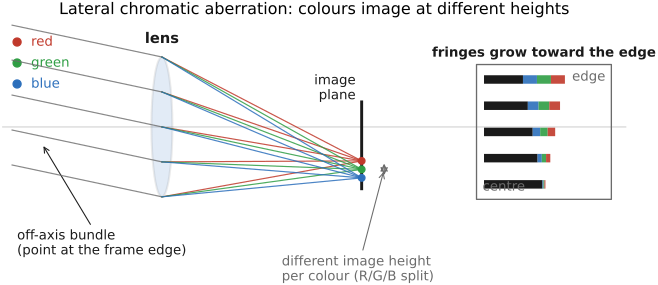
What it is. Glass bends blue light more than red, because the refractive index falls with wavelength — dispersion. So a lens has, in effect, a slightly shorter focal length for blue than for red, and the colors do not share a focus. The strength of a glass's dispersion is summarised by its Abbe number,
a ratio of the mid-spectrum refraction to the spread between blue ($F$) and red ($C$) lines; a high $V_d$ means low dispersion. Chromatic aberration (CA) comes in two flavours:
- Axial (longitudinal) CA — red, green, and blue focus at different depths along the axis. No single plane is sharp for all colors; each is slightly blurred by the others. It is worst at fast apertures and only partly relieved by stopping down.
- Lateral (transverse) CA — the colors are imaged at different magnifications, so they line up at the centre but spread apart toward the edges.
What it looks like. Axial CA gives color halos around high-contrast edges, classically a green-to-magenta glow that flips sign as you rack through focus, and it is a big contributor to the purple fringing you see on backlit branches and chrome trim (part CA, part sensor blooming and flare). Lateral CA gives colored fringes that grow toward the corners — a red edge on one side of a dark line, a blue edge on the other — strongest at the frame's margins and absent at the centre.
Why. Purely the wavelength dependence $n(\lambda)$; it would vanish in a single-color world. The classic cure is the achromatic doublet — a low-dispersion crown element paired with a high-dispersion flint so the color errors cancel at two wavelengths — and, for the demanding cases, apochromats with special low-dispersion glasses. Lateral CA, being a per-color magnification error, is essentially a geometric rescale and is therefore highly correctable in software; axial CA, a genuine per-color blur, is not. The full story of both cures, in glass and in code, is in Aberrations correction.
radial distortion⧉
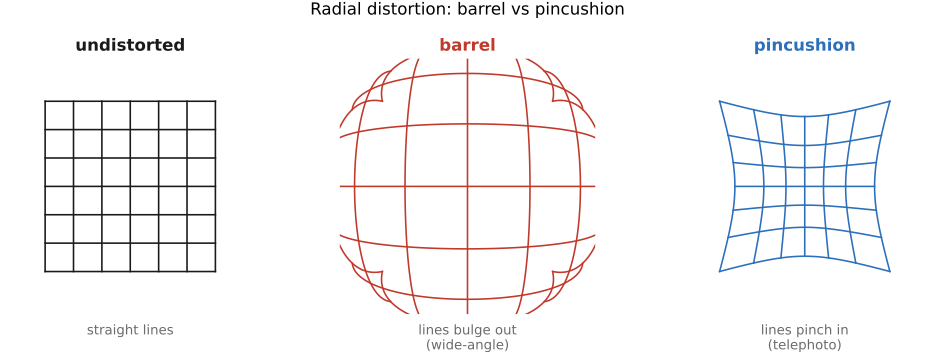
What it is. Distortion is the odd one out among aberrations: it does not blur anything. Every point stays perfectly sharp; the magnification simply varies with how far the point is from the centre of the frame, so points land at the wrong radius. When magnification grows toward the edge, straight lines bow outward — barrel distortion (think of a barrel's bulging sides), typical of wide-angle lenses. When magnification falls toward the edge, lines bow inward — pincushion distortion, typical of telephotos. Zooms often do both at different focal lengths.
What it looks like. Straight edges that should be straight — the horizon, a building, a door frame, the sides of the frame itself — curve gently. The effect is strongest near the frame edges and zero at the centre; a square grid is the cleanest way to see it.
Why. A Seidel term, but a peculiar one: because it merely relocates sharp points along the radius rather than spreading their energy, it is the single most software-correctable defect in optics. A measured radial warp — a per-lens map of true radius to imaged radius — straightens the lines almost perfectly, which is why nearly every camera and phone ships with built-in distortion correction in the image pipeline. (It is also why a fisheye's dramatic barrel is treated not as an aberration but as an intended projection — see Special optics.) The correction itself is detailed in Aberrations correction.
The standard parametric models. The radial remapping is captured, for both lens-profile correction and camera calibration, by a low-order polynomial in the radius. Writing $r_u$ for the undistorted radius and $r_d$ for the distorted radius (both measured from the distortion centre), the Brown–Conrady model expands the distorted radius forward as
with optional tangential (decentring) terms $p_1, p_2$ for elements mounted slightly off-axis; $k_1<0$ gives barrel, $k_1>0$ pincushion. An alternative that inverts more cleanly — a single parameter often captures even strong wide-angle distortion — is the division model (Fitzgibbon),
which is why it is popular in calibration pipelines. Either way the correction is a one-dimensional curve fit per lens; the mechanics live in Aberrations correction.
wave effects and diffraction⧉
What it is. Everything above treated light as rays. But light is a wave, and a wave passing through an aperture diffracts — it spreads. Even a geometrically perfect, aberration-free lens cannot focus a point to a point; the best it can do is a small bright disc ringed by faint haloes, the Airy pattern, whose angular radius is set by the wavelength $\lambda$ and the aperture diameter $D$:
This is a floor, not a defect of any particular lens — the diffraction limit. A bigger aperture (larger $D$) diffracts less; a smaller one diffracts more.
The pattern is the aperture's Fourier transform. There is an exact and rather beautiful way to say what that bright disc and its rings actually are: the diffraction pattern a point source makes is the Fourier transform of the aperture (its squared magnitude, to be precise — this is the point-spread function of a diffraction-limited lens). A round hole transforms into the Airy disc and its concentric rings; and because a wider function has a narrower transform, a bigger aperture makes a smaller spot — which is exactly the $\theta \approx \lambda/D$ floor, now read as a statement about Fourier transforms. The same fact explains sunstars, the radiating spikes around a bright streetlight or the sun in a stopped-down frame: they are the Fourier transform of the polygonal opening the diaphragm blades form, each straight blade-edge throwing a perpendicular streak of light, so an iris of $n$ blades makes a star with $n$ points when $n$ is even and $2n$ when $n$ is odd. This is the same Fourier transform that runs through the BASIC part — there it diagonalizes blur; here the lens computes one for free, in the time it takes light to cross the aperture.
What it looks like. Counter-intuitively, stopping down — which cures the geometric aberrations above — eventually starts softening the whole image again, because the shrinking aperture raises the diffraction floor. Every lens therefore has a sweet spot a couple of stops down from wide open, where the aberrations have mostly faded but diffraction has not yet taken over; close down further (a high f-number) and the picture goes uniformly mushy. Diffraction also caps the finest detail a sensor of given pixel size can usefully resolve.
Why. It is the wave nature of light, not a flaw in the glass — which is precisely why it is a limit rather than an aberration to be corrected. It connects forward to the part's recurring theme: because the smallest blur a lens can make is the diffraction spot, the PSF is never a true point, and engineering or inverting that PSF — by deconvolution, by coded apertures and wavefront coding — is the computational side of the story (forward-referenced to Aberrations correction and the Advanced part). The full optics of the Airy pattern and the resolution limit belong to the Fourier-optics treatment cited below; here we only flag that the floor exists.
vignetting⧉
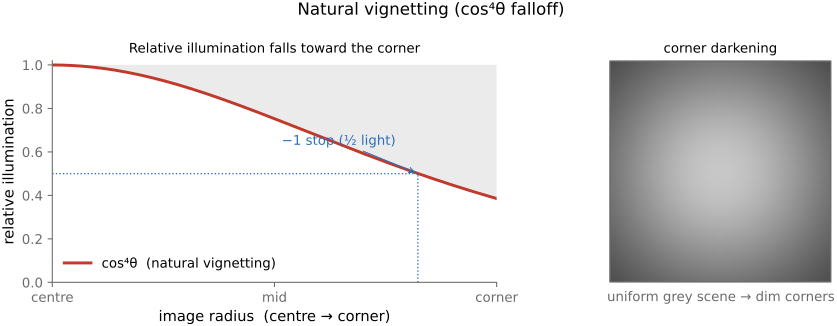
What it is. The image gets darker toward the corners. Two distinct mechanisms share the name. First, a purely geometric one that even a perfect lens cannot escape: light reaching the corner of the frame arrives at a steep angle and is dimmed by a factor of $\cos^4\theta$ (the natural or $\cos^4$ falloff introduced in FUNDAMENTALS, from the tilt of the pupil, the longer path, and the foreshortened aperture). Second, optical vignetting (sometimes mechanical vignetting): off-axis, the lens barrel and the front and rear elements partially block the aperture, clipping the bundle of light that would otherwise reach the corner.
What it looks like. A gradual darkening from a bright centre to dim corners, strongest wide open for the optical component and largely independent of aperture for the $\cos^4$ component. Optical vignetting also reshapes the out-of-focus highlights near the edges into cat's-eye or lemon shapes (the clipped pupil), a bokeh effect developed in Depth of field. Stopping down shrinks the bundle enough to clear the obstructions, so corner brightness — and round bokeh — return.
Why. The $\cos^4$ part is unavoidable projection geometry; the optical part is the finite size of the barrel and elements clipping the entrance pupil off-axis. Both produce a smooth radial brightness map, which is exactly what makes vignetting easy to undo: a measured radial gain map in the image pipeline lifts the corners back to match the centre (at some cost in corner noise). That correction, together with the distinction from sensor- and microlens-induced falloff, is in Aberrations correction.
flare and coating⧉
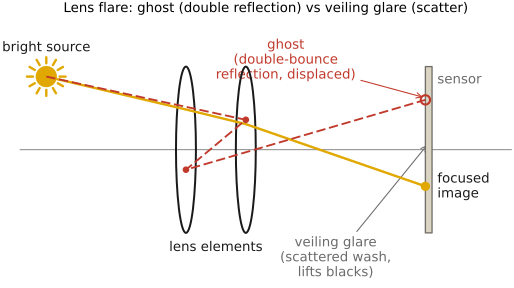
What it is. Aberrations are wanted rays landing in the wrong place; flare is unwanted light reaching the sensor at all. At every air–glass surface a few percent of the light reflects instead of transmitting — about 4% per uncoated surface, from the Fresnel reflectance $R = \big((n_1-n_2)/(n_1+n_2)\big)^2$. In a lens with a dozen surfaces those stray reflections bounce around and arrive as junk light. A ray that reflects twice can refocus into a discrete, often aperture-shaped bright blob — a ghost — typically strung along a line from a strong light source through the frame centre. Many faint scatters and reflections sum into veiling glare, a low-frequency wash that lifts the blacks and crushes contrast.
What it looks like. Shooting into the sun or with a bright source just outside the frame: a chain of colored polygonal ghosts marching across the picture, streaks and stars, and an overall milky loss of contrast in the shadows. The more elements a lens has, the worse it would be — $N$ surfaces give $O(N^2)$ pairs of surfaces that can inter-reflect — which is the hidden tax on the many-element designs the rest of the part celebrates.
Why. Fresnel reflection at each interface. The thing that made many-element lenses practical is the anti-reflection coating: a thin transparent film, a quarter-wavelength thick, whose two surface reflections interfere destructively and nearly cancel the reflection over a band — the faint colored sheen on a modern lens. Coatings drop per-surface reflection from ~4% toward a few tenths of a percent. Alongside coatings, lens hoods and internal baffles keep stray off-axis light from entering in the first place. This chapter only names flare as one of the optical challenges; the physics of thin-film coatings, hoods, baffles, and computational deflare is the subject of Glare suppression.
With the bestiary in hand, the rest of the part divides cleanly. The defects you have just met are met in turn by more glass — the compound designs of the next chapter, each element added to cancel a specific term — found by the optimization of Lens optimization, and finally by computation, which calibrates and corrects whatever the glass leaves behind. The analytic heart, where each aberration's cause and cure is developed in full — the Seidel sum, the achromat condition, lens-profile correction, and deconvolution by the measured PSF — is Aberrations correction. Keep this catalogue beside it: it is the list of diseases that the rest of the part exists to treat.